


Non-Emergency Incidents
If you need to report an incident that is not an immediate emergency, call Campus Safety at 7441 from a campus phone, or 253-535-7441 from a mobile phone.
When calling Campus Safety, follow the dispatcher’s instructions and answer their questions as you are able. Prepare to provide information about your location, the nature of the incident, a description of people involved, your name, and your phone number. Stay on the phone and seek safety until the dispatcher or a uniformed officer tells you otherwise.
University Emergency Procedures
For more information about how PLU is prepared, please take a look at the PLU All Hazards Plan.
Run, Hide, Fight.
Survival Strategies
Because an active shooter incident requires rapid response, the best time to consider how to react is in advance. By familiarizing yourself with your surroundings and possible escape routes, and considering how you might react in such a situation, you can act quickly and more efficiently if the need arises.
There are three options to consider if faced with an active shooter incident: Run, Hide, or – as a last resort – Fight, if your life is in imminent danger.
- RUN – If there is a way to escape the threat and you are reasonably sure you can do so without being harmed, do it. This is your first and best option. Be sure to:
- Have an escape route in mind.
- Evacuate regardless if others agree to follow.
- Leave your belongings behind. (Keep your cell phone in your pocket.)
- Help others escape, especially those with special needs.
- Tell others not to enter the area where the active shooter may be.
- Keep your hands visible at all times.
- Follow the instructions of any law enforcement personnel.
- Do not attempt to move injured people.
- Call 911 when it is safe to do so and provide the following information:
- Your name and location
- Location of the incident (be as specific as possible)
- Number of shooters (if known)
- Number of persons who may be involved
- HIDE – If evacuation is not possible, you are told “to shelter in place,” or if the active shooter is outdoors, find a place to HIDE where the active shooter is less likely to find you. Choose the best space that is available quickly.
- Your hiding place should:
- Be out of the view of the active shooter.
- Provide protection if shots are fired in your direction (i.e., lock or barricade a door by any means available).
- Do not trap you or restrict your options for movement.
- To prevent an active shooter from entering your hiding place, you should:
- Turn off the lights.
- Lock all doors and windows, if possible.
- Place heavy furniture or equipment in front of any doors (especially if the door does not lock or opens into the hallway).
- Close blinds, and cover and move away from windows.
- To keep yourself safe while hiding you should:
- Remain quiet.
- Hide behind large items (i.e., cabinets, desks).
- Silence your cell phone and turn off vibrate mode.
- Turn off any sources of noise (i.e., radios, TVs).
- Don’t respond to voice commands or move barricades until you are sure that commands are coming from the police.
- If you can speak to a dispatcher without being overheard by the assailants, dial 911, and alert the police to the situation.
- If you cannot speak, mute the speaker and leave the line open so the dispatcher can listen.
- Do not approach emergency responders; let them come to you.
- If outside when a shooting occurs:
- Drop to the ground immediately, face down and as flat as possible. If within 20 feet of a safe place or shelter, duck and run for safety.
- Move or crawl away from gunfire, trying to use any obstacle between you and the gunfire. Remember, obstacles may conceal you from sight, but may not be bulletproof.
- When you reach a safe place, stay down, and do not move. Do not peek or raise your head to try to see what is happening.
- Wait and listen for further instructions from law enforcement personnel.
- Your hiding place should:
- FIGHT, as a last resort if your life is in danger. If you cannot evacuate or hide effectively, or have been discovered, be ready to fight.
- Take steps to incapacitate the active shooter:
- Act as aggressively as possible against him or her.
- Throw any items available at the intruder(s) to distract them (books, backpacks, etc.).
- Use improvised weapons such as a fire extinguisher or chair.
- Yell.
- Commit to your actions to save your life.
Report all bomb threats to Campus Safety by calling 7911 from a campus phone or 253-535-7911 from a mobile phone.
Bomb threats usually come by telephone. If you receive a bomb threat call, remain calm and obtain as much information as possible from the caller.
- Attempt to keep the caller on the phone line as long as possible.
- Ask the caller to repeat the message and record every word.
- Use the telephone bomb threat checklist (listed below).
- Ask for the exact location of the explosive device.
- Get as much information as possible about the caller, i.e., vocal characteristics, sex, group affiliation, and why the bomb was placed.
- Listen for clues from background noises, which might indicate the caller’s location.
- Immediately after the caller hangs up, report the threat to Campus Safety by calling 7911 from a campus phone or 253-535-7911 from a mobile phone.
- Refrain from speculating about the incident. Let the authorities share any information at the appropriate time.
If you receive a WRITTEN MESSAGE about a bomb threat, remain calm and follow these instructions:
- Avoid handling the message unnecessarily, in order to preserve evidence such as possible fingerprints. This will prove essential in tracing the threat and identifying the writer.
- While written messages are usually associated with generalized threats and extortion attempts, a written warning of a specific device may occasionally be received; it should never be ignored.
- Immediately call Campus Safety by calling 7911 from a campus phone or 253-535-7911 from a mobile phone.
- Refrain from speculating about the incident. Let the authorities share any information at the appropriate time.
Bomb Threat Checklist
Exact time of call: ___________AM / PM
Exact words of the Caller:_______________________________________________________________________________________________________
Questions to ask the caller:
When is the bomb going to explode?_________________________________________________
Where is the bomb?____________________________________________________
What does it look like?______________________________________________________
What kind of a bomb is it?______________________________________________________
What will cause it to explode?__________________________________________________
Did you place the bomb? ____ yes ____ no
Why?_____________________________________________________
Where are you calling from?_____________________________________________________
What is your address?__________________________________________________
What is your name?____________________________________________________
Caller’s Voice (Circle all that apply):
Calm Disguised Nasal Angry
Broken Stutter Slow Sincere
Lisp Rapid Giggling Deep
Crying Squeaky Excited Stressed
Accent Loud Slurred Normal
If the voice is familiar, who does it sound like?___________________
______________________________________________________
List any background noises you remember hearing________________________________________________
Remarks:_______________________________________________
The person receiving the call: ______________________________________________________
The telephone number to which the call was made:______________________________________
Date: _____________
Suspicious Letter, Package, or Other Items
If you notice protruding wires, strange odors, smoke, vapors, beeping, ticking, or a suspicious powdery substance on letters, packages, or any other items. Treat as suspicious, and follow these instructions:
- If you are holding the item, set it down carefully and walk away from it, then wash your hands with soap and water.
- Do not open, shake the item, or disturb the contents.
- Do not try to smell the item.
- If you have handled the item, keep your hands away from your eyes, nose, mouth, or any part of your face. Do not touch others or let others touch you.
- Do not pass the item to others or move its contents.
- Call Campus Safety by calling 7911 from a campus phone or 253-535-7911 from a mobile or any other phone.
- Provide the location of the item, a description including size, and your location and phone number.
If the suspicious letter, package, or item has a powdery substance on the outside or is leaking:
- Follow the instructions listed above.
- Do not try to clean up powders or fluids.
- If possible, cover the item and leave it undisturbed. Close windows; turn fans, close doors, and section off the area to minimize exposure to others.
- Wash your hands with soap and water, and move to an area that minimizes your exposure.
- Remain in the area and prevent others from entering until the arrival of the Pierce County Sheriff’s Department or other first responders.
- After being cleared by emergency personnel, faculty and staff who are exposed should report immediately to PLU Health Center at 253-535-7337
An item should be treated with suspicion if one or more of the following conditions are met:
- No return address
- Use of restrictive markings (“Personal,” “Confidential,” etc.)
- Excessive packing material
- Addressed to title only, misspelled common words, poorly typed or written
- Excessive postage
- Oily stains, discolorations, or crystallization on the wrapper
- Strange odor
- Protruding wires
The intended purpose of a threat is to interrupt normal operations. Nearly all bomb threats do not result in explosions or the presence of actual explosives. Alternatively, those who wish to cause harm to others will rarely alert the target victims, so the first notification will be the explosion.
Searches
Campus Safety will investigate the reported threat and may report it to local authorities including the Pierce County Sheriff’s Department. Campus Safety or local authorities may ask occupants to assist in the search for potential bombs because the occupants know best what is normal or out-of-place in their own building.
Evacuation
A building evacuation may be ordered by PLU Campus Safety whenever there is sufficient evidence indicating a bomb threat is valid. The order to evacuate will be initiated using emergency notification methods such as the building fire alarm and PLU Alert!
Campus Evacuation
PLU may initiate a full or partial campus evacuation when it is either unsafe for students, guests, or employees to remain on site or when basic services, such as sewer or power, cannot be provided over an extended period of time. PLU will also follow all evacuation orders declared by local emergency agencies.
Be prepared to evacuate. Take essential clothing, food, water, a flashlight, and a first aid kit with you. Do not return to campus until told to do so by a recognized authority.
Accountability
Tell your Resident Assistant (RA) or Emergency Building Coordinator (EBC) where you are going as you leave campus.
Reunification
PLU may designate a reunification site for students and employees to meet family members after a campus evacuation. The site location will depend on the scope of the incident that has caused the campus evacuation. See the Emergency Notification & Information Resources section to learn how to receive reunification information.

Civil Disruption
Report any security concern or suspicious activity to Campus Safety or call 911 Pierce County Sheriff’s Department (PCSD).
If you encounter:
A disruptive or hostile individual
-Someone making threats (in person or on cyber/social media)
-A person acting suspiciously
-Harassing or threatening phone calls/text messages
- Contact the Pierce County Sheriff’s Department (PCSD)
- Dial 7911 from any campus phone
- Dial 911 from any other phone
- Provide the following information:
- Your location
- Description of events
- Description of subjects
- Types of threats or possible weapons
- Stay on the phone with the dispatcher until instructed otherwise.
- INTERFERENCE with normal operations of the university.
- OBSTRUCTION of access to offices, buildings, or other university facilities.
- THREAT of physical harm to persons or damage to university facilities.
Alert all employees in the area of the situation. Stay in place by locking all doors and securing files, documents, and equipment. Stand by for further instructions. If instructed to do so, cease operations and evacuate the area.
Report It
Report criminal activity (e.g. theft, rape, assault) and suspicious or threatening behavior by calling 7911 from a campus phone, 253-535-7911 from a mobile phone. If the incident is life-threatening or occurred off-campus, call 911 first. Warn or tell others in the area.
Note the Following Characteristics of a Suspicious Person
- Height / weight
- Hair color / length
- Glasses
- Facial Hair
- Shirt, jacket color & style
- Pants color & style
- Shoes color & type
- Type of property, weapon
- Distinguishing Features: Tattoos, Scars, Birthmarks
All employees are required to immediately report the following:
- Any life-threatening situation in progress, such as a physical confrontation.
- Acts of violence or threats in the workplace or other conduct indicating that violence is eminent.
- Title Ⅸ reportable offenses, including sexual harassment, sexual misconduct, and sexual assault. Learn more about Title Ⅸ here.
- No-Contact order violations that list the university as a restricted location.
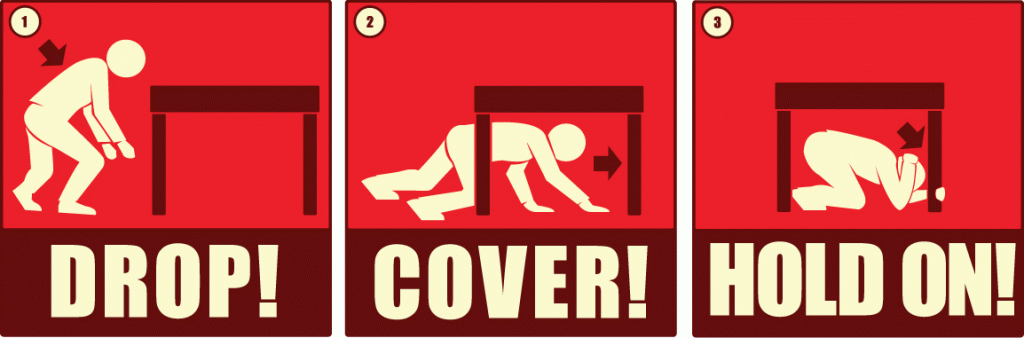
Earthquakes strike suddenly, violently, and without warning. The majority of earthquake-related injuries result from collapsing walls, flying glass, and falling objects.
If indoors:
- If you’re indoors, stay there. Get under – and hold onto – a desk or table, or stand against an interior wall. Stay clear of exterior walls, glass, heavy furniture, fireplaces, and appliances. The kitchen is a particularly dangerous spot. If you’re in an office building, stay away from windows and outside walls, and do not use the elevator.
- If you’re in a crowded public place, avoid panicking and do not rush for the exit. Stay low and cover your head and neck with your hands and arms.
- In laboratories, extinguish all flames (if possible) before taking cover. Stay clear of areas with large quantities of hazardous materials.
If outside:
- If you’re outside, get into the open. Stay clear of buildings, power lines, or anything else that could fall on you.
- If you’re driving, move the car out of traffic and stop. Avoid parking under or on bridges or overpasses. Try to get clear of trees, light posts, signs, and power lines. Remain vigilant and be on the lookout for road hazards.
- Keep looking around to be aware of dangers, which may demand immediate motion.
When the shaking stops:
- Check for injuries to people in your area. DO NOT attempt to move seriously injured persons unless they are in immediate danger.
- Check the area for safety hazards such as building damage, fires, chemical spills, or gas leaks.
- Exit the building and go to your designated assembly area Emergency Assembly Area Map. Stay at least 500 feet away from the affected building or other hazards. Keep streets, fire lanes, and walkways clear for emergency vehicles and crews.
- Take roll and report missing persons, injuries, damages, and/or potentially hazardous conditions to your Emergency Building Coordinator (EBC) or Campus Safety.
- Supervisors and designated points of contact should call the Peirce County Fire and Rescue to report any immediate emergencies.
- Once you have exited the building, DO NOT re-enter the building until the building has been inspected by emergency personnel.
- Use the telephone to only report emergencies.
If you see smoke or fire outside of a building, call Campus Safety at 253-535-7911.
Emergency Evacuation FIRE
If you smell smoke, see a fire, or hear a fire alarm:
- IMMEDIATELY EVACUATE THE BUILDING. Always use the stairs. Never use elevators during a fire. Help individuals requiring assistance in evacuating.
- If the fire alarm has not been activated, pull the manual fire alarm by the nearest exit.
- Before opening doors, check for heat:
- IF THE DOOR IS COOL:
- Open the door carefully and proceed to the nearest exit.
- Close doors behind you and leave lights on.
- If there is light smoke, stay low and cover your face with a cloth (shirt, blouse, etc.) to filter out particulates.
- IF THE DOOR IS HOT, DO NOT OPEN IT:
- Seek another exit.
- If you are on the ground floor, try to exit through a window.
- IF THE DOOR IS COOL:
- If you are trapped in a room on an upper floor:
- Dial 911 to report your building, floor, room number, and the number of people with you.
- Prevent smoke from entering the room. If available, place wet towels or cloth material at the bottom of the door and cover any vents.
- If the room begins to fill with smoke, you can open the window slightly. Never break the window because this might cause a chimney effect and help spread the fire.
- Assist the physically impaired as needed:
- Offer to guide the visually impaired.
- Instruct the hearing impaired to evacuate with you. If you encounter a wheelchair-bound person, assist them to a refuge point and instruct them to wait for Fire Department assistance.
- Call 911 to report your building, floor, and location of the person needing evacuation.
- The first choice for a refuge point would be a widened stairway landing that will accommodate a wheelchair without impeding patrons as they exit.
- If no stairway refuge exists, then have them remain in a room with a window.
- Make every attempt to ensure they have a phone or cell phone available.
- Make note of the individual’s exact location and continue to evacuate the building.
- After you safely evacuate from the building, report to your designated assembly area.
- Report to your supervisor, instructor, resident assistant, Emergency Building Coordinator (EBC), or, a Campus Safety officer contact and report:
- The location of anyone who could not be evacuated.
- The location and phone number of any mobility-impaired person you assisted.
- Any problems you witnessed while exiting the building, such as hallways/stairs filling with smoke or being blocked by fire.
- DO NOT go back into the building until the Fire Department or PLU Campus Safety indicates that it is safe to do so.
NOTE: Review and practice evacuation routes, assembly areas, and procedures for your office, classrooms, laboratories, residence hall, or another facility BEFORE an emergency happens.
Procedures for responding to various spills at PLU can be found in the Spill Response Protocol document.
Outdoor Hazardous Materials Release
If an incident involves an outdoor hazardous materials release, or other outdoor hazards, remain inside or seek shelter in the nearest building.
- If outside, seek shelter in the nearest building, preferably in an interior room with few windows. Allow access to others seeking shelter. Allowing others into the building will not jeopardize your safety.
- Shut and lock all windows (locking will form a tighter seal) and close all exterior doors.
- Avoid overcrowding by using several rooms if necessary.
- Turn on a radio or television and listen for further instructions. Make yourself as comfortable as possible; prepare for the possibility of an extended stay.
- Check for PLU Alert! updates.
- Look after each other. You will be notified when it is safe to leave.
What to do for an outdoor hazardous materials release:
- Choose a room above ground level.
- If possible, turn off air conditioners, heaters, and fans.
- Close vents to the ventilation system as you are able.
- Follow the Instructions for shelter in place listed above.
- Check for PLU Alert! updates.
Blood and Body Fluid Spills
NEVER clean up a blood or body fluid spill unless you have undertaken the required training. In the event of a blood or body fluid spill:
- Isolate the spill, and prevent others from entering the area.
- Call PLU Health Center at 253-535-7337 or health@plu.edu. The Health Center may consult with the Tacoma/Pierce County Health Department (TPCHD) to investigate the incident. PLU will follow the direction of TPCHD.
- If a person is exposed, immediately and thoroughly wash all skin surfaces with soap and water.
- Flush mucous membranes of the eyes, mouth, or nose immediately, and rinse thoroughly with water for 10-15 minutes. Remove contact lenses.
- Check for PLU Alert! updates.
Chemical Spill
NEVER clean up a chemical spill unless you have undertaken the required training. Chemical safety training is available through the Office of Clinical and Research Safety.
In the event of a chemical spill: Procedures for responding to various spills at PLU can be found in the Spill Response Protocol document. Evacuate everyone in the immediate area. Isolate the area, close doors as you leave, and prevent others from entering the area. Keep people away from the spill and await the arrival of trained personnel.
Obtain the Material Safety Data Sheet (MSDS) or Safety Data Sheet (SDS) on the chemical, if known.
If students are exposed they should report immediately to the PLU Health Center at 253-535-7337. If staff or Faculty members are exposed, they should report immediately to the nearest Medical Center Emergency Room. Contact Campus Safety at 253-535-7911. If after hours, they should call 911.
Radioactive Material Spill
NEVER clean up a radioactive material spill unless you have undertaken the required training. Radiation safety training is available through the Office of Clinical and Research Safety.
In the event of a radioactive material spill:
- Evacuate everyone in the immediate area.
- Isolate the area, close doors as you leave, and prevent others from entering the area.
- Isolate all individuals involved in the spill until they can be cleared by OCRS or other first responders. Remove contaminated shoes and clothing. Follow directions learned in radiation safety training regarding contaminated shoes and clothing.
- Notify Campus Safety immediately. Dial 7911 from any campus phone, or 253-535-7911 from any other phone.
- Keep people away from the material until trained personnel arrive.
- After being cleared, exposed individuals should report immediately to the nearest Medical Center Emergency Room. If, after hours Additional radiation safety information can be found on the VEHS Radiation Safety website. Safety Policies & Procedures Manual.
Evacuate
Evacuate and limit access to the affected release area to prevent further contamination of others. Move to a safe area outside that is crosswind or upwind or to another area inside that is on a separate ventilation system to avoid exposure to fumes. If there is a large spill indoors, activate the fire alarm at a pull station and exit the building.
Safety Data Sheets
Be prepared to give emergency responders the Safety Data Sheet (SDS, formerly MSDS) for the released material and to stand by for further instructions. You may be asked to join the incident command as a technical specialist if you are knowledgeable about the substance.
Cancellation of Classes & Activities
In extreme weather situations, classes may be canceled and/or the university closed. A determination will be made by 6:00 a.m. for morning and afternoon classes and activities, and by 1:00 p.m. for evening classes and activities.
Weather-induced closure or schedule change information is available three ways:
- Online at the PLU homepage and at FlashAlert.net
- The PLU Weather Closures and Emergency Information Line at 1-877-322-0872
- Local television and radio news broadcasts
Faculty to Notify Students
Faculty who are unable to travel safely to campus when classes are not canceled should communicate quickly with students by sending an email and/or leaving an alternate greeting on their telephone voicemail extension. Please inform your students beforehand how you will communicate with them when canceling class.
Emergency Kits
All faculty, staff, and commuter students are encouraged to keep an emergency kit in their vehicles, including a sleeping bag and overnight bag. It is also a good idea to keep a flashlight and other supplies handy in your resident hall room or office.
Severe Thunderstorms and Lightning
Lightning kills more people on average each year than hurricanes and tornadoes combined. Lightning can strike up to 10 miles away from a rain area.
The 30/30 Lightning Safety Rule:
During thunderstorms no place outside is safe but you can minimize your risk by assessing the lightning threat and taking appropriate actions. Count the number of seconds from when you see the lightning flash until you hear the thunder. If you count 30 seconds or less you are in immediate danger. Even if you can’t see the lightning, just hearing the thunder means lightning is likely within striking range.
If you are caught outdoors in a severe thunderstorm or when lightning threatens:
- Immediately seek shelter in the nearest building.
- DO NOT seek shelter under trees during thunderstorms.
- DO NOT seek shelter in unprotected open structures such as picnic pavilions, rain shelters, or bus stops.
- If a building is not available, a metal-topped vehicle with the windows up is the next best option.
- Avoid contact with metal fences, metal bleachers, or metallic structures.
- Avoid using hardwired corded telephones or any electrical appliances. Cell phones are a safe alternative.
- Avoid plumbing—do not take a bath, shower, or wash your hands during a thunderstorm.
- Wait 30 minutes or more after hearing the last thunderclap or rumble before leaving the safe location.
If Caught Outdoors and No Shelter Is Nearby:
- Find a low spot away from trees, fences, and poles that is not subject to flooding.
- If you feel your skin tingle or your hair stand on end, squat low to the ground on the balls of your feet. Place your hands over your ears and your head between your knees. Make yourself the smallest target possible and minimize your contact with the ground. DO NOT lie down. If you are swimming, get out of the water immediately.
REMEMBER: If you can hear thunder, you are close enough to be struck by lightning.
Once you have taken shelter indoors, you should monitor a weather radio, a commercial radio/television station, the internet, or another weather service provider. Even when a specific storm cell has passed beyond the area, conditions may still be right for high winds, lightning, and other hazardous weather conditions.
Stranded on Campus?
Non-residential students or employees needing temporary housing during hazardous weather may contact Campus Safety at 253-535-7441. Students or employees will be offered a temporary stay in an empty residence hall room or lounge. Bedding is not available.
Report
Report possible air or foodborne illness to the PLU Health Center at 253-535-7337 or health@plu.edu. The Health Center may consult with the Tacoma/Pierce County Health Department (TPCHD) to investigate the incident. PLU will follow the direction of TPCHD.
TPCHD may recommend cohorting, isolation, quarantine, or social distancing to mitigate the spread of illness among the PLU and larger Pierce County community. This may result in re-locating sick individuals to shared spaces, canceling conferences or games, or closing campus.
Reduce Infection
Reduce your risk of infection by washing your hands frequently, getting vaccinated when possible, and disinfecting shared surfaces such as desks and doorknobs. When sick, self-isolate (stay at home) and drink plenty of fluids. People with complicating health factors should consult with their physician initially by phone.
Lockdown
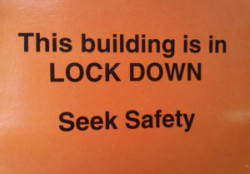 Campus Safety may initiate a campus-wide emergency lockdown when there is an imminent threat to the PLU community. Occupants may also initiate a lock down to protect themselves from a perceived threat. If you see a threat requiring a lockdown, move to safety first, then call Campus Safety at 7911 from a campus phone or 253-535-7911 from a mobile phone. Some buildings also have blue lock down pull stations that can be activated.
If you see or hear a PLU Alert message indicating a lockdown, do the following:
- Share the alert message to those in your immediate area. Use judgment about the safety of doing so.
- Move to a secure area, if it is safe to do so:
- If you are inside: Move to a secure room such as a classroom or office. Lock or barricade the door, close the window shades, and turn off the lights. Get low on the ground and move to the least visible area of the room.
- If you are outside: Move away from campus as quickly as possible, stay low, and hide behind natural concealment such as foliage, vehicles, and structures. Be aware that all campus buildings will be locked and your LuteCard will not unlock any doors.
- Stay calm, quiet, low, and out of sight.
- Silence your mobile phone and disable vibration alerts.
- Do not open any doors for any reason until an “all clear” signal is given by PLU Alert or uniformed officers.
- Do not call Campus Safety or other departments to request information. Important information will be broadcast using PLU Alert.
- If you have specific information about an ongoing threat, call 911 from a mobile phone or 9911 from a campus phone to inform responding agencies.
- Do not approach or talk to officers unless they tell you to do so. Officers are highly trained to find and stop the threat before aiding victims.
- Assess the situation and be prepared to move.
- Be alert if the fire alarm is activated. It may indicate that there is a fire in the building requiring evacuation. It may also be triggered by an attacker in order to draw a crowd into a target area. Use your best judgment and be ready to move if necessary.
During a lock down, designated personnel in each building will lock doors that are not controlled by the LuteCard access system. LuteCard access doors will be locked remotely for all cards.
Stay in Place
Campus Safety may initiate a campus-wide stay in place order when there is a potential threat near the PLU community, but is not an imminent threat. If you see suspicious activity requiring a stay in place order, move to safety first, then call Campus Safety at 7911 from a campus phone or 253-535-7911 from a mobile phone.
If you see or hear a PLU Alert message indicating a Stay in Place order, do the following:
- Move to a secure building:
- If you are outside, move into the nearest building. The doors will be locked, but you may use your LuteCard to get inside. If you do not have a LuteCard, leave campus and seek safety.
- If you are in a vehicle or in a parking lot, use your best judgement and consider where the activity is occurring. You may decide to get inside of the nearest building, stay in your vehicle, drive to another part of campus, or drive away from campus and wait.
- If you are inside, make sure that the external building doors are closed and locked. Internal doors may remain unlocked.
- Continue with classes/business as usual. You do not need to close the window shades or turn off the lights. When a class period or meeting ends, stay inside and do not leave the building until an “all clear” signal is given.
- Do not call Campus Safety to request information. Remain alert to changing conditions and be ready for updates from PLU Alert.
Atmospheric (biological, chemical, radiological, volcanic, etc.) Threat
Close sources of fresh air, such as windows, fireplace dampers, and ventilation systems, and do not use the elevator. Do not move in and out of building. If the threat is severe, relocate within the building to an upper floor away from exterior doors and windows. Select a room that is easy to seal and, if possible, has a water supply and restrooms access. If you smell gas or vapor, hold a wet cloth loosely over your nose and mouth.
Medical Emergencies
In the event of a medical emergency:
- Call the Central Pierce Fire and Rescue (CPFR).
- Dial 9-911 from any campus phone
- 911 from a mobile phone
- Report the incident to Campus Safety at 253-535-7911.
- Provide the following information:
- Building name
- Floor and room number
- Caller’s name and phone number
- Nature and severity of the injury
- Approximate age of the injured person
- Sex of injured person
- Current condition
- Any known medical history of the injured person
- Remain with the person with the medical injury. DO NOT move the individual unless required to prevent further injury.
- If possible, send someone to meet the responding emergency personnel at the location designated by the dispatcher
Campus Safety will dispatch a first aid-trained staff member to initiate care and meet EMS to facilitate access to the victim’s location.
First Aid, CPR, AED Trained?
Provide care to the level for which you have been trained until emergency service personnel arrive to relieve you.
Cardiac Arrest and Automated External Defibrillators (AEDs)
If the medical emergency involves someone who has experienced cardiac arrest is not breathing and has no pulse, an AED may be required. AEDs have the ability to detect an irregular heart rhythm and to apply an electrical shock (or shocks) to the person’s heart in an attempt to reset it back into a normal and effective rhythm.
Using an AED: Almost anyone can apply for and use an AED. Voice prompts guide the user through the appropriate steps. AEDs are over 99% accurate in rhythm interpretation, so they won’t shock unless an individual requires it.
AEDs on the PLU Campus: First Aid kits and automatic external defibrillators (AEDs) are located throughout campus. Current lists of AED and First Aid locations are available on the EHS website.
Media
Some incidents that impact the university may draw the attention of the local media. Please direct the media to Marketing & Communications.
Essential Personnel
All Employees are considered essential personnel and are expected to respond to the incident. Personnel may be released through the chain of command that is activated to respond to the incident, which may be different than the employee’s regular leadership structure.
Department heads should assess their organizational needs and define “essential” personnel based on those needs before an incident occurs. Consider varying levels or severity of response and recovery as you define essential personnel.
Incident Command System (ICS) & the National Incident Management System (NIMS)
PLU has adopted and uses an incident command system during emergencies in an effort to facilitate coordination within PLU and with local, state, and federal response agencies.
As a result, employees and students should anticipate a very different decision-making process with different personnel and authorities than during normal operations. Some will recognize ICS from the military or fire services.
Report Failures
During business hours (8 a.m. to 5 p.m. Monday through Friday), report gas, power, water, sewer, and elevator failures to Facilities Management at 253-535-7380.
Telecommunication failures to the Telecommunications Help Desk at 253-535-7525.
Card Access
Door locks will default to the locked position. Contact Campus Safety for access during non-business hours at 253-535-7911.
Facility Issues & Utility Failure Guide
Elevator Outage
Persons stuck in an elevator should:
- Remain calm and do NOT try to exit the elevator car.
- Use the emergency phone or intercom call button to call for help, call Campus Safety at 253-535-7911 from any cell phone, or bang on the doors and shout for assistance.
- Wait for trained personnel to assist with extraction.
Power Outage
In the event of a power outage:
-
- Remain calm and assess the extent of the outage.
- During Business Hours (8 a.m. to 5 p.m. Monday -Friday) Report the outage to Facilities Management at 253-535-7380
- During Non-Business hours report the outage to Campus Safety at 253-535-7911
- DO NOT light candles or other types of flames for illumination.
- Keep lab refrigerators/freezers closed during the outage
- Secure all equipment, experiments, and hazardous materials if safe to do so.
- Emergency lighting may activate but will last about 20 minutes enough time to locate a flashlight or evacuate the building safely.
Gas Leak
Natural gas has a distinct, pungent odor so it is easy to detect. Leaking gas can cause an explosion and fire. In the event of a gas leak:
- Immediately extinguish open flames.
- Immediately evacuate the building
- DO NOT use telephones, flashlights, or electrical switches.
- Report to your designated building evacuation assembly area.
- Once safely outside, During Business Hours (8 a.m. to 5 p.m. Monday -Friday) Report the gas leak to Facilities Management at 253-535-7380
- During Non-Business hours report the gas leak to Campus Safety at 253-535-7911 from any cell phone.
All Other Facility/Utility Failures
- Call Facilities Management at 253-535-7380
Always dial 911 and evacuate the building in case of:
- Fire/Smoke
- Explosion
- Structural damage or collapse
- Uncontrolled gas leak
- Uncontrolled chemical or hazardous materials spill
Shelter-In-Place
Stay indoors until the ash has settled, unless there is a danger of the roof collapsing from the load of ash. If possible, close doors, windows, and ventilation (chimney vents, furnaces, air conditioners, fans, and other vents).
Ash Fall Safety
Use a dust mask or hold a damp cloth over your face to help with breathing. Wear long-sleeved shirts and long pants. Use goggles and wear eyeglasses instead of contact lenses.

Campus Evacuation
Be prepared to evacuate. PLU will follow evacuation orders initiated by local response agencies. Take clothing, food, water, flashlight, and a first aid kit with you. Avoid river valleys and low-lying areas. Stay away from areas downwind from the volcano to avoid volcanic ash. Avoid driving in heavy ash fall unless absolutely required. If you have to drive, keep speed down to 35 MPH or slower.
Accountability
Tell the resident assistant or emergency building coordinator where you are going before you leave campus.