
Colleen Hacker’s Annual Camp About Much More Than Just Soccer
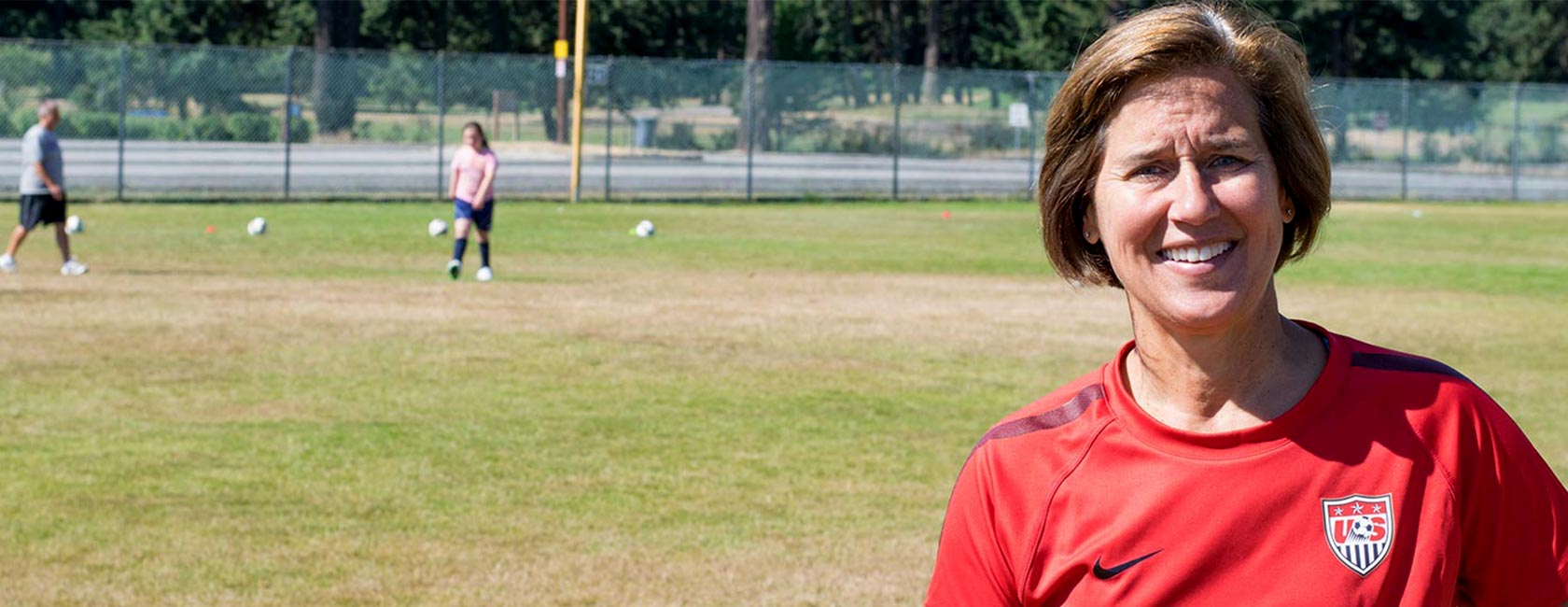
Image: “It’s for kids, it’s about kids, (and) it’s about the love of the game.” – Colleen Hacker (Photos by Zach Powers/PLU)
By Zach Powers '10
PLU Marketing & Communications
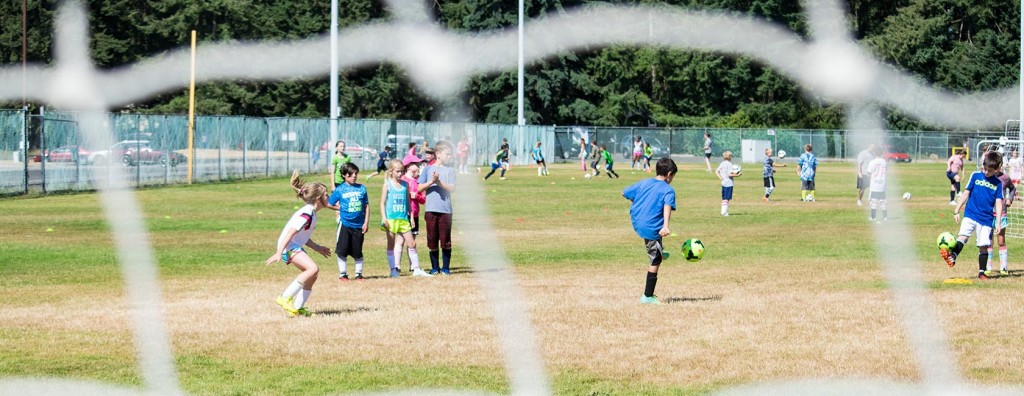
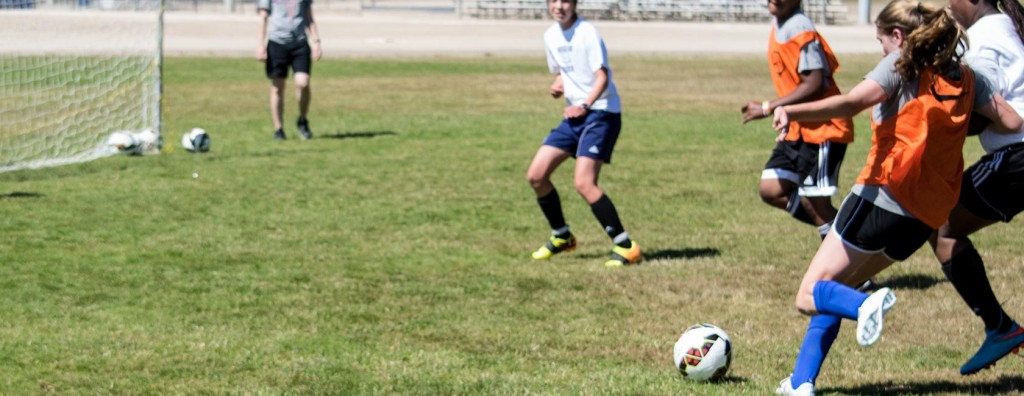
SPANAWAY, Wash. (June 25, 2015)— On the grassy fields outside of the Sprinker Recreation Center at 9:30 a.m. the temperature has already climbed to the mid-80’s. Day two of Success Soccer Camp has begun, and over 200 campers ages 6-17 are already enthusiastically working up a sweat.
On the walk from the parking lot to the soccer fields, you can hear the unmistakable sounds of youth soccer; the soft thuds of synthetic cleats against polyester soccer balls, players chatting, laughing and cheering, and, cutting through the bustle, the exuberant voices of coaches hollering out encouragement and instructions.
Here in Spanaway, thoughtfully directing the camp she founded over 20 years ago, Colleen Hacker is in her element. Well, one of her many elements.
Equally at home directing a soccer camp, presenting academic research or consulting some of the world’s most celebrated athletes, the PLU Professor of Kinesiology has been a catalyst for achievement and an exemplar of dedication throughout her dynamic career.
Hacker’s resume is staggering, including a Ph.D. in Exercise and Movement Science, extensive applied research in Sports Psychology, coaching the PLU Women’s Soccer Team to 3 National Championships, serving as a Mental Skill Coach and Performance Enhancement Specialist for Team USA at five Olympic Games and a long tenure on the coaching staff of the U.S Women’s National Soccer Team.
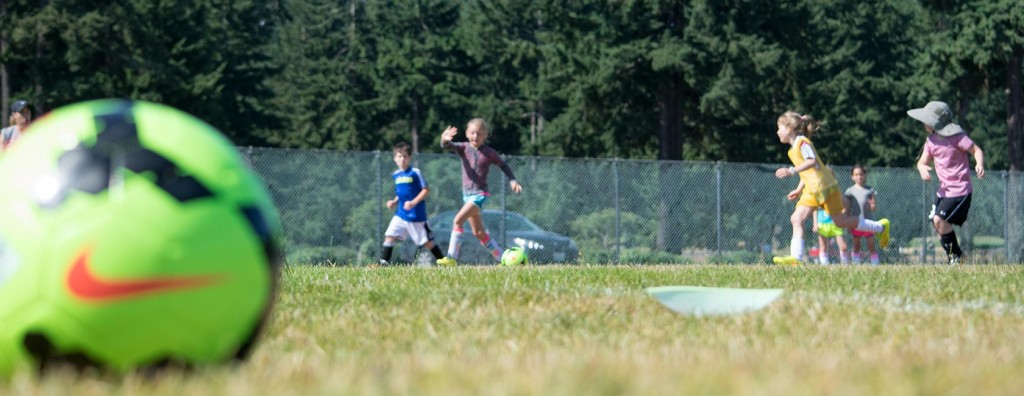
At first glance, Success Soccer Camp doesn’t appear to be very different than most other sports camps, but it’s quickly evident that Hacker and her team are preparing campers for far more than just the autumn soccer season.
“There are so many camps that are all about soccer and about being seen and ID’d (by youth clubs or college scouts), but this is a camp about people, values, and positivity,” Hacker tells me.
“I feel like so often we coach the fun out of kids,” Hacker continues. “We put this insane focus on winning, outcomes, and making it to the next level.
“I want them (campers) to challenge themselves to enjoy the process, I want them to love the game and to enjoy watching other people succeed.”
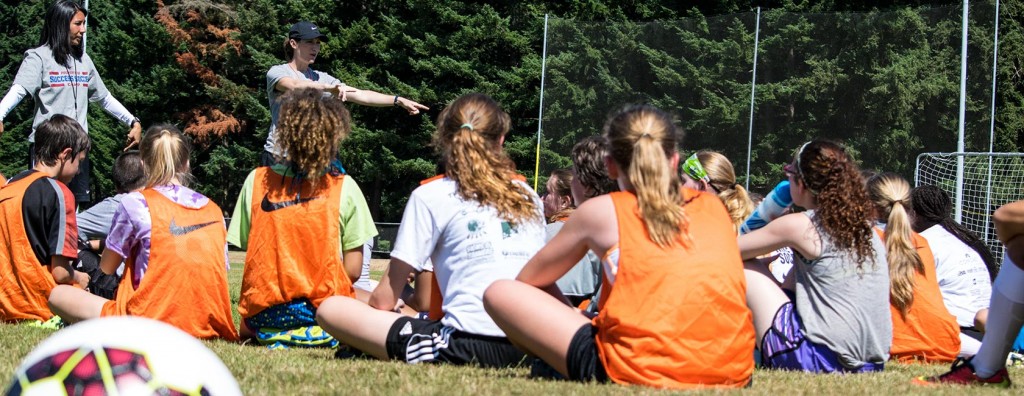
For Hacker, who serves on the National Advisory Board for the Positive Coaching Alliance and on the board of the Center for Youth Sport and Parenting, her annual week at Sprinker represents her commitment to actualizing the values and practices for which she is a national advocate.
“I’ve made a commitment in my professional life to function in these professional organizations where teaching a values driven approach to sport is the hallmark,” Hacker explains. “This (camp) is my local commitment to that.”
“I joke that our camp is an Up With People concert, only with soccer balls,” Hacker explains with a laugh. “It really is about the gift of sport, good sporting behavior and ‘put ups’ of other players and themselves.”
Attendees come from as far away as Oregon, Montana and Hawaii, but the camp is priced and placed to be accessible for families in Parkland and Spanaway.
“This is the least expensive (high-level soccer) camp that you will find for five days, and that’s done intentionally,” says Hacker. “What we’ve done is create a first class operation but with an orientation to serve and to give back.”
Though not technically affiliated with PLU or the university’s Department of Athletics, Success Soccer Camp is a Lute family affair. Sixteen of the camp’s coaches are either PLU graduates or faculty members and Hacker coached many of them on the PLU Women’s Soccer team.
“We’re PLU proud here!” Hacker shouts out to me as I arrive, waving me over to a field where 10 and 11 year olds are passionately competing to win a passing-centric relay race.
Hacker speaks with equal parts passion, authority and knowledge, reminiscent of national sports icons like Jim Valvano and Julie Foudy. It’s clear that the soccer field is her second home and I can’t help but notice that she’s wearing a U.S Women’s National Team jersey from the late ‘90s – an era during which she served as a member of the coaching staff.
As she discusses her camp, career and the Women’s World Cup, Hacker’s faith in the power of athletics to alchemize a young person’s character, attitude and trajectory is gloriously on full display.
After visiting with other coaches, taking photographs and walking around the three full-size soccer fields the camp occupies, I realize that I have one final question for Hacker:
“In one sentence, what is your greatest hope for this week?”
Hacker has clearly thought about this before, as her answer is immediate and crystal-clear: “I want the campers to love soccer more than they did when they got here.”
Given the inspiring coaches, optimal weather and all-around jovial atmosphere, it’s hard to imagine they won’t. Plus, the top-of-the-line soccer ball and T-shirt that all campers receive thanks to Hacker’s USA Soccer-forged relationship with Nike can surely only help.