


Learning Communities (LCs)
Learning Communities are for all PLU students. At PLU, every residential student (including first-year, new transfer, returning, and upper division) is part of an LC. Additionally, commuting students participate in LCs via the Lutes Commute Community.
LCs provide opportunities for students to connect with community through co-curricular events and programs. Students who participate in LCs have increased community and academic support to promote student success. Learning Communities are a valuable part of the PLU experience, adding to the learning that happens in the classroom and beyond!
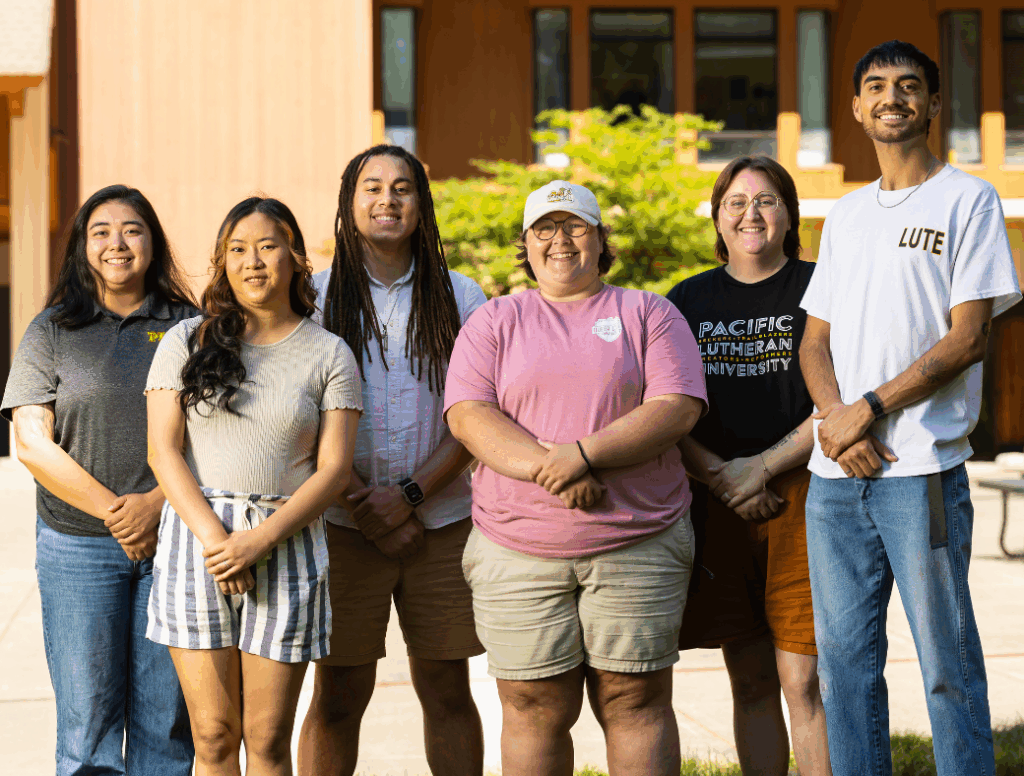
About Learning Communities
The Lutes Commute Community is specifically designed to support all commuting and off-campus students.
Connected space: Located on the first level Anderson University Center, the Lutes Commute Lounge is a great place to hang out, meet other students, catch up with friends, study, enjoy lunch, or rest between classes.
- The Lutes Commute Lounge has many amenities to support commuting students, including a kitchen, lockers, comfy seats and tables, and Community Advocate student staff who serve as campus resources.
- This space is vibrant and the diverse community members create a warm and welcoming space for all.
- After 5pm and on the weekends, the Lutes Commute Lounge hosts concerts, performances, and club meetings.
The Community for Creative Expression is for students interested in a co-curricular focus on creativity and innovation across all disciplines. Students who consider themselves creatives or would like to experiment with their creativity are encouraged and welcome to participate in all activities!
Connected Residence Hall: This learning community is located throughout the entirety of Hinderlie Hall.
The Diversity, Justice, and Sustainability Communities are for students interested in gaining an increased understanding of their cultural identities through reflection on values while learning how to create positive change in their communities. This community focuses on intersectionality across the following sub-communities:
- First in the Family for students who are first in their families to attend college (first-generation students whose parents did not graduate from a four-year, degree granting institution in the U.S.) with support to connect them to resources for success in and out of the classroom.
- Students of Color for students who identify as People of Color (or not White) who are interested in exploring their racial and ethnic social identities and cultures.
- Lavender Community for students who are interested in exploration of the LGBTQ+ (Lesbian, Gay, Bisexual, Transgender, Queer, +) social identities through conversations, activities, and reflection.
- LatinX Community for students who self identify as LatinX/a/o/e; this is an affinity based space celebrating LatinX cultures, social identities, and languages
- Gender Empowerment & Equity for students who are women-identified and Transgender/Gender Non-Conforming residents (who are comfortable using women-identified restrooms) with a focus on gender equality, community building, and programming that explores gender and empowers women.
- DJS House with a focus on general Diversity, Justice, and Sustainability learning
Connected Residence Halls: These communities are located across campus in halls, including Ordal Hall, Stuen Hall and Tingelstad Hall
Global Community (Global Engagement & Language Immersion Theme) is for students who are interested in a global study focus. The Global Community features the following sub-communities:
- Global Language & Culture Community — for any and all students interested in learning about and engaging in global communities, including: language learning, study away interest, enjoying global education, having held cultural identities from global locations and more!
- International Honors Program (IHON) Community — for students enrolled and taking classes in PLU’s International Honors program
- International Student Community — for students who identify as international and/or are coming to PLU from beyond the fifty states
Connected Residence Hall: The Global Community is currently housed in Kreidler Hall.
The Outdoor Experience Community promotes engagement and exploration with the outdoor environment.
Connected Residence Hall: This community is located in Pflueger Hall.
STEM House is for students interested in learning about the fields of STEM (Science, Technology, Engineering, and/or Mathematics). This community is great for intended STEM-related majors and also for those not majoring in STEM who would like to continue their learning on these topics.
Connected Residence Hall: This community is located in Tingelstad Hall.
All learning communities (except Lutes in Community and the Upper Division Community) have a first year component to them, so you’ll find first year students in all themed learning communities. The Becoming a Lute Community is specifically designed to support students during their first year of college, as they navigate on campus resources, vocational discernment and build healthy habits!
Connected Residence Halls: The Becoming a Lute Community can be found in Ordal Hall and Tingelstad Hall.
The Lutes in Community is a continuation of the Becoming a Lutes Community, which supports students throughout their time at PLU. This can include helping students choosing a major, vocational discernment, and finding their place at PLU. Programming is geared towards student wellbeing and building community.
Connected Residence Halls: This community can be found in Ordal Hall, Pflueger Hall, and Tingelstad Hall
The Upper Division Community focuses on preparing students for post-graduation skills including navigating careers and adulting life skills. These communities promote independent living to support students as they transition into post-collegiate life.
Upper Division Criteria: Students must be either 20 years old or have completed 60 credits at PLU to be eligible for upper division.
Connected Residence Halls: Upper Division housing is located in Harstad Hall and South Hall
Campus Life works intentionally with PLU community members — students, faculty, and staff alike — to develop diverse Learning Community (LC) offerings across eight residence halls. The communities are organized across a variety of themes: some academically focused, some by interest/topic, some by social identity, and some by the stages students find themselves in at PLU. Each one continues to be developed with care, with student input and comparison research. The learning communities are assessed on a regular basis so Campus Life can understand how effective and meaningful they are for the students who choose to live in them. Learn more about the PLU history of LCs and research supporting this learning model.
Most importantly, ALL students — residential and commuter — are welcome in all of the halls and all of the LCs. Everyone is invited to most hall programs. Students are invited and encouraged to visit halls and wings even if they don’t live there, to make friends with peers, learn from offerings, and connect with faculty and staff.
Some students choose communities based on academic interest, such as an immersive language wing in Hong International Hall or in the STEM House in Tingelstad. Other students pick their campus home based on an area of interest, such as Hinderlie’s Community for Creative Expression or Tingelstad’s Wellness House. We also know some students prefer to live with a diverse group of peers in communities that are not organized by topic. So, we have intentionally held spaces that connect students based on their transition into, through, or out of PLU: for first-year students, new transfers and returners, and upper-division students.
Several of our newer communities, built around social identities, are a direct response to students who voiced a need for affinity spaces. Students told us those spaces were in demand, and we listened — especially to those who identify with historically marginalized and underrepresented communities. For students who opt into these affinity spaces, it’s an important step in finding a sense of belonging at PLU. They are a home from which the rest of the PLU experience can be explored.
Students actively choose the themes centered on social identity. For example, residents of the Students of Color Wing (in Ordal Hall’s Diversity, Justice, and Sustainability community) chose to live in that space because they self-identify as a Person of Color and are interested in learning alongside other students who identify in similar ways. This also is true for our Lavender wing in Ordal (for LGBTQ+ identified students) and First in the Family wings in Ordal Hall’s Diversity, Justice, and Sustainability community (for first-generation students). These identity-based communities provide an intimate, cohort experience for students who want to intentionally engage their social identities in their learning at PLU.
If you are curious about a particular Learning Community or residence hall, we encourage you to learn more! If you are a prospective student or community member, feel free to explore our Learning Community (LC) web pages and/or email the Community Director who works with that LC. If you are a current student, we welcome you to come to a program, get to know the Campus Life staff and ask us questions, or get to know your peers who live there to understand why they chose that space and what they love about that community.
Social Media