


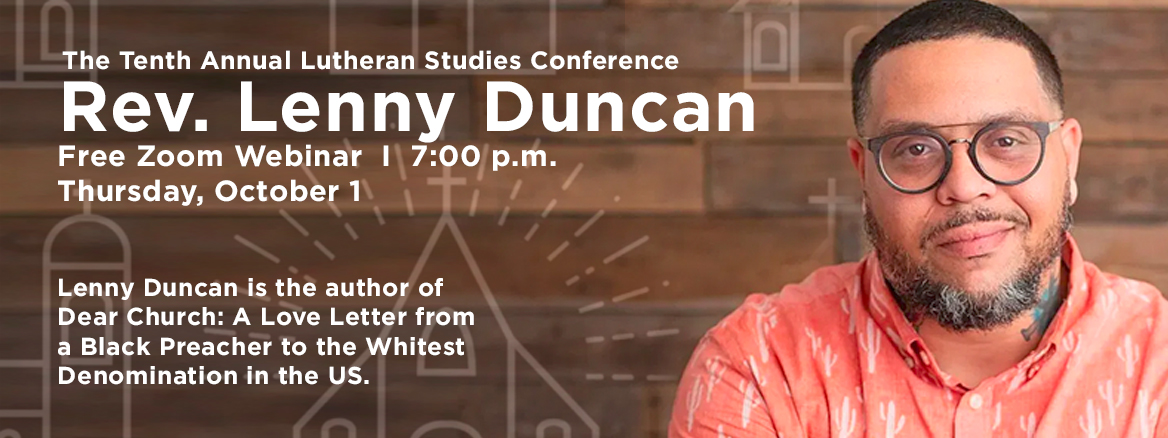
2020 Lutheran Studies Conference
“Dear Church: A Love Letter from a Black Preacher to the Whitest Denomination in the US”
October 1, 2020
Tenth Annual Lutheran Studies Conference at PLU – Thursday, October 1, 2020
This year’s Lutheran Studies Conference will be a Zoom webinar with Rev. Lenny Duncan, author of Dear Church: A Love Letter from a Black Preacher to the Whitest Denomination in the US (2019). This webinar will be in the evening at 7 p.m.
Adult forum book discussions are offered for congregations for two Sundays in September (Sunday Sept 20 & 27 at 9:00am) prior to the conference.
Conference Webinar:
Following the killing of George Floyd, people all over the U.S. are confronting the legacy of white supremacy and racism that has shaped our nation, culture and churches. In addition, we find ourselves in the middle of a global pandemic. This year’s Lutheran Studies Conference focuses on systemic racism and will involve opportunities for reading, reflection and commitment to action for individuals and their faith and/or educational communities. We will be guided in this work and reflection by Rev. Lenny Duncan, an ordained pastor in the Evangelical Church of America (ELCA), and his 2019 book addressed to the ELCA: Dear Church: A Love Letter from a Black Preacher to the Whitest Denomination in the US. During the Webinar, we will be joined by our guest speaker, Rev. Duncan and have the opportunity for a time of question and answer.
Prior to the webinar, congregations and individuals are welcome to join Dr. Marit Trelstad, University Chair of Lutheran Studies, for two weeks of adult forums focused on racial justice in our churches and discussion of Duncan’s book. Congregations are encouraged to read the book prior to the adult forums. This offers us the opportunity for self-reflection and questions in preparation for our time with Rev. Duncan. His book may be ordered from the PLU Bookstore (Lute Locker – insert link) and is also available online through other sources. Duncan’s approach to his own church is one of sincere, deep love and direct truth-telling concerning racism in the church that calls itself the “body of Christ” in the world.
Come Join us virtually for this unique opportunity to “gather” and discuss our calling to address systemic racism in our own lives, our educational systems and churches. This is central to the mission of PLU “educate students for lives of thoughtful inquiry, service, leadership and care – for other people, for their communities, and for the earth.”
The annual Lutheran Studies Conference provides an opportunity for the university, the larger community, and persons from diverse religious and humanistic viewpoints to explore particular and pressing issues within the thoughtful and generous milieu of Lutheran higher education. Each conference welcomes scholars, artists, and religious leaders whose expertise is offered in an engaging and thought-provoking manner. Past conferences have been devoted to the limited gift of water (2011), political commitments (2012), the figure of Jesus of Nazareth (2013), and justice in society (2014). As a university of the church, PLU promotes the 500 year Lutheran tradition of asking difficult questions, welcoming opposing viewpoints in civil conversation, nurturing a community of intellectual charity, and challenging students, alumni, and friends to promote a just, peaceful, and sustainable way of life for all, not just the privileged few.
The conference is free and open to the public and is made possible by the generosity of the anonymous donors who endowed the University Chair in Lutheran Studies.
Speaker
Rev. Lenny Duncan Bio
Lenny Duncan is the unlikeliest of pastors. Formerly incarcerated and homeless, he is now a black preacher in the whitest denomination in the United States: The Evangelical Lutheran Church in America. Shifting demographics and shrinking congregations make the all headlines, but Duncan sees something else at work—drawing a direct line between the church’s lack of diversity and the church’s lack of vitality. The problems the ELCA faces are theological, not sociological. But so are the answers.
Part manifesto, part confession, and all love letter, Dear Church offers a bold new vision for the future of his denomination and the broader mainline Christian community of faith. Dear Church rejects the narrative of ‘church decline’ and calls everyone—leaders and laity alike—to the front lines of the church’s renewal through racial equality and justice.

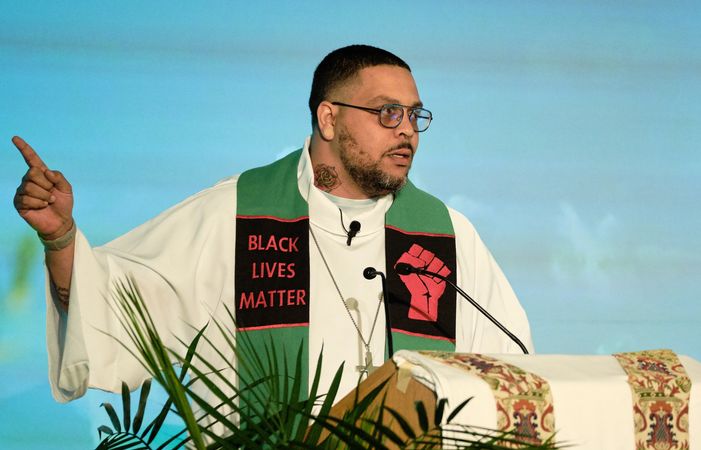
It is time for the church to rise up, dust itself off, and take on forces of this world that act against God: whiteness, misogyny, nationalism, homophobia, and economic injustice. Duncan gives a blueprint for the way forward and urges us to follow in the revolutionary path of Jesus.
Suggested Readings
Book descriptions from Publishers
Rev. Lenny Duncan, Dear Church: A Love Letter from a Black Preacher to the Whitest Denomination in the US (Fortress Press, 2019)
“Lenny Duncan is the unlikeliest of pastors. Formerly incarcerated, he is now a black preacher in the whitest denomination in the United States: the Evangelical Lutheran Church in America (ELCA). Shifting demographics and shrinking congregations make all the headlines, but Duncan sees something else at work–drawing a direct line between the church’s lack of diversity and the church’s lack of vitality. The problems the ELCA faces are theological, not sociological. But so are the answers.
Part manifesto, part confession, and all love letter, Dear Church offers a bold new vision for the future of Duncan’s denomination and the broader mainline Christian community of faith. Dear Church rejects the narrative of church decline and calls everyone–leaders and laity alike–to the front lines of the church’s renewal through racial equality and justice.
It is time for the church to rise up, dust itself off, and take on forces of this world that act against God: whiteness, misogyny, nationalism, homophobia, and economic injustice. Duncan gives a blueprint for the way forward and urges us to follow in the revolutionary path of Jesus.”