
Into the Grove
Researching the ecosystem hiding in Tacoma's backyard
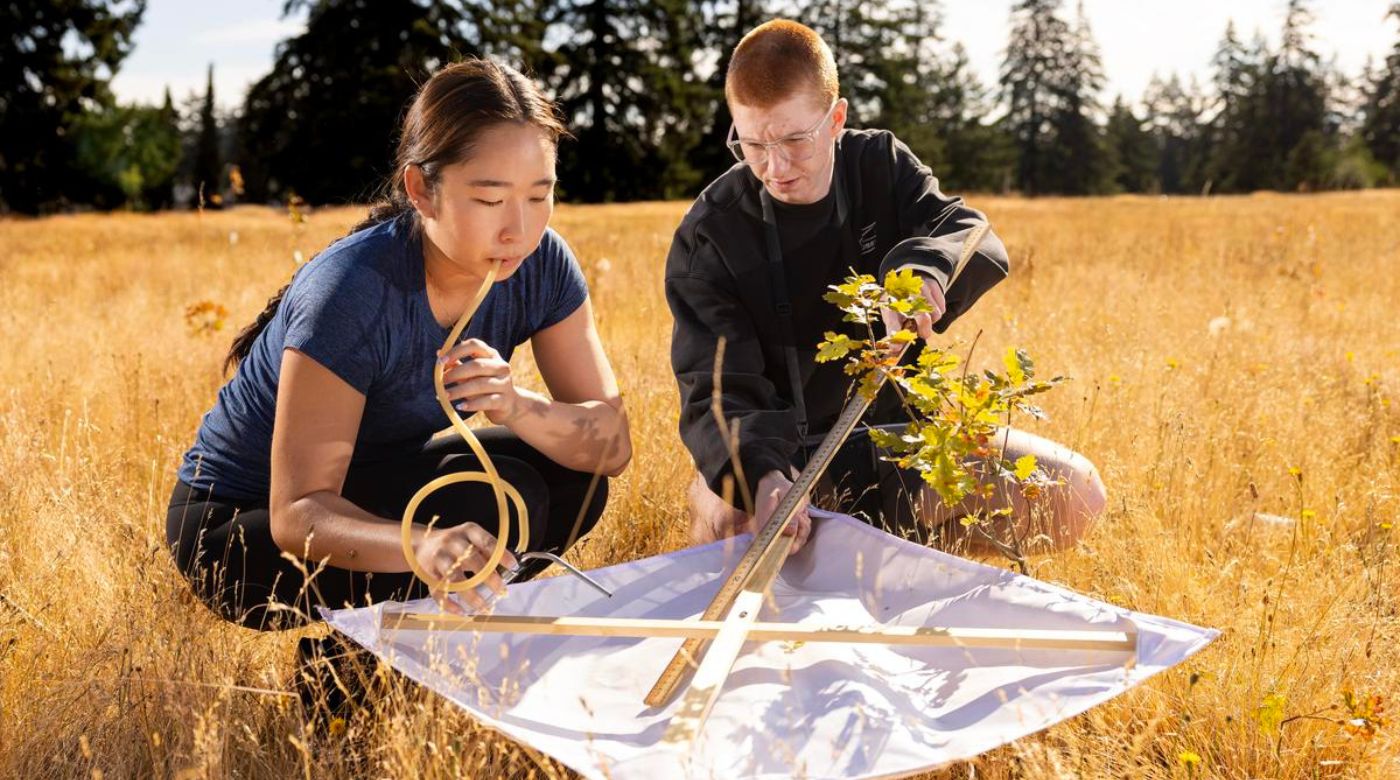
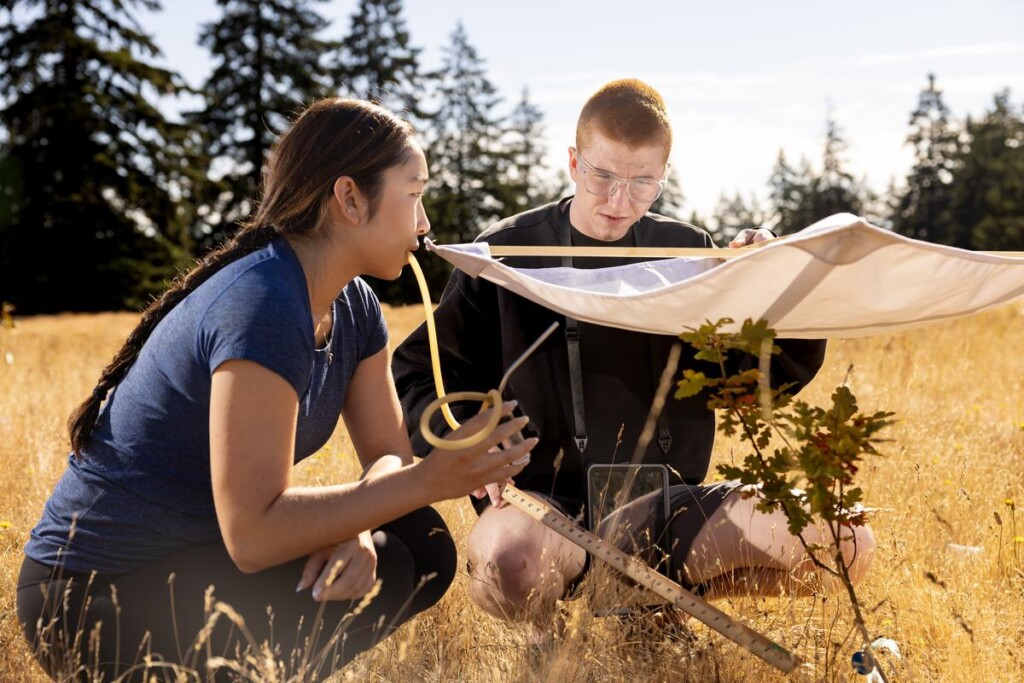
Image: Ayre Takamoto ’28 and Corban Piper, Biology Majors, collect insect samples on oak saplings on lower campus as part of their summer research project, Tuesday, July 14, 2026, at PLU. (PLU Photo / Sy Bean)
By Jeffrey Roberts
PLU Marketing and Communications
Three PLU researchers are finding something extraordinary hidden in the small stands of aspen trees scattered across Tacoma’s parks and college campuses. While most people ignore these quiet groves, the research team sees them as vital hosts to a complex, diverse ecosystem that scientists still don’t fully understand.
Throughout the summer, biology majors Ayre Takamoto ’28 and Corban Piper ’28, working alongside PLU Assistant Biology Professor Olivia Cope, are conducting some of the first focused field research on these South Sound aspen communities – cataloguing the insects that live on them, mapping their distribution across sites, and asking what these groves reveal about wetland health in the greater Tacoma area.
“If we can get enough data that aspens are a wetland indicator species, that could be used as another tool to protect wetlands from development,” says Corban, who hopes to pursue graduate work in ecology.
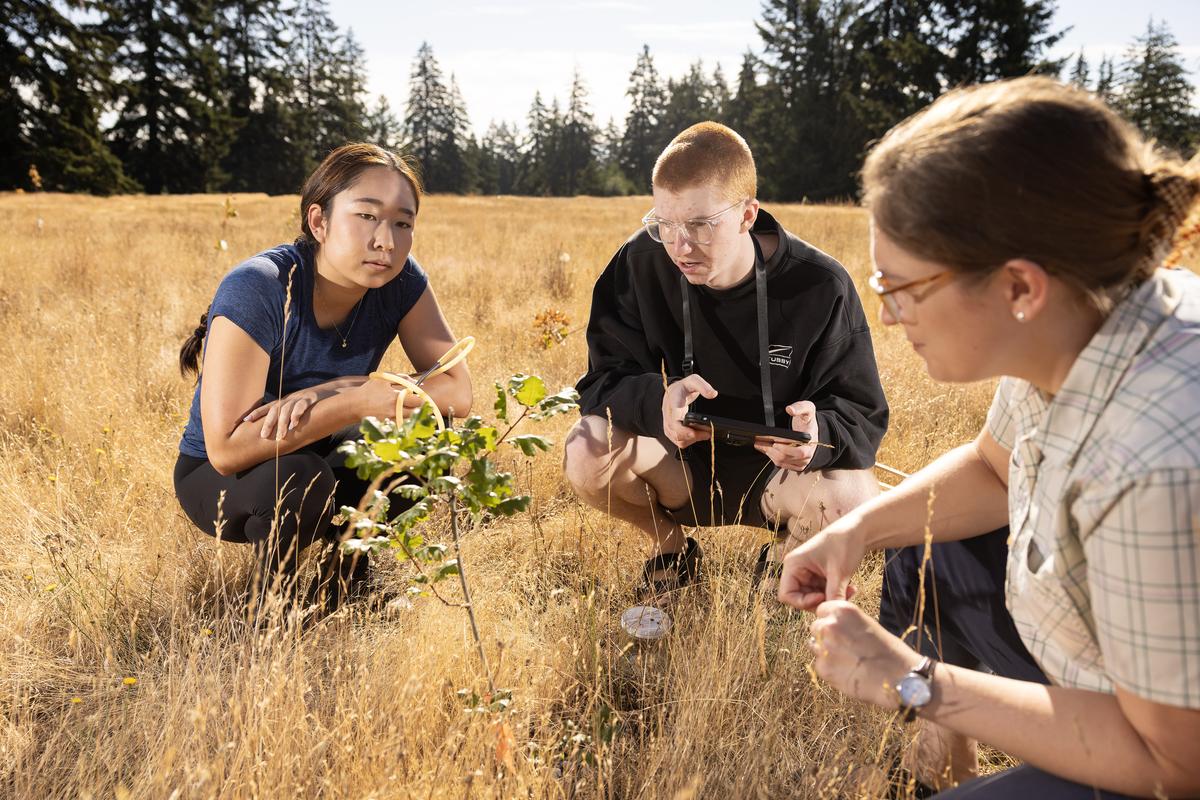
"It’s a lot of different skills I’ve never done before and that I don’t think I’d ever get to practice outside of this experience." –Ayre Takamoto ’28
In addition to supporting conservation efforts, the goal of this research is to understand what insect communities these trees support, how connected those communities are across isolated sites, and whether Tacoma’s lowland aspens resemble their mountain or midwestern counterparts – or represent something distinctly their own. The team also hopes this work will aid conservation efforts.
“It’s rare and fascinating that these trees are here,” remarks Cope. “Our low elevations are so developed that the trees are really fragmented from each other; whereas in higher elevations, the aspens grow clonally and are often connected underground as one massive organism.”
Their work is methodical. Across three research sites, the team has tagged 30 trees per location, recording height, sapling density, and the insect life on each one. Recording evidence of insects can be as simple as observing partially-eaten leaves and excrement, but to be thorough, these researchers take a “hands-on” approach. After making their visual observations, researchers thwack branches with a yardstick over a white tarp and then use an aspirator to collect anything that drops. Specimens are then labeled and brought back to campus for microscope analysis.
For Ayre, the project has equipped her with a toolkit she couldn’t have built in a classroom alone.
“Some days we’re out here doing field work, and other days we’re in the lab looking at insects under the microscope or doing data analysis,” she says. “It’s a lot of different skills I’ve never done before and that I don’t think I’d ever get to practice outside of this experience.”
For Ayre and Corban, the summer has been as much about learning to think like researchers as it has been about the aspens themselves – putting down roots of their own in a field that once might have been foreign, but is quickly becoming their home.