
Smarter submarines: How generative AI is rewriting the rules of marine exploration
Beneath the swirling surface of our coastal waters, where radio signals vanish and human eyes cannot see, a new generation of robotic submarines are learning how to think.
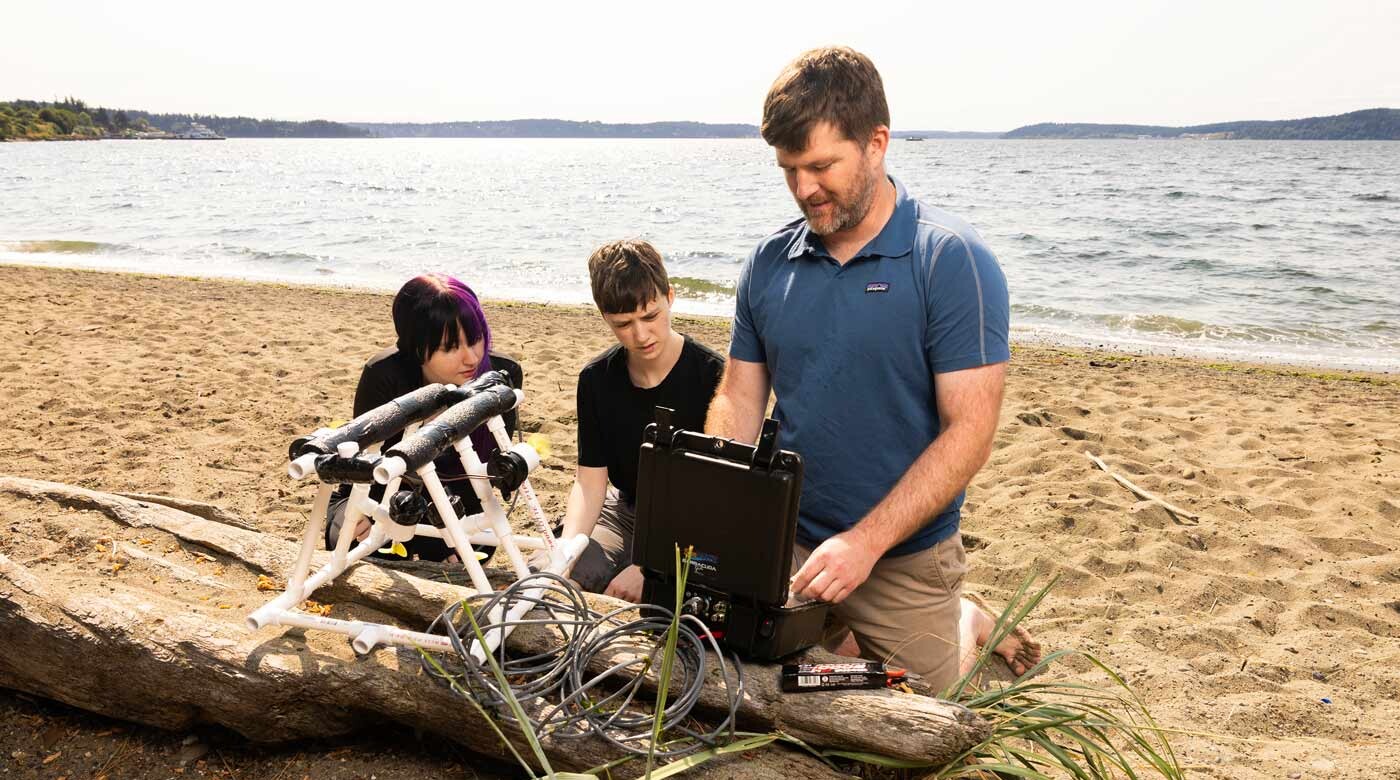
Image: Associate Professor of Computer Science Jeff Caley and his research students, Thursday, July 23, 2026, at Sunnyside Beach Park. Photographed for Resolute. (PLU Photo / Sy Bean)
By Chris Albert
Scientists are building artificial intelligence that gives these underwater explorers the autonomy to navigate the planet’s most unpredictable and dangerous currents entirely on their own.
At the forefront of this digital frontier is PLU Associate Professor of Computer Science Jeff Caley, students Ember McEwen ’27, Sam Brown ’27, and Lin Birgen ’29, roboticist Seth McCammon, and oceanographer Gordon Zong from the Woods Hole Oceanographic Institution.
Backed by a $980,000 National Science Foundation grant, they are determining how robots see and navigate the ocean, transforming autonomous underwater vehicles (AUVs) into intelligent, independent explorers.
“We’re looking at this characterization of 3D flow structures in headland eddies,” Caley says. “What that basically means is we have a physical oceanographer from Woods Hole that we’re working with, and he’s interested in understanding how headland eddies form and progress. We don’t have a great understanding of that because they are ephemeral.”
If successful, this research will shift timelines for building ocean models from months to minutes, offering rapid forecasting for environmental emergencies, like tracking oil spills or monitoring harmful algal blooms, McCammon says.
"We are training a neural net to act like a brain" –Ember McEwen ’27
“We are training a neural net to act like a brain,” Ember, a computer science major, explains. “We give it a snippet of the ocean, and it learns to fill in the surrounding flow patterns.”
Instead of using slow, traditional physics models that require days of supercomputer processing, the team is turning to generative AI. Their method treats ocean prediction like a digital photo-restoration project. Using the same type of AI that generates digital imagery, the submarine can take a few scattered data points from its onboard sensors and instantly reconstruct a highly accurate, full-scale map of the surrounding fluid flow.
Essentially, the team is giving the AUV the ability to understand what the ocean should look like, allowing it to make real-time decisions that vastly expand the scope of marine exploration.
By bridging computer science, robotics, and oceanography, the project tackles the three hurdles of marine exploration: cost, time, and precision.
“The closest other way that you could collect this data would involve multiple research vessels,” McCammon notes, adding that crewed ships can easily cost tens to hundreds of thousands of dollars per day. The AI-driven approach also allows robots to make split-second navigation decisions, maximizing limited battery life by targeting priority areas.
To ensure precision, the team uses physics-informed neural networks that hardcode physical laws directly into the AI’s programming. McCammon added that because the models are trained not to violate physics, the predictions are inherently more accurate and trustworthy.
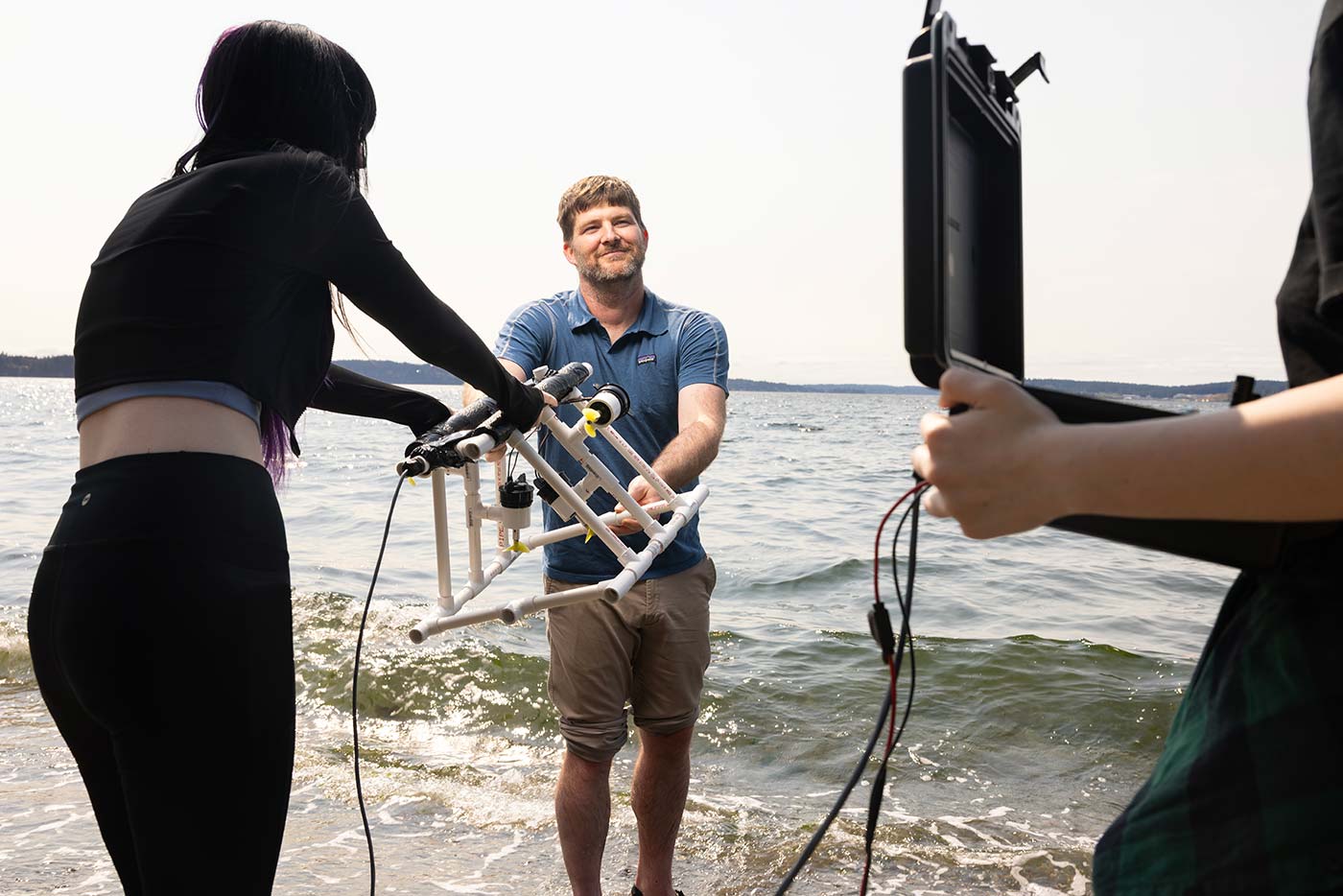
The team is constantly working through details step-by-step, not only creating AI, but also finding the best way to use current AI to work through problems.
Problems such as:
“How can we get it to learn big structures of the ocean without us telling it what those big structures are,” Lin says.
Navigating these types of concepts is a big part of figuring out how to build a neural net.
“It’s so interesting,” Lin says. “It doesn’t feel real. It feels like sci-fi.”
Caley first began exploring neural nets as a graduate student at Oregon State University, where he was a classmate of McCammon. More than a decade later, when McCammon began exploring the possibilities of AUVs, a collaboration with Caley was a natural fit.
Lin and Sam joined the team, with the encouragement of Ember.
“Ember said, ‘Oh, I have things you can do over the summer,’” Lin recalls. “I have a professor you should connect with. You’ve already taken his AI class.”
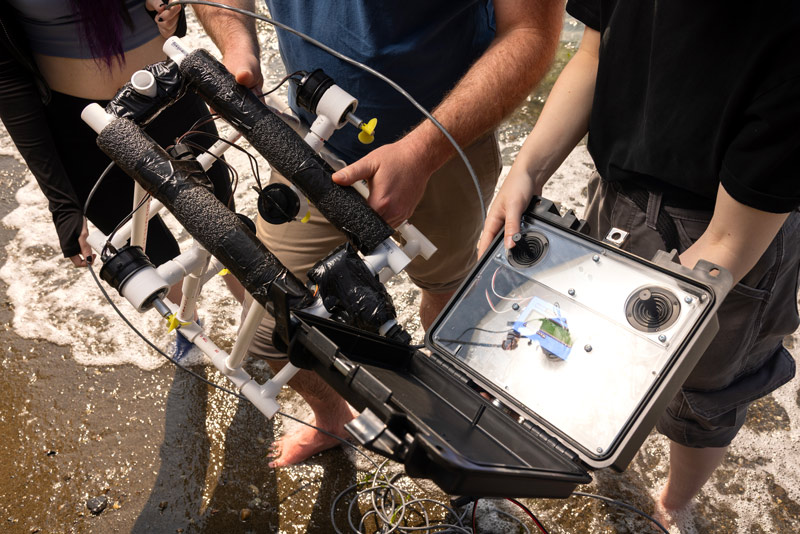
For Ember, the deep dive began even before they joined the research project, when Caley provided personal, one-on-one mentorship to prepare her for the advanced codebase. This individualized mentoring led to more than two years on the project.
“Before Dr. Caley officially hired me, I would meet with him every week,” Ember says. “He would, in his own time, teach me a crash course in machine learning, which was super cool and fun for me. Obviously, I learned a ton, and it really prepared me for both that job and my career going forward.”
“A lot of what surprised me is how complex, hard, and amazing the research process is,” Ember adds. “We’re doing stuff that’s new. No one has done it before using these techniques.”