


Hidden in Plain Sight: Julie Ann’s Quest for Rosemaling Treasures
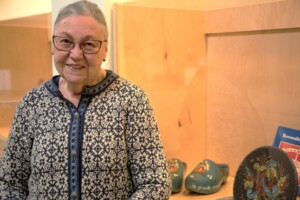
Julie Ann Hebert (Western Rosemaling Association) brings her traveling Rosemaling collection to the Scandinavian Cultural Center, Wednesday, March 11, 2026, at PLU. (PLU Photo / Sarah-lynn Bennett)
Where does an adventurer go to find treasure? While Robert Louis Stevenson’s readers might look to a swashbuckling island and Frank Baum’s to a yellow brick road, Julie Ann Hebert finds hers in much humbler places. Julie Ann knows that “priceless” rosemaling masterpieces are often hidden in plain sight—perhaps a $3 bread board in a local antique shop or a decorative plate in a quiet Norwegian kitchen. Over the years, she’s cultivated a traveling rosemaling collection that covers the better part of a century of Norwegian history, now currently on display in the Scandinavian Cultural Center’s brand new exhibit cabinets. For Julie Ann, the real gold isn’t found in storybooks; it’s the heritage and the richness of the artists’ lives that make these pieces true treasures.
The Art of the Rescue
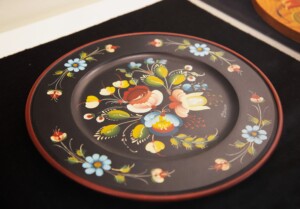
As a historian for the Western Rosemalers Association, Julie Ann’s treasure map is composed of various antique and secondhand shops across the PNW, including the ones where she has staged her most daring rescues. One such rescue involved a vibrant Os style rosemaled plate that had been relegated to a shelf of housewares. “I paid $14 for it,” she exclaims proudly. “That’s always so special to me, when I find out how little I paid for a priceless piece.”
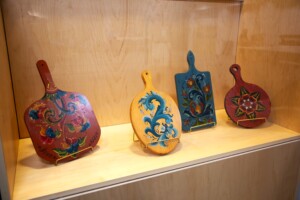
Many of Julie Ann’s finds are personal victories that serve a dual purpose: they are both museum-quality artifacts and functional tools. In the exhibit, a dedicated shelf showcases items she uses in her own kitchen, including an array of breadboards—each specifically shaped to accommodate different types of loaves.
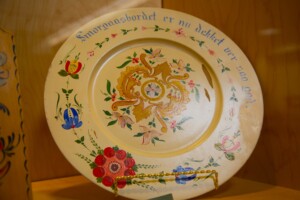
These include a $5 Telemark board and a $3 Rogaland-style board, both found in local shops. However, her most significant “rescue” is a Smorgasbord plate found in a junk store for $48. This piece connects Julie Ann to Per Lysne, the artist credited with popularizing rosemaling in the United States. “This has got a lot of history,” she says, noting the plate should be worth at least ten times what she paid. “If you go to a restaurant that’s kind of found home in Norwegian cooking, you might see one of these plates on the wall,” she recalls. When Lysne’s career as a cart painter stalled, he pivoted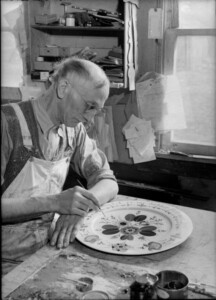 to selling decorative plates to major Chicago retailers. His work became so fashionable that it even appeared in a 1933 issue of Vogue for his work to “Ten Chimneys,” the home of stage performers Alfred Lunt and Lynn Fontanne. For Julie Ann, the find is deeply personal: “I always saw these when I was a child because I’m from Ashland, Wisconsin. I never knew what that was all about,” she admits. “Now, I’m sorry I didn’t ask for one.” Finding a Per Lysne piece means more to Julie Ann than adding a dish to her collection, it’s preserving and celebrating a piece of history that is now featured in the exhibit.
Julie Ann’s quest is far more about the thrill of a found treasure. By scouring antique shops, she connects the Pacific Northwest, the Midwest, and Norway together in the preservation of the rosemaling tradition. She realizes that these treasures weren’t meant to be locked away, they were meant to be used, touched, and admired. Her traveling collection at the Scandinavian Cultural Center ensures the vibrant artform will remain “hidden in plain sight” no longer.