


Empowering Coaches: PLU kinesiology receives $900,000 grant from Names Family Foundation
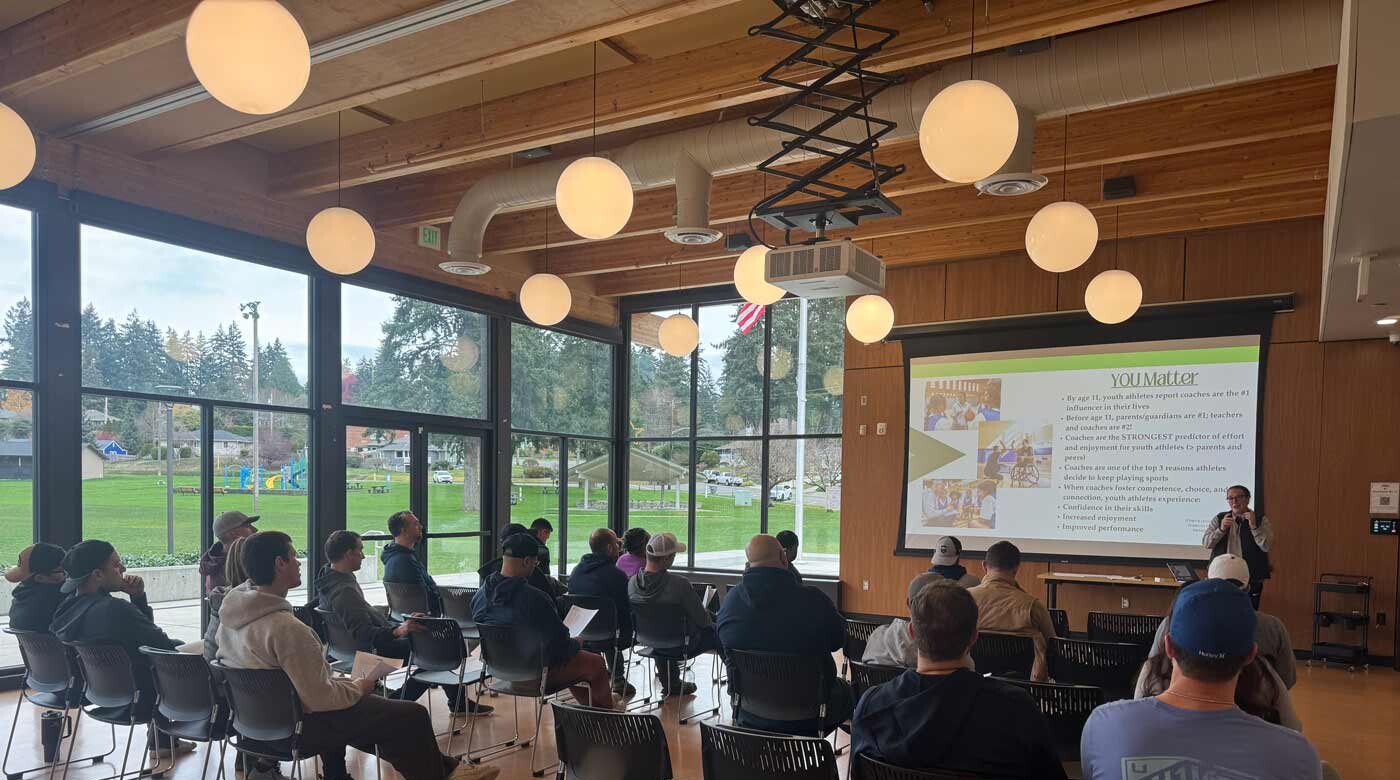
Image: Mallory Mann giving a presentation.
By Britt Board
Assistant Director of Communications
Pacific Lutheran University’s Department of Kinesiology has been awarded a three-year, $900,000 grant from the Names Family Foundation to expand and strengthen youth sport coach education across Pierce County.
The grant will support the development of a dynamic, evidence-based coach education platform designed to meet the specific needs of local youth sport organizations and the communities they serve.
The Names Family Foundation is a longtime philanthropic leader in the South Sound, focused on improving health, wellness, and access to physical activity for children and families. Their support helps local organizations expand community impact through evidence-based, youth-centered programs. Their investment in PLU reflects a shared commitment to building healthier, more active communities.
Spearheading the project is Mallory Mann, department chair and associate professor of kinesiology, who reflects, “This grant brings faculty, students, and community partners together in meaningful, collaborative work to help solve the youth athlete retention issue and, as a result, play a role in increasing physical activity among young people in Pierce County.”
This grant brings faculty, students, and community partners together in meaningful, collaborative work to help solve the youth athlete retention issue and, as a result, play a role in increasing physical activity among young people in Pierce County.
The need for this work is clear. Nationally, 70% of youth drop out of sports by age 13. Locally, only 19% of youth in Pierce County meet recommended daily physical activity levels, underscoring the importance of high-quality coaching in keeping young people engaged and active.
Mann applied for the grant in collaboration with professor of kinesiology Karen McConnell at PLU and worked closely with community partners Jeff Grover and Ryan Brown with the City of Fircrest Parks and Recreation. Patricia Shults, executive director of the Names Family Foundation, also served as a key thought partner throughout the process.
Below, Mann shares more about the grant, the project’s vision, and what it means for students, faculty, and the broader community.
What is the Names Family Foundation grant, and what is it designed to support?
The grant supports the creation of a coach education platform that brings coaching theories and science to youth sport coaches in organizations throughout Pierce County. Each organization is different in terms of the athletes it serves, the culture it has established, the experience level of its coaches, etc. So, we work with the organization on a needs assessment, then design a series of learning opportunities for their coaches to support them. In other words, we’re creating dynamic, context-driven, evidence-based coach education. The materials are designed for immediate implementation.
How will this project roll out over the three years of the grant?
In year one, we are working with City of Fircrest Parks and Recreation to help develop their coaches. In years two and three, the goal is to expand our reach and connect with other youth sport organizations throughout Pierce County.
Who is involved in the project, and how are students contributing?
We currently have five PLU students from various disciplinary backgrounds working on the project, and we’re excited to involve additional students with interests and skills in coaching, teaching, video production, and video editing. We also have our project organizer, Emily Whittaker (FTWL instructor and coach education project assistant), who has been instrumental in supervising students and ensuring the platform is operating smoothly. Without her skills and expertise, this platform would not exist. Kinesiology faculty are offering their expertise, and additional faculty involvement will increase as we move forward with the project and create educational tools.
Why is youth sport coach education such an important focus right now?
A recent report by the American Academy of Pediatrics in 2024 showed that 70% of youth drop out of sports by the age of 13. Two of the top reasons for kids dropping out are negative experiences with the coach, and sports are no longer considered “fun” by the child.
Here in Pierce County, only 19% of youth meet the Center for Disease Control’s recommendation of 60 minutes of daily physical activity.
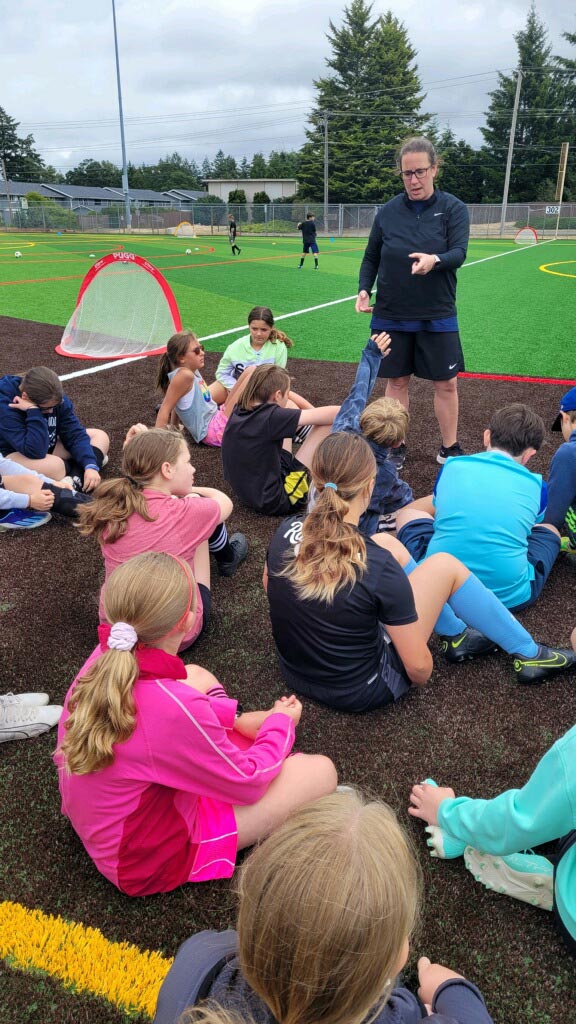
When youth are more active, they report higher levels of excitement, happiness, and motivation compared with inactive peers (this is according to the Aspen Institute State of Play Tacoma-Pierce County report). Movement and staying active is key for individual and community health.
What does receiving this grant mean to you personally and to the department?
This award demonstrates that the Names Family Foundation recognizes the expertise and excellence that exists in PLU’s Department of Kinesiology. I am proud to work alongside my colleagues and am proud to be a member of this academic unit.
I also believe this grant represents community-informed work. It is the result of assessing the needs of the community, which was done through the Aspen Institute’s State of Play Tacoma-Pierce County report and talking with community partners. Then, we leveraged research and evidence to help fill that gap.
The grant also recognizes the significant mentorship I have received throughout my life. I am fortunate to now work with two of the people who have had the greatest impact on my life — Dr. Colleen Hacker (professor of kinesiology) and Dr. Karen McConnell. I view this grant and recognition as much as a product of their investment in me over the past two plus decades. I hope to work and live in a way that honors and carries forward the significant impact they have had on my life.
What makes the kinesiology program at PLU stand out?
We have a strong reputation as one of the top programs in the PNW. Our department includes some of the preeminent scholars and community-engaged experts in their fields.
What I am most proud of is that my faculty colleagues consistently think about how they can leverage their professional knowledge to improve students’ learning experiences. They are mental performance consultants for corporations and sports organizations, authors, and executive directors for various nonprofits. They choose to use their positions to create opportunities for experiential and community-based learning for students.
Students first learn content in our classes from experts in their fields. Then, they have the opportunity to apply that knowledge in a variety of contexts. They are creating lesson plans for K-12 physical education classes, applying team building skills in high ropes course experiences, participating in cooking demonstrations, presenting research at local conferences, participating in community health promotion events, and engaging in coaching observations.
We have also cultivated a close-knit, collaborative culture in our program among faculty and students. I feel lucky and grateful that I have fun interacting with my colleagues and coming to work each day.
What’s it like working with students on projects like these?
It has been fun and fulfilling to create an interdisciplinary team and to work with students from a variety of backgrounds and career interests. Each student has brought their own unique skills to benefit the team, and this project really wouldn’t exist without them taking an active role in it.
Student Impact: Skills & Experiences
Through this project, PLU students are gaining real-world expertise in:
Content Co-Creation: Developing educational tools, videos, and handouts from the ground up.
Coaching Science: Applying research-based pedagogical strategies to youth sports.
Community Engagement: Collaborating directly with stakeholders and local sport coaches.
Instructional Design: Building practical curriculum and digital communication assets.
Interdisciplinary Teamwork: Working across diverse backgrounds to solve complex problems.
Professional Storytelling: Translating research into accessible, impactful narratives.