


South African Divestment
by Katlyne Smith
The Mooring Mast April 25, 1986
In the mid 1980s, the PLU community became increasingly aware of institutional stock investments that supported the apartheid regime of South Africa. On January 27, 1986 the university’s Board of Regents adopted the first clause to Section VI of the American Lutheran Church’s (predecessor body of the Evangelical Lutheran Church in America) official statement concerning the practice of South African apartheid in 1981, which stated, “The Board of Trustees in total agreement, sympathy and support of the American Lutheran Church’s (ALC) condemnation of apartheid and fully committed to the cause of justice and wholeness for the South African black majority.”
The Mooring Mast, April 25,1991
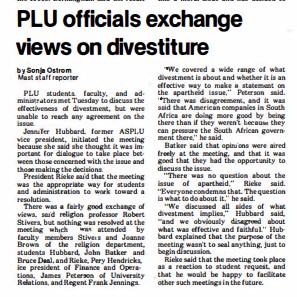
While this statement did not mention divestment, a faction of PLU faculty members created a proposed resolution for their April 11, 1986 Faculty Assembly that would call for their retirement fund, TIAA-CREF, to withdraw from any financial corporations that had mutual ties to the South African government. Before the resolution was proposed in the meeting, some faculty members tasked the Judiciary Committee of the Assembly to evaluate if the resolution violated their bylaws on political bias speech. The committee found that the resolution did not violate their constitution, and it was allowed to be addressed as a motion in the following faculty meeting. When the motion was put to a vote, it did not pass.
Some members argued that the motion was out of the scope of the faculty’s administration and suggested it should be left to the Board of Regents to solve, while others countered that it was the faculty’s retirement money that was being used, and they had a right to discuss divestment. A member argued that the divestment motion was badly worded and could not be adopted or rejected without “undesirable consequences.” The member then proposed through Robert’s Rule of Order a new motion to dismiss the previous divestment motion permanently to avoid an official vote. The motion passed after President Rieke broke the tie vote.
The Mooring Mast, April 25, 1986
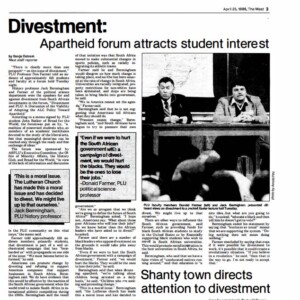
On April 22, 1986, the Office for Minority Affairs, along with student organizations Bread for the World, and ASPLU, sponsored a forum entitled “Divestment and PLU: A Discussion of the Visibility of Adopting the ALC Policy Toward Apartheid,” featuring Political Science professor Donald Farmer and History professor Jack Bermingham. Farmer argued divestment was a popular understudied movement that could harm Black South African’s employment, provoke rebellion, and disrupt the incremental integration progress. In contrast, Bermingham framed divestment as a moral, globally supported strategy led by Black South Africans that was partially responsible for the integration progress.
Student Protest on Red Square, 1986
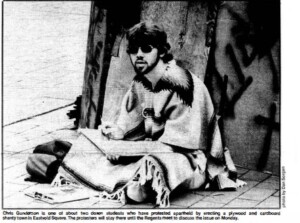
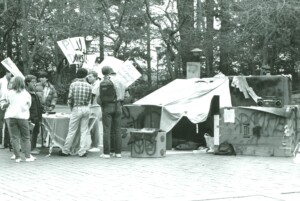
Student protesters, however, wanted PLU to commit to divestment. According to the April 25, 1986 issue of the Mooring Mast, dozens of students started a weeklong protest on the Red Square. In order to draw attention to the living conditions of Black South Africans at the time, protesters built “shanty towns,” temporary box structures made out of plywood and cardboard. The group also held picket signs that advocated for divestment, as well as to free South Africans and the country of Namibia, which was under subjection to the South African Government.
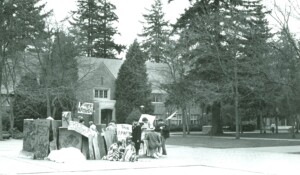
Shanty Protesters on the Red Square.
Student protesters planned to remain outside until the next Board of Regents’ meeting on campus, which was scheduled for a week after the protest demonstration started. The protesters wanted the university to adopt the entire statement of the ALC stance on South African Apartheid, not just the Section VI which included methods of divestment. President Rieke referred to the demonstration as “an inappropriate method of protest on campus where there are correct channels for disagreement… When systems break down one invites anarchy and then everyone loses.” While Rieke disagreed with the method of protest, he promised that he would relay the protesters’ petition and their signed cover letter to the Board of Regents.
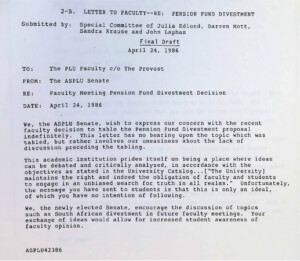
ASPLU April,24 1986
On April 24,1986, ASPLU wrote a letter to the university’s faculty that stated, “This academic institution prides itself on being a place where ideas can be debated and critically analyzed … unfortunately the message you have sent to students is that this is only an ideal of which you have no intention of following.”
Just four days later Bruce Deal, ASPLU president, and Greg Nyhus, Residents Hall Committee Chair (RHC) attended the annual Board of Regent meeting to communicate the students body concerns on divestment. After long deliberations, the Board of Regents approved a finance committee motion to investigate the university’s funds for ties to South Africa. The committee sought stock alternatives adhering to the Sullivan Principles, which were Equal Right Principals that led to “legislation [that] prohibited U.S. companies from engaging in segregationist practices anywhere in the world.”
On September 23, 1986, the finance committee reported finding mutual funds connected to South African companies and proposed divesting from all such companies. The motion was passed and scheduled to be implemented on September 1, 1987.
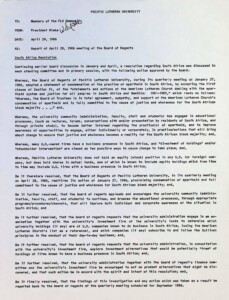
Rieke Divestment Memo, April 29,1986
In conjunction with divestment, Reverend Ron Tellefson, Pacific Lutheran University’s pastor, became the lead coordinator of a Lutheran church campaign to help sponsor full-ride scholarships for Namibian students across 28 Lutheran colleges across the United States.