


Clover Creek Watershed Studies - Digital Postcards
ENVT 350: Environmental Methods of Investigation
This interdisciplinary watershed-based course examines the health of PLU’s watershed: the Chambers-Clover Creek Watershed. ENVT 350 draws from a variety of disciplines, including Biology, Geology, Chemistry, South Coastal Salish Studies, and English. Students in ENVT 350 are asked to create “digital postcards” – using photographs and brief messages to share their experience and arguments about the health of the Clover Creek Watershed.
Professors involved with the course include Mike Behrens, Suzanne Crawford O-Brien, Jenny James, Rose McKenney, Brian Naasz, Gairet Nason, and Amy Siegesmund.
| Methodology | |
|---|---|
| Data Collection | Data Analysis |
| Observation | Deep Reading |
| Indigenous Research Methods | Integration |
| Application | |
Study Locations
Spring 2026
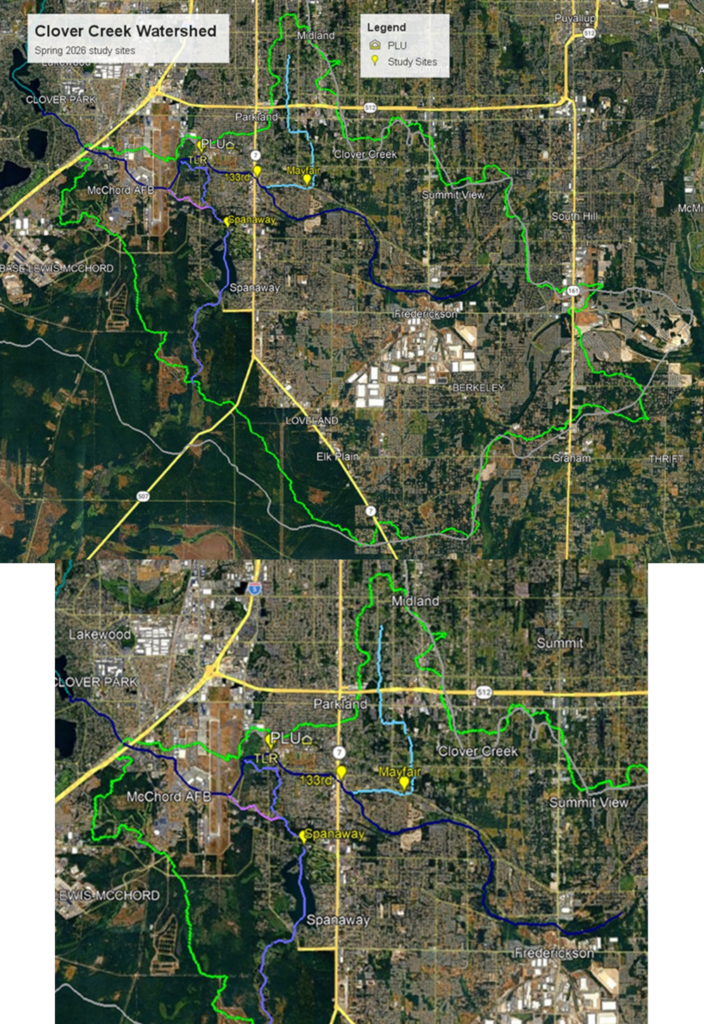
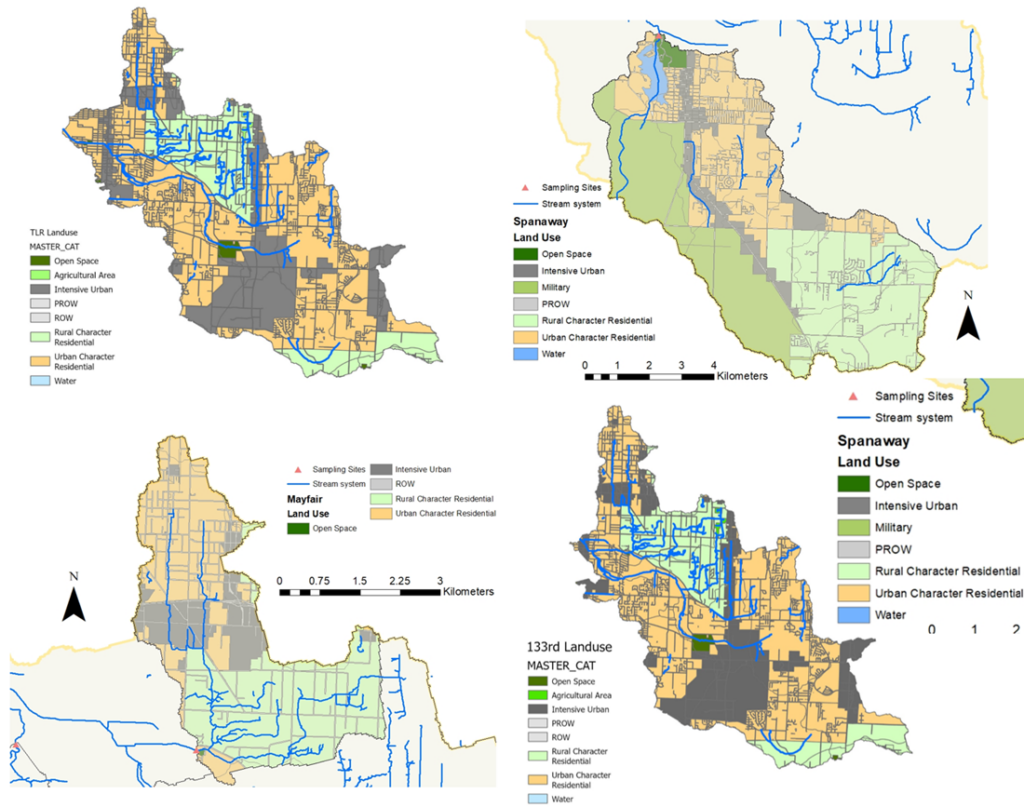
These four maps show the ENVT 350 2026 spring semester sampling sites done at 133rd, Tule Lake Road (TLR), Mayfair Playfield, and Spanaway Park/Lake respectively. The Clover Creek watershed is a well-developed urban area largely consisting of residential areas, primarily of urban residents. The streams (dark blue) cross through intensive and residential urban areas, with some going through rural residential and military zones. Each sampling site was located next to a road that experienced regular traffic, two zones (Spanaway and Mayfair) are frequented by dog walkers and visiting families in addition to their surrounding areas. Though both Spanaway and Mayfair hold more vegetation and a sense of “remoteness” than TLR and 133rd their status as recreational sites still lead them to be subjected to harm: i.e. Spanaway is subjected to frequent toxic algae blooms caused by heat and excess nutrients in the streams. These nutrients (nitrogen, phosphorus) can originate from fecal matter from animals, storm water runoff, and sewage. 133rd experiences the highest amount of urban activity and runoff, the stream is located directly by a gas station, car wash, and multiple tire shops and has the least riparian vegetation of all the sites observed. Mayfair’s presence as a public recreational spot formed in 2016 after being reconstructed from an abandoned baseball field. The water quality of each site despite these sources of pollution is average but could be better maintained, as there is no clear pattern of improvement. Considering the surrounding environments that the watershed’s streams are in can lend useful insight into what the sources of each stream’s problems may stem from. Any possible restoration cannot be carried out without addressing the greater system (i.e. land use/architecture) to ensure sustained health.
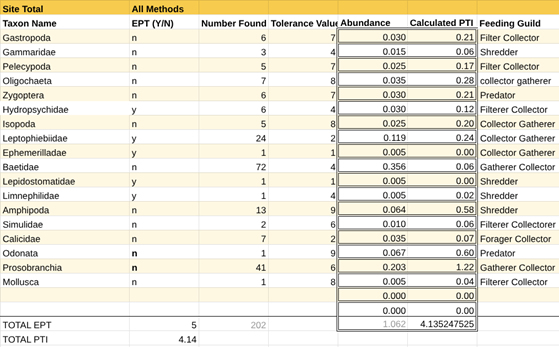
PTI (Pollution Tolerance Index) is a tool that is used to help make sense of organisms in a stream or river. It looks at indicator organisms and the tolerance levels. Indicator organisms are macroinvertebrates that live solely in water at the bottom of a river or stream, they are sensitive to water quality changes and respond in predictable ways to changes in their environment, their presence or absence indicates something about the water quality. An example of an excellent quality assessment would be 23 or more, with fair being 11-16, and poor being 10 or less. EPT is closely related to PTI, but EPT solely focuses on the richness of three sensitive insect orders- Ephemeraptera (Mayflies), Plecoptera (Stoneflies), and Trichopetera (caddisflies). It measures the total number of individuals within these groups, with higher numbers indicating better water quality. PTI and EPT is important when looking at water quality because it doesn’t just show results provided by chemical tests, the macroinvertebrates act as living sensors to show a variety of pollution that may or may not be in the water, kind of like a canary in a coal mine that miners used as an early indicator to detect deadly odorless gas. I chose to look at Spanaway Lakes PTI and EPT results since it’s in a fairly high urbanized area. The results showed that the PTI was at a 4. 14 and the EPT at a 5. According to the Streamkeepers guide, that data would put the water quality assessment at poor since the water is mainly dominated by tolerant organisms, meaning there could be high pollution in the water. While we could use other chemistry tests to look at water quality, PTI is a sure way to look at what organisms are thriving in our streams and which ones are disappearing. This allows people to take the appropriate steps in figuring out what kind of pollution is in the water and what can be done to negate it.
Stream insects come in various feeding guilds. Shredders break down organic particulate matter. Their absence can lead to leaf litter accumulation, nutrient lockup, and algal overgrowth. Scrapers maintain water quality. Their absence can lead to algal overgrowth and oxygen depletion. Collector-gatherers gather fine particulate matter from the stream bed. Their absence can increase sedimentation, nutrient imbalances, and water quality degradation. Collector-Filterers filter fine particulate matter from the water column. Their absence can increase turbidity and reduce water quality. In the absence of predators, some species may be eliminated due to other species acting as invasive.
From the provided data, we find that collector-gatherers are extremely overrepresented in the stream habitats of Clover Creek. Sites Mayfair and 133rd have relatively normal feeding guild percentages. However, sites Tule Lake Road and Spanaway are severely lacking numbers in the non-gatherer feeding guilds. Based on the charts, collector-gatherers have been acting as dominant invasive-like species in their streams. Proper feeding guild ratios help maintain the water quality of streams. Higher populations of scrapers, shredders, predators, and collector-filterers would improve the status of our watershed.
Humans have terraformed the natural landscape for human uses for thousands of years. The Clover Creek Watershed (CCW) serves as a reminder of how human alterations of Watersheds can drastically impact the ecosystem. CCW used to be with the land where many different types of fish swam up past Pacific Lutheran University (PLU) to their spawning grounds. Once Europeans arrived in the mid-1800s many streams were diverted to make way for agriculture, homes, leisure spaces, and roads. Many people who have lived in Parkland in the 1930s – 1970s remember many public projects that channelized the Clover Creek Watershed. Many interviews with these people mention that there were many hop farms (plant used to make beer) that were built around the stream that diverted water from the stream to support the farms. Like the hop farms, another major stream change occurred when the Workers Progress Administration (WPA), created by President Franklin D. Roosevelt to provide jobs for unemployed people during the Great Depression, implemented flood control and mitigation projects in the Clover Creek Watershed. Many longtime residents recall the stream being significantly altered between 1938 and 1941 because of these WPA projects. After these projects were completed, they sparked a movement that encouraged a community-wide effort to modify the stream. As more new property owners redirected it away from their land to reduce erosion and flooding, water levels dropped and fish populations declined. This movement led McChord Air Force Base to build a culvert under the runway, followed by dredging projects upstream. Together, these engineering changes permanently reshaped the stream’s natural flow. Overall, the history of the Clover Creek Watershed demonstrates how decades of human development, flood control projects, and land modification can significantly reshape and impact the natural watershed and contributed to the decline of the fish populations that once thrived here.
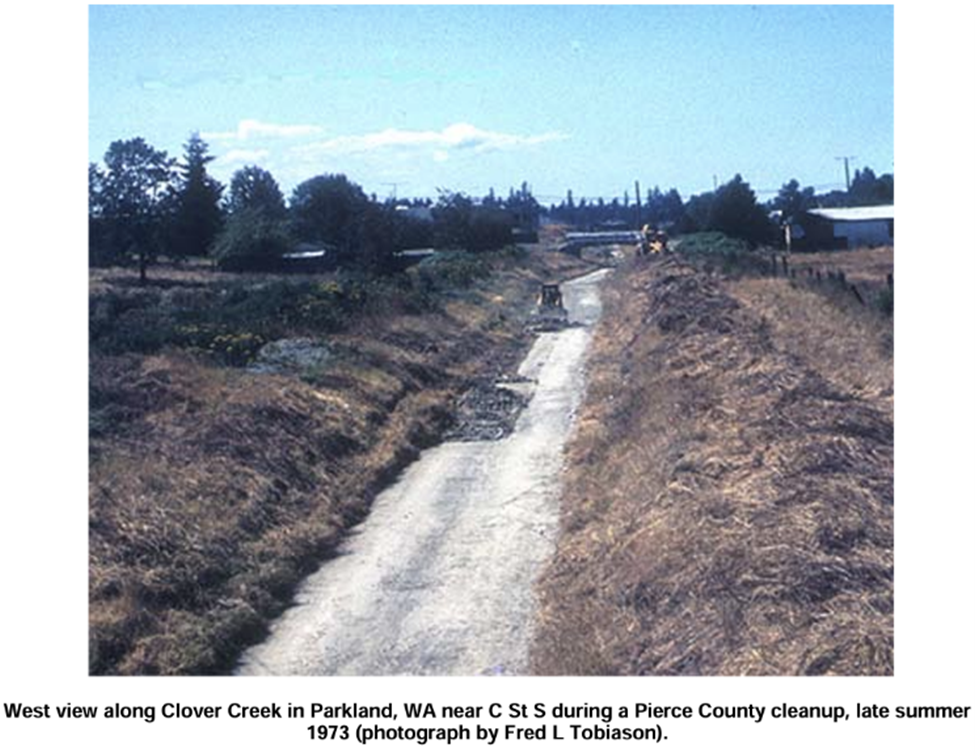
Reference: Tobiason, F. L. 2003. Historic flows, flow problems and fish presence in Clover Creek—1924–1942: Interviews with early residents. Pierce County, Washington. Pierce County Document Center. link: CCHistoricFlows.pdf
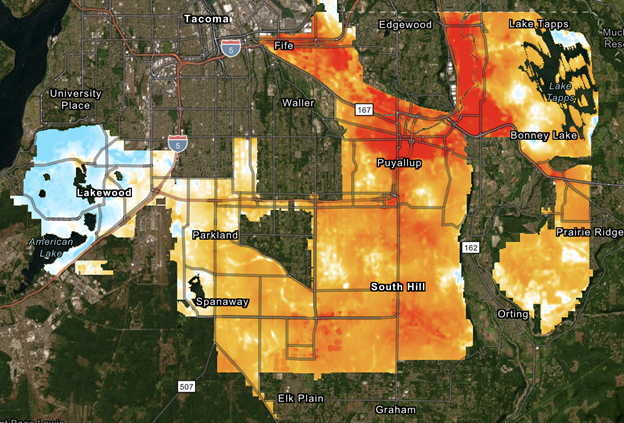
Urbanization increases temperatures through impervious surfaces, increased building density, and removal of tree canopy coverage. Asphalt and concrete carry high amounts of heat which release continuously after the sun sets. In Spanaway, areas directly next to Bresemann Forest and Spanaway Lake are cooler than neighborhoods just four streets away. Temperature differences as significant as seven degrees can occur within a few miles of each other based on presence of green spaces and permeable ground surfaces which allow groundwater penetration. The deep red area in Puyallup is home to five different K-12 schools and the Puyallup fairgrounds, which has recorded evening temperatures as high as ~86 degrees Fahrenheit. Highly populated urban areas are especially at risk due to elevated human activity which may increase temperatures (e.g. cars, industry pollution). Building density increases temperatures in urban areas as hot air becomes trapped between buildings, reducing air flow in certain areas. Urban heat disproportionately affects impoverished communities in Pierce County due to lower amounts of green spaces and potentially limited access to temperature regulation in homes. According to the Tacoma Tree Foundation, there may be correlation between historically redlined areas and sensitivity to urban heat. Urbanization impacts living conditions for all biota in the watershed, especially as climate-driven heat waves become more frequent and intense.
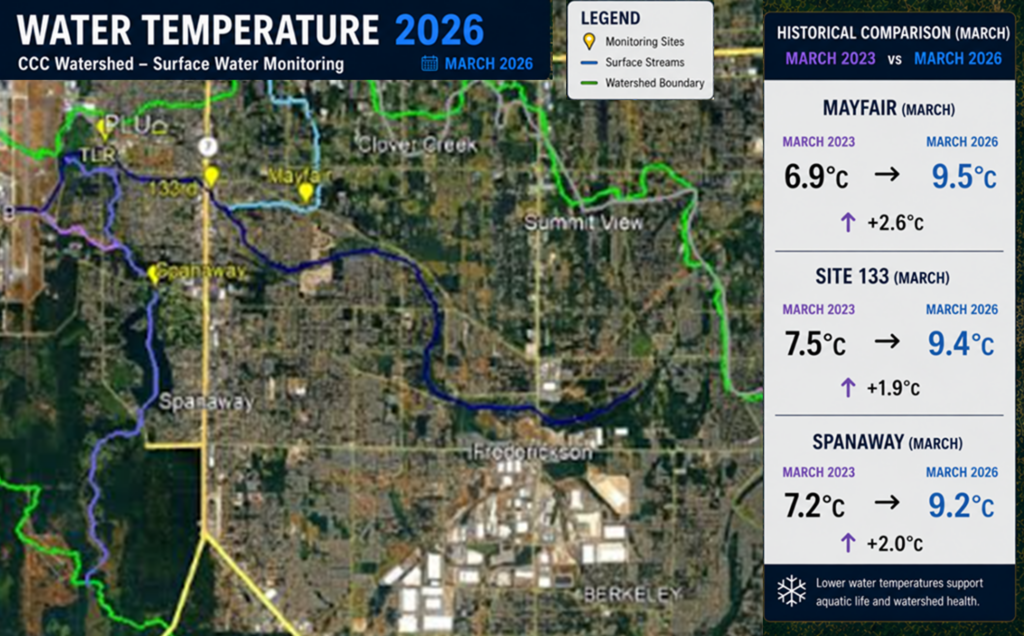
In our PLU ENVT 350 class water temperature was an important measure of watershed health because it affects both water quality and aquatic life. Many organisms, such as salmon and aquatic macroinvertebrates, depend on cool and stable water temperatures to survive and reproduce. When water temperatures increase, dissolved oxygen levels can decrease, creating stress for sensitive species and changing the balance of the ecosystem. Studying water temperature also helps scientists track how environmental conditions in a watershed are changing over time and identify areas that may be experiencing ecological stress. Water temperature studies are also useful because they help researchers compare conditions between different sites and different years. These comparisons can show patterns in stream health and help identify areas that may be more affected by environmental change. Since temperature responds quickly to changes in weather, vegetation cover, and human activity, it can provide an early sign that a watershed is becoming stressed. By monitoring temperature over time, scientists can better understand long-term trends and support efforts to protect and restore freshwater ecosystems. Water temperature was recorded at each study site using a handheld temperature probe placed directly into the stream water. Measurements were taken during field sampling in March 2023 and March 2026 at Site 133, Mayfair, and Spanaway to compare temperature conditions across the Clover Creek watershed.
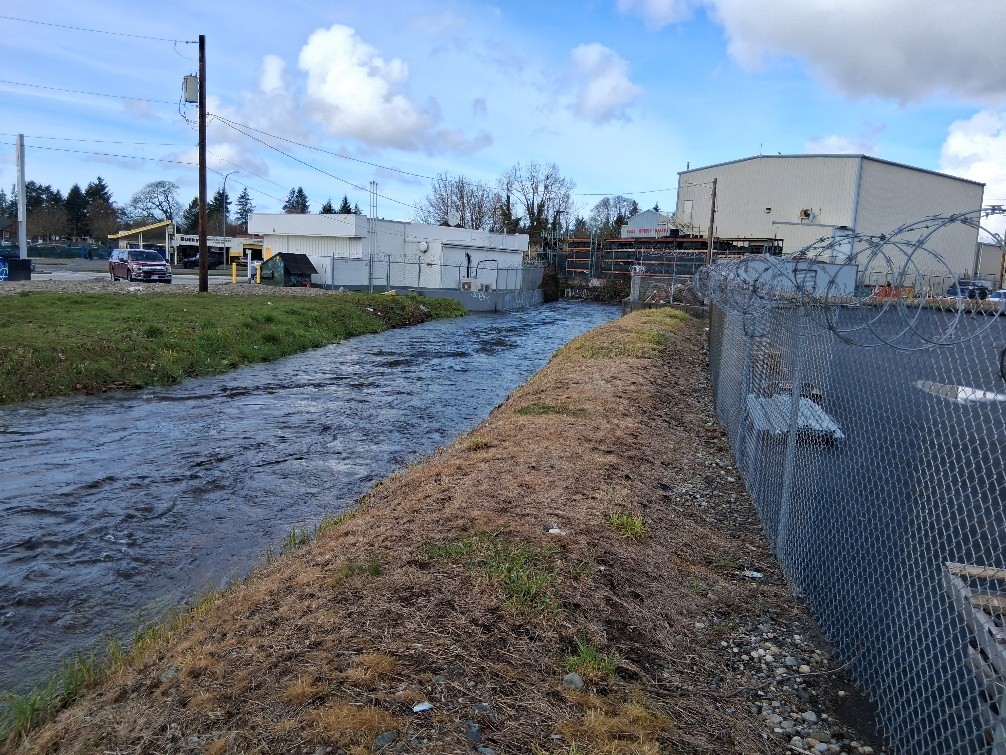
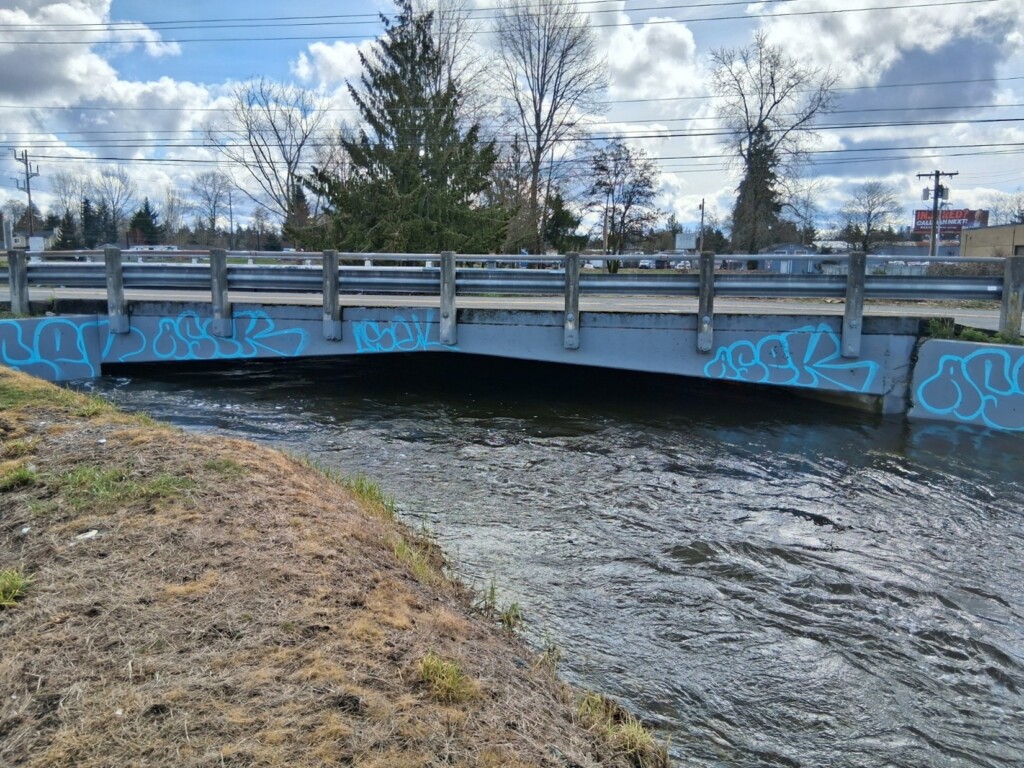
The riparian zone refers to the land that runs along the edge of a river. These areas are often called riparian buffers because they help filter pollutants from runoff before the water flows into streams or rivers. Riparian buffers can form naturally or be intentionally planted to restore the area or stabilize the stream banks. For example, native plants shade waterways, help lower summer water temperatures, stabilize shorelines, and reduce erosion. Riparian vegetation also helps keep streams healthy by supporting insects that feed fish, frogs, birds, and other animals, and by providing leaves and branches that form the foundation of freshwater food webs. In certain places in the Clover Creek watershed, such as the stream located near 133rd Street, riparian vegetation is being threatened by increasing urbanization, which destroys these buffers, potentially increasing the effects of pollution in this area. The photo below was taken at one of our sampling sites at 133rd Street. We can see in the photo that the river runs directly between a gas station and a large rack of tires, and where the river hits the gas station, a concrete wall, which is now covered in graffiti, has been constructed on both sides of the stream. Furthermore, though it is small in this photo, you can see Himalayan Blackberry, an extremely prominent invasive species in Washington, growing under the large rack of tires. These factors combined leave the overall health of this site at risk due to the amount of pollutants that may enter the stream system, as a result of the destruction of the riparian vegetation surrounding it.
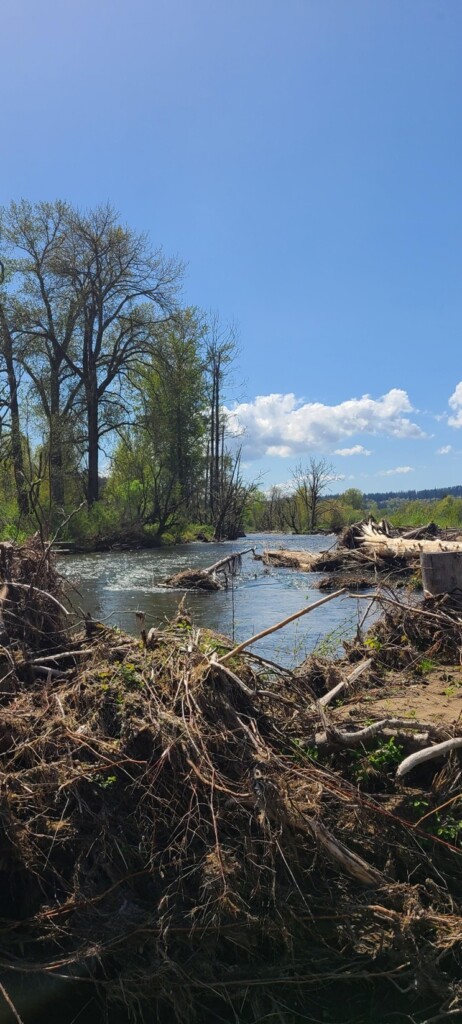
The Clover Creek watershed is constantly changing, just as much as we do. Places like the S Prairie Creek Restoration show both the damage the people can cause and the effort being made to help the creek recover. The fallen trees, exposed roots, and buildup of debris show how powerful water movement can reshape the landscape over time, leaving behind signs of both destruction and renewal. At the same time, the creek is still supporting plant life and creating habitat for many different species even after everything. There is something hopeful about seeing life continue to exist and adapt even in places that have been heavily disturbed over so many years. Areas like this are important because native plants and animals depend on healthy streambanks, flowing water, and natural habitat to survive. Native species such as willows, cottonwoods, salmonberry, and other riparian plants help hold the soil together, provide shade to cool the creek, and create shelter for life in and out of the stream. When streams are heavily disturbed by development, erosion, or pollution, non-native and more disturbance-tolerant species often become more common, changing the balance of the ecosystem. Plants like Himalayan blackberry and reed canary grass can spread quickly through damaged areas making it harder for native plants to grow back naturally. Standing near this part of the creek makes it easier to understand the damage humans have caused and continue to cause. Though we try to bring things back to once they were, the scars the land bears run much further than the skin. The health of the creek reflects the choices people make over time, but the efforts like this show that recovery is possible. When people choose to care for and think more about the life around them the environment becomes more than just a place but one of family.
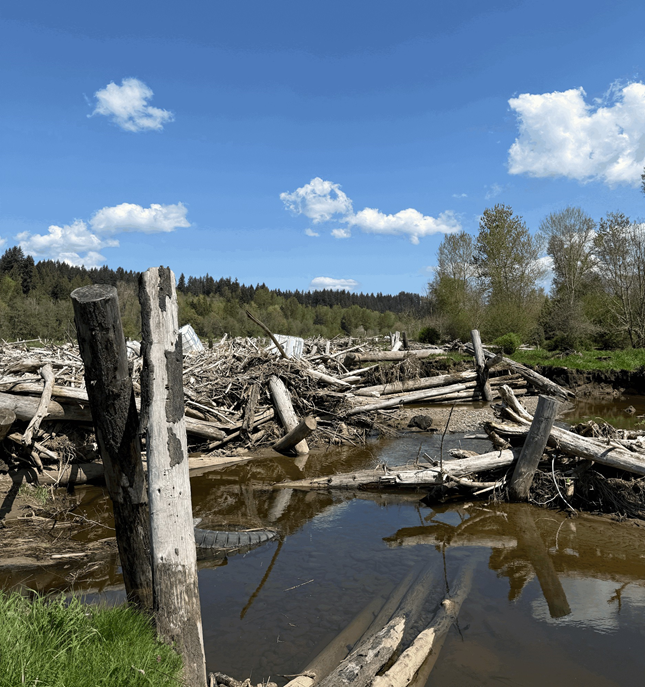
This photo was taken during our tour of the South Prairie Creek restoration site with Dr. Suzanne Crawford O’Brien. The image shows restoration work being done to help the creek return to a healthier and more natural condition. The large wood debris helps slow water flow, reduce erosion, and create better habitat for salmon and other living species in the watershed. Even though the creek still shows signs of damage and human impact, this restoration work shows that watershed health can improve over time when people care for and protect the land and water. This also connects to what we learned in Native American Studies about Coast Salish relationships with water and the importance of respecting and restoring the environment for future generations.
Current efforts are being made to restore different parts of the Clover Creek watershed. A local non-profit organization called the Clover Creek Restoration Alliance (CCRA) is actively involved in political action and hands-on restoration work for the creek. Partnering with other groups like the Chambers Clover Creek Watershed Council (CCWC) and local indigenous tribes, their restoration work is focused on reversing the damage done to the watershed over the years, restoring and protecting groundwater and habitats, and protecting the integrity of the creek. They are particularly interested in restoring salmon populations in the watershed. These projects come in many forms: fighting to stunt or halt the progress of projects harmful to the watershed, repairing or removing structures in the creeks and streams, removing invasive species, restoring riparian areas, and creating and fostering native gardens. They have a couple programs meant to educate and assist home owners and youth in restoration efforts and held their very first watershed festival in 2025 to bring awareness to watershed issues. With the help of groups like the CCRA, the Clover Creek Watershed’s habitats and waterways are projected to benefit from higher biodiversity and better water quality.
If you’re interested in helping the alliance’s efforts, you can volunteer or join their local events by visiting clovercreekra.com.
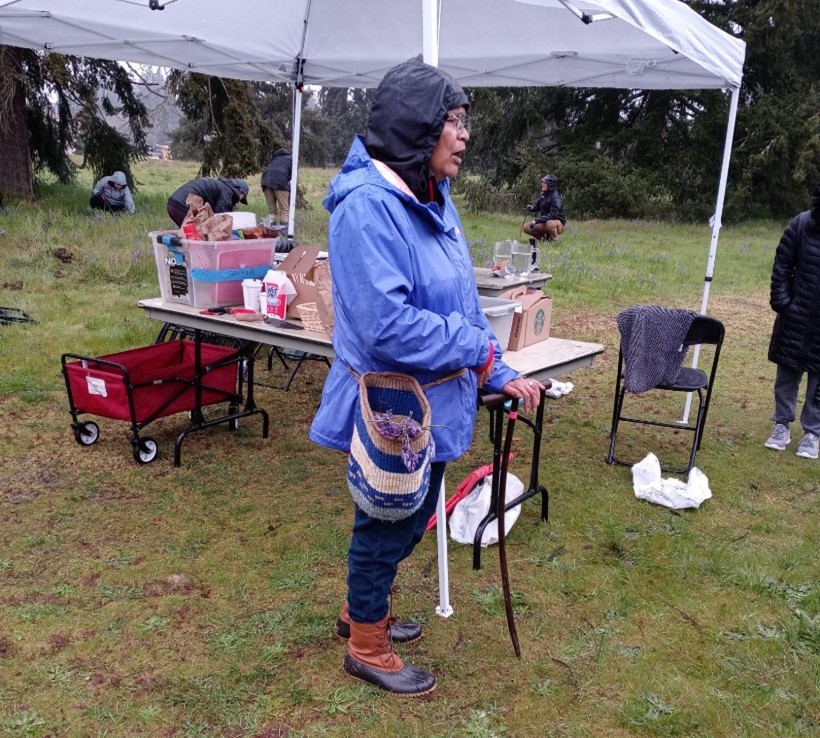
Restoration efforts don’t just help ecosystems recover. At PLU’s old golf course and Parkland Prairie Nature Preserve, camas restoration helps repair human relationships too. In addition to the planting of camas bulbs, restoration efforts have included partnership with the Puyallup tribe to renew camas harvests. Camas harvesting supports healthy populations by preventing the plants from becoming overcrowded. Camas is an iconic native wildflower of the Pacific Northwest meadow ecosystem and was a vital food for many native tribes for thousands of years. The camas harvests in Parkland support both a healthy plant population and cultural revitalization for the Puyallup, who use the camas in important ceremonies such as the First Salmon festival. These restoration efforts have provided an opportunity for Pierce County and PLU to meaningfully partner with and support the tribe, strengthening the relationships between these organizations. This project has improved the health of the watershed in many dimensions. Healthy, well-managed populations of camas increase biodiversity, native plant cover, and support native pollinators. The camas harvest is an example of a human-nature relationship that is mutually beneficial, strengthening beneficial human presence in the watershed and forging a more intimate connection between human residents and meadows at PLU and Parkland Prairie. Cooperation between PLU/Pierce County and the Puyallup tribe also benefits human to human relationships, creating cohesion that can make further restoration projects in the watershed easier to coordinate in addition to benefitting all human residents of the watershed.
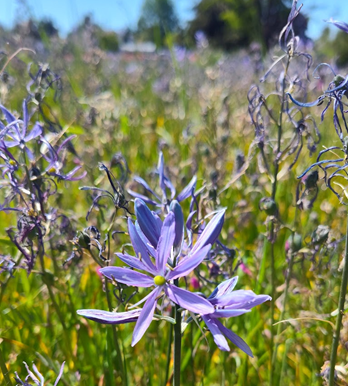
The Clover Creek Watershed is home to many Native people including the Nisqually, Puyallup, Steilacoom tribes. These tribes have incredibly reciprocal relationships with the watershed, and would consider themselves a part of it, rather than separate things. Part of this relationship includes the belief that truly everything has its own purpose and is seen as its own living being, with its own spirit. Partly due to this belief, Native people work hard to ensure the health of the watershed, and in turn, it has become incredibly important to their own health. One example of this is Camas, a purple-blue flower that is considered a Native First Food. These are foods that have always been staples in their diet and often have traditions relating to them. Many of these traditions help to ensure that the resources the watershed provides, including First Foods, will continue to be available in the future. A pivotal way that this is ensured, is through the ethic of only taking the resources that are needed when harvesting anything, which is something that many tribes throughout North America follow. This reciprocal relationship with the watershed encourages the health of both the watershed and the people, and it helps Native tribes feel more connected with each other, and with the land itself.
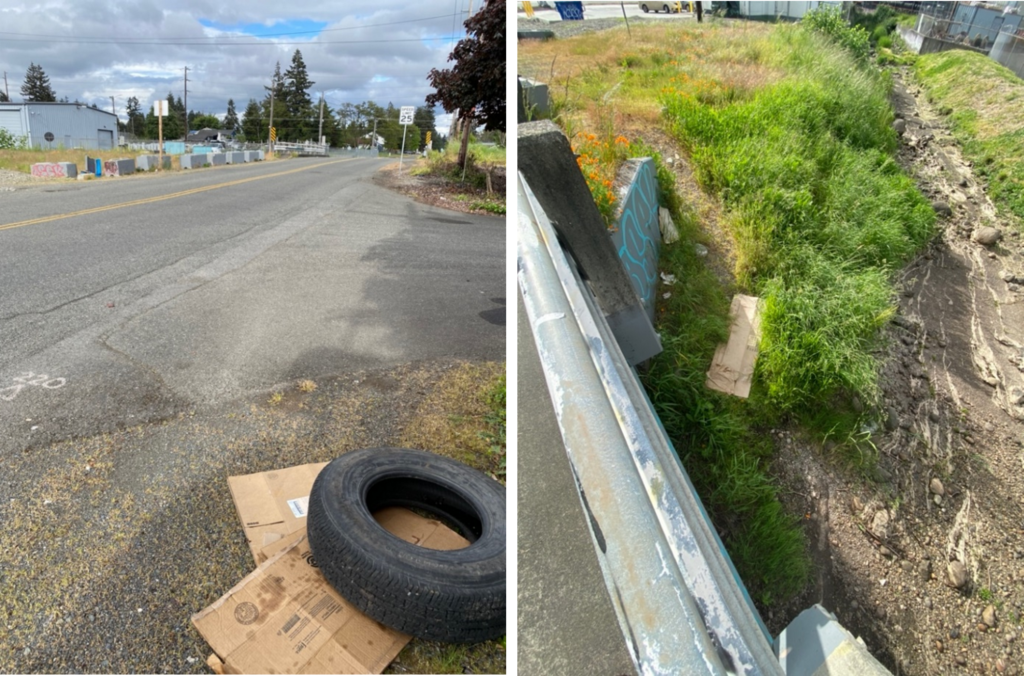
Trash and solid waste are a prevalent issue within the Clover Creek Watershed, particularly in Spanaway-Parkland where urban sprawl and human-made debris contributes significantly to the amount of litter in the watershed. Discarded plastics, metals, cardboard, and other such waste materials travel from urban streets to public waterways, in this case Clover Creek and its tributaries, including Morey Creek, and the North Fork of Clover Creek. Impacts on the watershed’s water quality, morphology, ecology, and habitat are induced by transported contaminants (fecal coliform, chemicals, fertilizer, etc.), drainage system clog, and degraded waste in the water. This form of pollution harms vital habitat: forming physical barriers that blocks both water flow and stream access, reducing riparian vegetation, altering streambed composition that is instrumental in salmon egg laying and incubation, and introducing toxic chemicals and fragments of waste that are either consumed by the fish or entangling them, resulting in death. In addition to posing a threat to the nonhuman side of the ecosystem, build-up of our garbage also holds risks for the human population within the watershed. The metals, microplastics, and chemicals, derived from litter, that finds its way into our streams puts people at risk both health wise and in economic terms: forming habitable environments for the growth and propagation of severely harmful biological hazards, and negatively affecting property values as well as the aesthetic and recreational value of urban green spaces, sometimes even preventing access. In order to mitigate the issue of trash, smaller scale counter measures such as community-wide cleanup, public outreach, and policy change on a local scale should focus on development of relationships and channels of communication between residents, landowners, agencies, and other stakeholders as well as putting into place program(s) that motivates interest and action to restore the watershed.
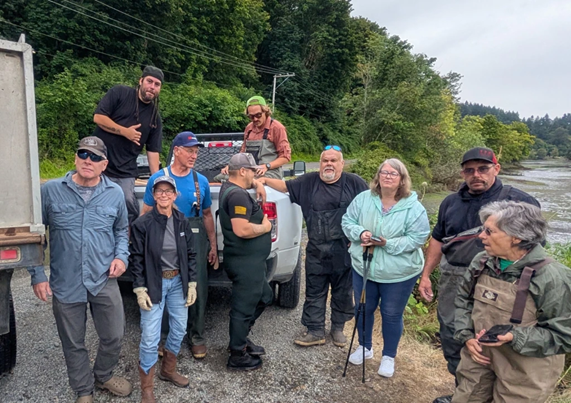
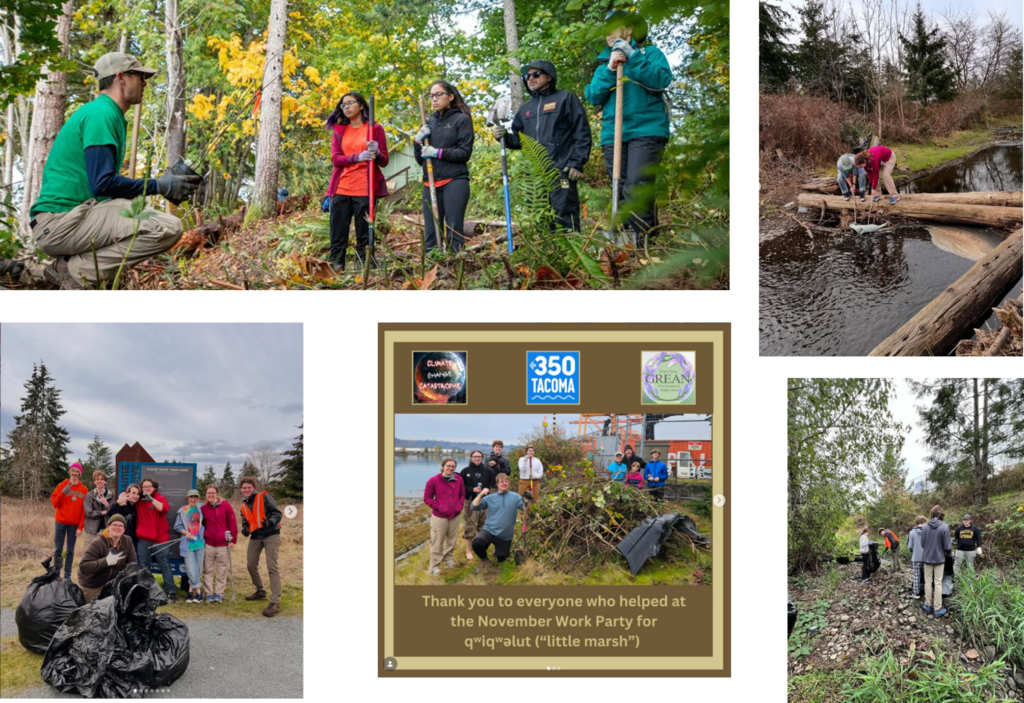
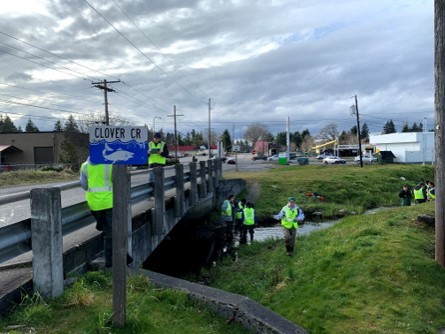
A crucial part of a healthy watershed is the interactions between the watershed and its residing communities. In the Clover Creek Watershed, there are many institutions that provide an opportunity for community members to participate in the maintenance and care of the watershed. For instance, the photos above showcase some of the work that the Pierce Conservation District and the PLU G.R.E.A.N Club encourages that promotes both the physical health of the watershed and building a relationship between the watershed and its people. These opportunities give volunteers the freedom to interact with each other and their watershed in ways that will let them build community, acknowledge the historical contexts that influence the watershed today, and educate themselves about the environment and their role in combating pollution. Promoting these community interactions to be both more visible and accessible will deepen the relationship between the people and their watershed in a way that will help improve, and sustain, the long-term health of the watershed.
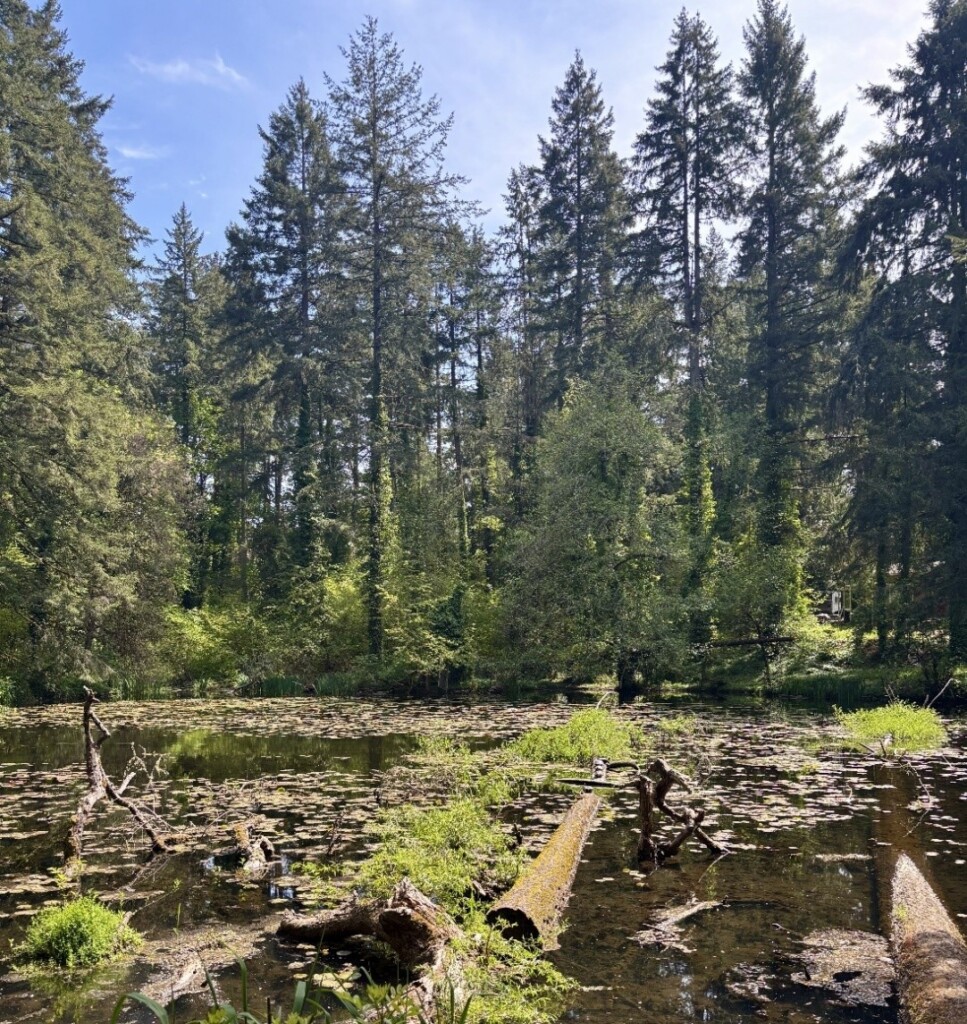
How do you photograph the absence of something? During our exploration of the watershed at various different locations, something I noticed was the lack of art. Elsewhere in the Tacoma area, you will find many art installations about water and our connection to it. At Point Ruston, a walking path along the beach is painted with murals of local marine animals. Around the Point Defiance marina, there are several murals painted by local students with the slogan “If it hits the ground, it hits the Sound”. Every April, the Snake Lake Nature Center collaborates with the public library to create a poetry walk around the lake in honor of Poetry Month. There’s plenty of literature uplifting the beauty of the Puget Sound, but you won’t find anybody waxing poetic about the section of Clover Creek running across the corner of 133rd and Pacific Avenue. During the English literature week of our investigation, we had to borrow works on other watersheds because ours doesn’t have any of its own. This picture is from a walk we took around Spanaway Lake after reading Theory of Water by Leanne Betasamosake Simpson, who writes about bodies of water near her home in Canada. It may seem silly to measure watershed health using art and literature, but it indicates community commitment. The presence of so much art about the Puget Sound shows that people care about it a lot, just as the absence of art around Clover Creek shows people are less interested in overall watershed health.
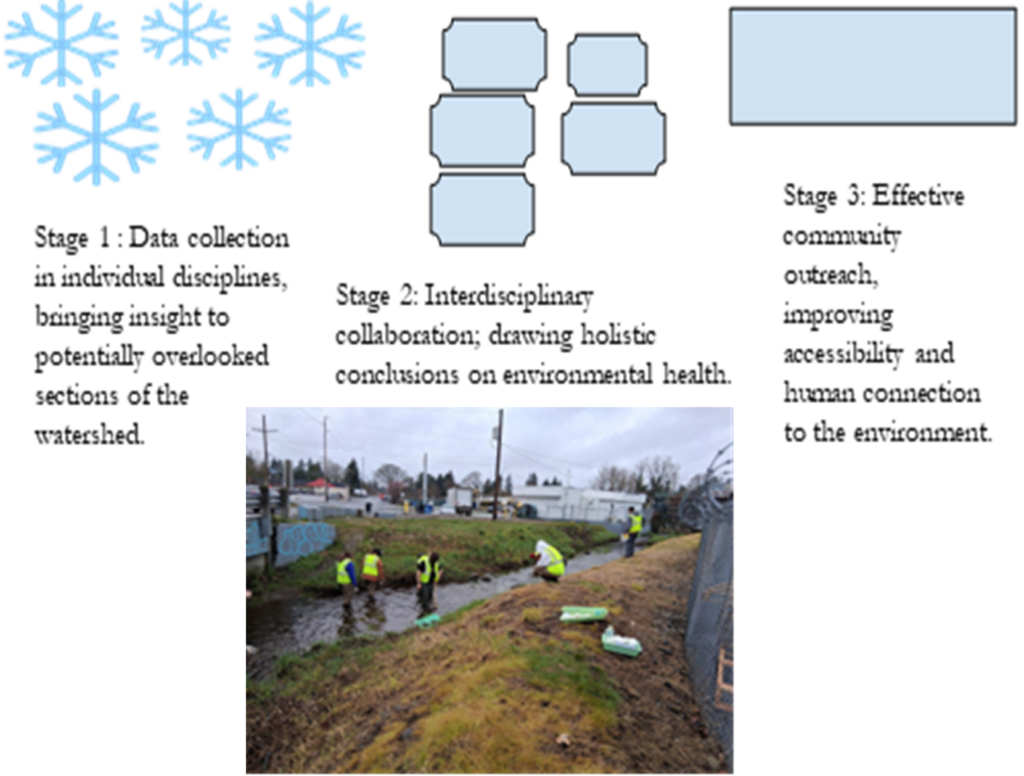
The intersection between environmental studies and literature is overlooked as an indicator of watershed health. Leanne Betasamosake Simpson offers the concept of sintering as a spiritual and literary framework to approach one’s relationship with the environment. In her book Theory of Water, she explains how sintering transforms individual snowflakes into a snowpack. Over time, snowflakes lose their jagged edges, creating higher surface area and allowing for strong intercrystal bonds. She operates within an indigenous methodology, viewing water itself as a teacher; “The snow is telling me that sintering is how Michi Saagiig Nishnaabeg make worlds, how we weave ourselves into the land without destroying it” (Simpson, 19). People can sinter just as snowflakes can by integrating themselves in their immediate environment in a way that cultivates mutual flourishing. Using an indigenous viewpoint, Betasamosake Simpson raises a literary theory that can be applied to the field of environmental studies. For instance, above is a photo of BMI sampling at 133rd St S. This heavily urbanized asphalt-lined section of the Clover Creek stream runs parallel to a tire shop. In 2026, this location exhibited relatively low biological health markers, possibly because heavy urbanization causes geomorphic changes to the stream. However, we can acknowledge that environmental field work at 133rd St could indicate the beginning of sintering. Community outreach can only occur if we raise awareness on the poor conditions of neglected areas of the CCW. Like the first snowflake in winter, future environmentalists must transcend boundaries between disciplines and encourage community connection to make meaningful change. Therefore, applying an indigenous literary theory, the CCW isn’t in good health just yet. However, the first edges of the snowflake are rounding.
Recommendations to encourage positive cultural attitudes toward watershed health:
- Adult and youth writers, artists, musicians, and film makers in residence to create literature and art focused on watershed
- Restoration programs for landowners
- Collaboration with indigenous groups and incentives for community education, youth summer camps, and volunteer programs to improve community-watershed interactions
- Improved pedestrian access to stream
- Improved media and social media outreach to young adults about watershed opportunities & issues
Compiled by: Nobi Altanzul, Lola Chargualaf, Hayden Crowe, Calvin Fisk, Taylor Justice, Corrine Larson, Randall Marti, Jamie McGrail, Noah Montgomery, Katrina Moran, Gabby Myers, Anna Norris, Ella Rose Raynolds, Jacob Swenson, Corbin Tercero, and Cassandra Vega
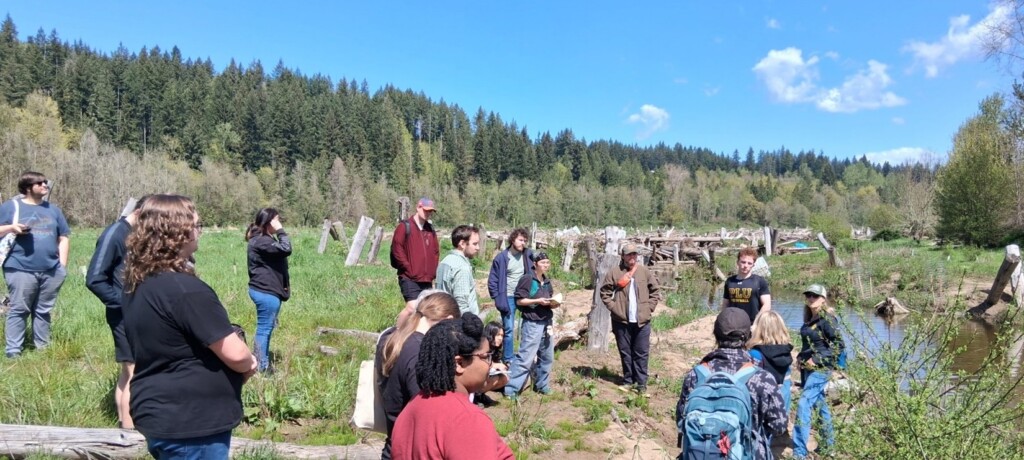
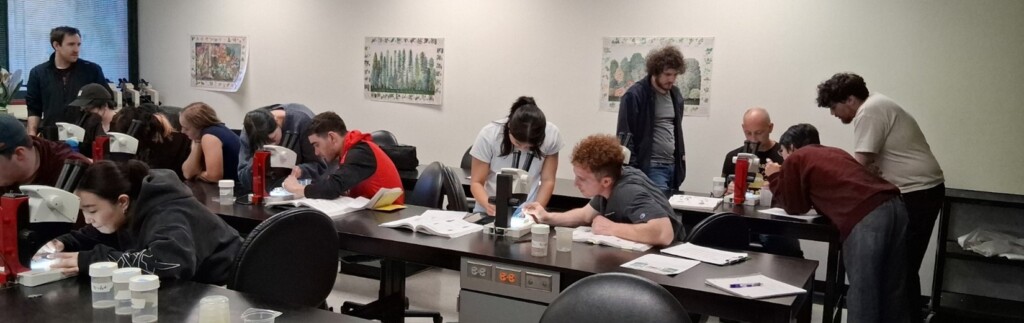
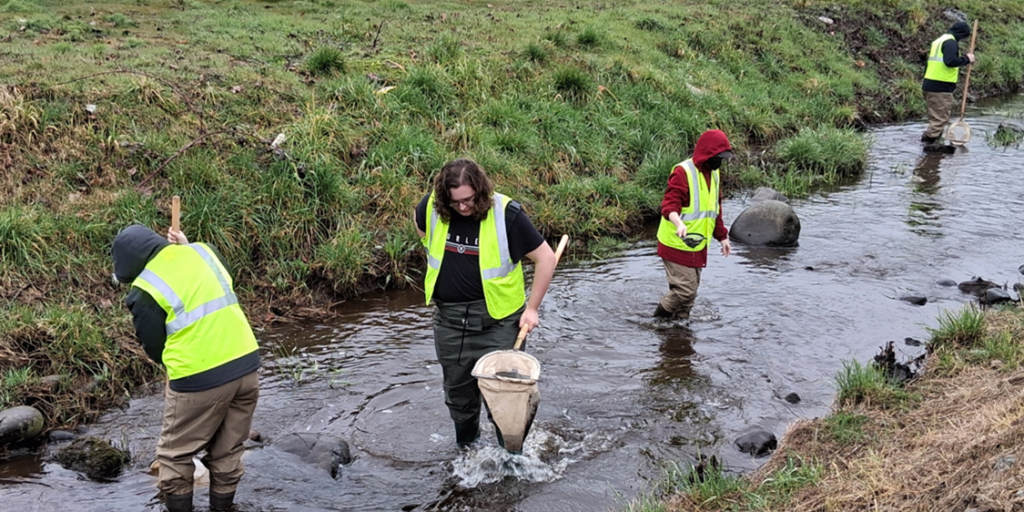
Spring 2021
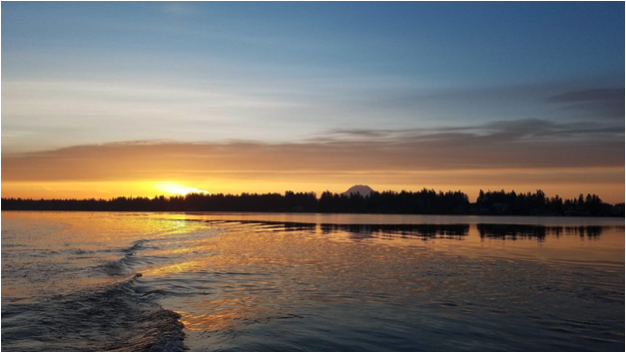
Dear residents of (and visitors to) the Chambers-Clover Creek Watershed,
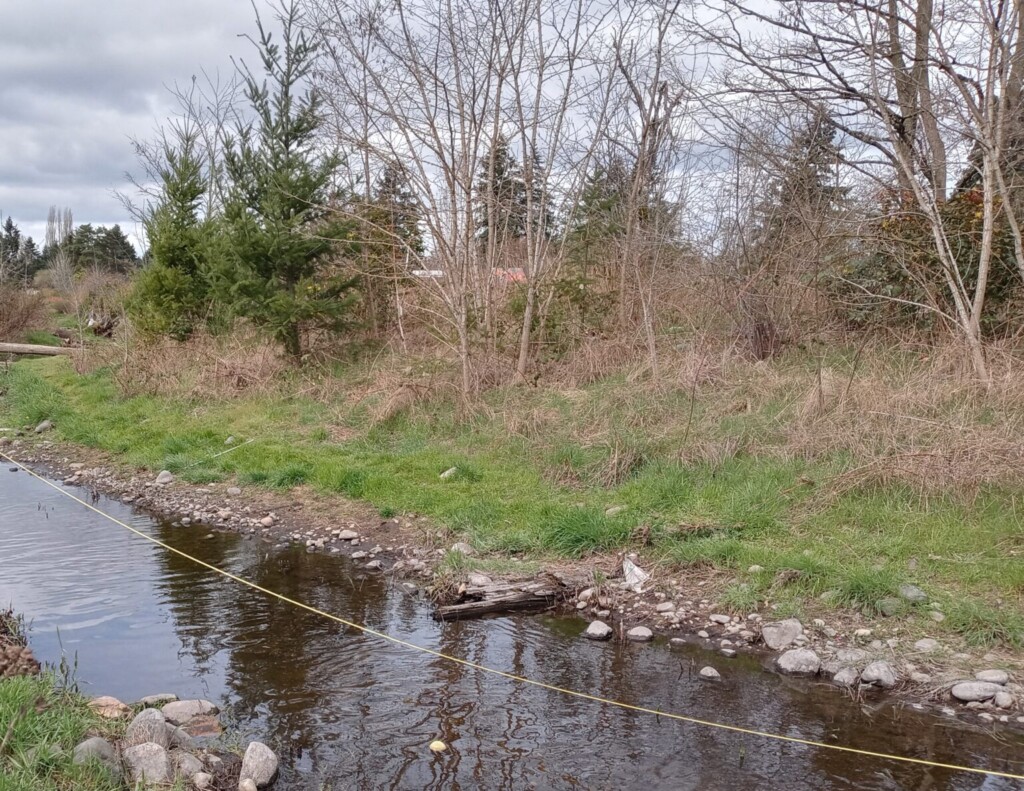
It’s easy to look at elements of this watershed and think that it’s not healthy. Looking at Clover Creek, especially at times when the flow is low, and seeing the litter around it and the debris left around, it certainly doesn’t look like the ideal, healthy stream, and reading about algae blooms in the lakes in the watershed, urbanization, and the complicated groundwater system makes it easy to see a troubled watershed. However, when investigated closely, the watershed isn’t actually that unhealthy. Certainly, these are all issues faced by the watershed, but the water itself is relatively healthy. The chemistry of the water is, generally, pretty good, including pH, phosphate, nitrates/nitrites, turbidity, and dissolved oxygen, and areas of Clover Creek that we investigated in our class had a variety of small organisms that can be used as indicators of water health which were able to survive. The watershed isn’t perfect, and there’s issues that need to continue to be addressed, but it’s better than it can seem, and not something to be entirely pessimistic about.
Best,
Allison Sheflo
Dear Residents and Landowners of Clover Creek Watershed,
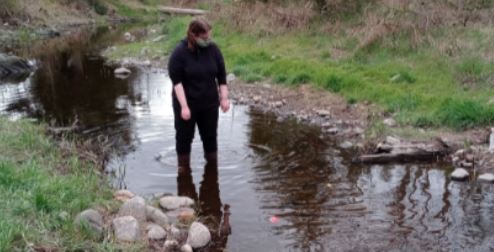
You can make a difference in the health of our watershed. I urge you to consider native plants as your first choice in landscaping your property. By doing so, you will be contributing to the larger effort to restore the watershed’s riparian areas. Restoration is key to building a healthy ecosystem for both the human and non-human residents of Clover Creek Watershed, the benefits of which are too numerous to count. Thank you for your contribution!
Best,
Bethany
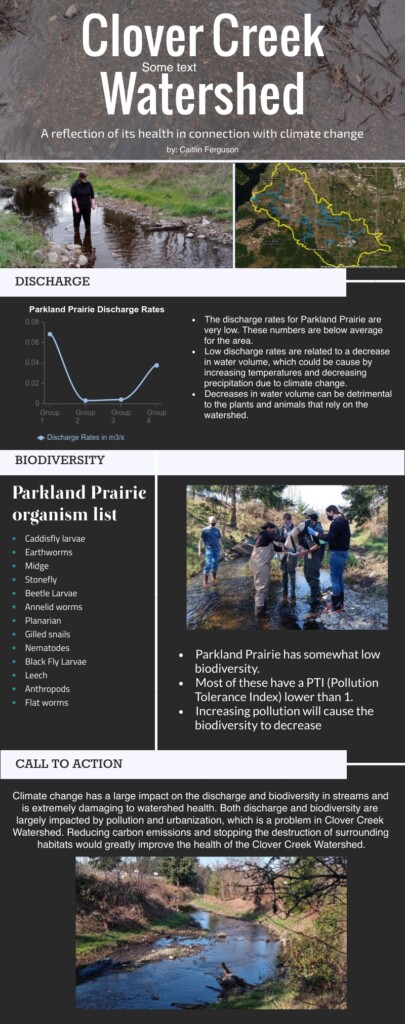
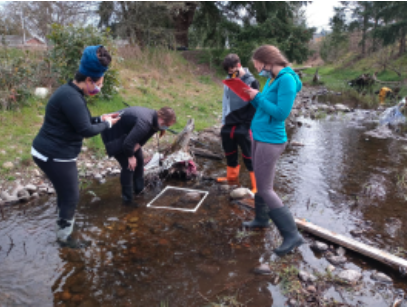
Dear Residents and Landowners of Clover Creek Watershed,
Everyone in the community has the power to make Clover Creek a healthier watershed. During our experience at Clover Creek, it has been impossible for anyone to ignore the overwhelming amount of trash in and around the stream. This pollutes the environment, resulting in an unhealthy habitat for all of the organisms within the ecosystem. As a community, we need to ensure that we are disposing of our trash properly, and genuinely caring for the environment. This includes recycling whenever possible, making sure trash can lids fit tightly, and never littering. Collectively doing our part will go a long way toward restoring and maintaining our local ecosystems.
Best,
Cooper
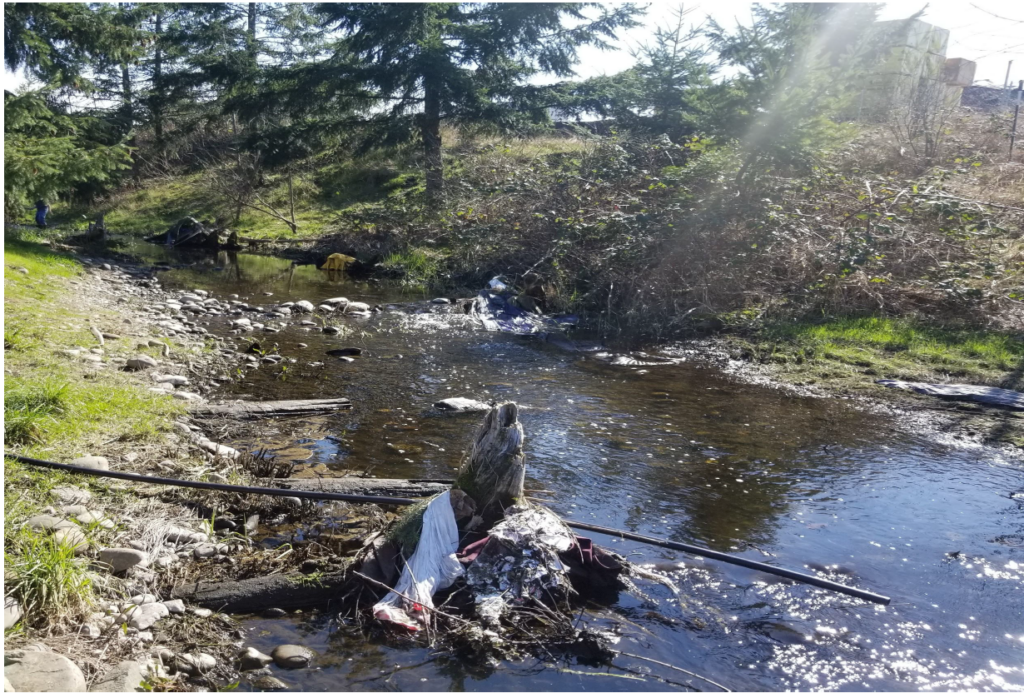
To the Chambers-Clover Creek watershed Residents,
The Chambers-Clover Creek watershed is a water system of lakes, creeks, and streams in your area. If you are a Parkland, WA resident, you live near a branch of the watershed. For example, Parkland Prairie is a stream located just a few minutes’ walk from Pacific Lutheran University. During my time there I saw the beautiful blue green ducks swimming in the water as I collected data. I also saw the area littered with waste. Such as the white material wrapped around the tree stump, or the tarp and countless other objects on the banks pictured here. Stream
health is an important part of the entire community’s health, to human and non-human residents alike. From the big green trees to the smallest mayfly larva or the rocks embedded in the substrate, each plays a role in stream health.
You can help take care of these ecosystems that serve the community. Take a positive, active role in stream health. It is as simple as going for a walk and taking out the trash. Please, go on a walk here, take a bag and some gardening gloves to pick up trash. See the beauty and the local plants among the trash laden vegetation.
– Dannie Vashchenko
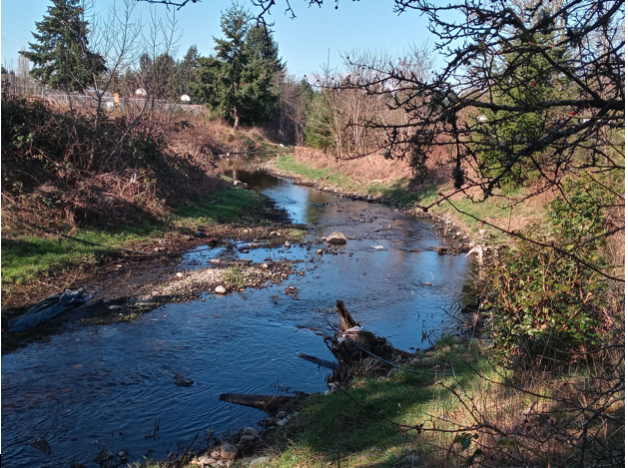
Dear Pierce County Council,
It is expected that as time goes on, the population within the Clover Creek Watershed will continue to increase, bringing not only more urbanization but more impervious surfaces and trash. Already within the watershed, in particular Parkland Prairie, there is a trash problem, with trash lining the edges and being present within the stream bed. I believe that a system should be employed to reduce this problem, such as planned weekly cleanups alongside water sources in the watershed, so that more trash can be removed to reduce the pollution that comes from it. In addition, impervious surfaces allow for toxic pollutants to get into the watershed and our water sources through runoff so I believe that in the future, Pierce County should try to incorporate more pervious surfaces as urbanized development continues. Should less pervious surfaces and more trash become present in this watershed, there will be greater observed impacts on water quality that could be detrimental and we must act before it is too late.
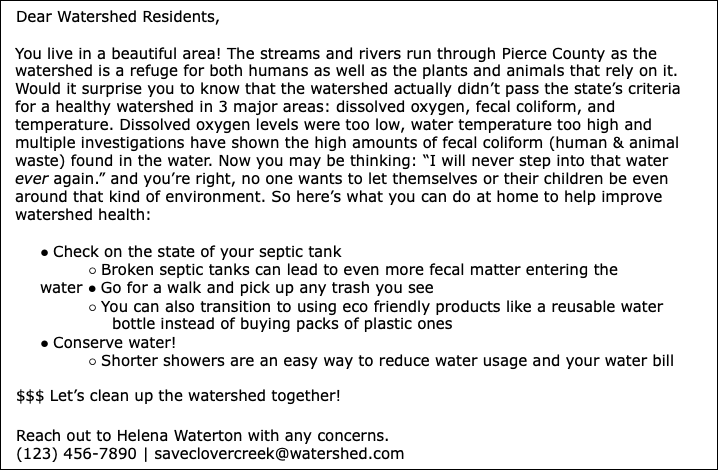
Dear fellow Chambers-Clover Creek Watershed residents,
Some of you may not know that you are living in the middle of a watershed that once supported a diverse population of plant and animal life. This watershed used to provide a space where salmon could spawn their eggs during the summer months, and bring new life into the world. Now, however, the water levels in the creek are drastically reduced. Salmon are now struggling to find a place to lay their eggs and, as such, their population is dropping. I am not telling you this to guilt you into finding a home for the salmon. I am telling you this because I want you to be aware of the state of our watershed. I want you to consider how our actions may have impacted the lives of other creatures that also call this place home. I hope that if we are able to do that, then we may be able to bring back what the salmon have lost, and restore our environment.
Sincerely,
Jonny Maier
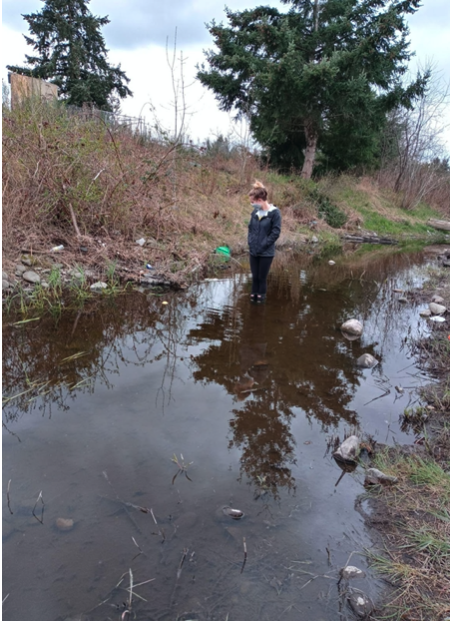
Dear Clover Creek Watershed residents,
Through my time as an ENVT 350 student at PLU, I conducted multiple experiments in this watershed. Each experiment I noticed more and more trash around me. Our local Parkland Prairie was developed as public park space and has slowly become a place for garbage to collect and it harms the biodiversity there. We, as residents, need to have more care for our local watershed. I’m asking visitors of Parkland Prairie to stop littering and show more respect for our park space. I’m also asking the Pierce County Council to allocate funds in their Garbage and Recycling and their Sustainability programs for better maintenance of this area; that maintenance should include waste management and more intentional restoration efforts of native plants and creek systems.
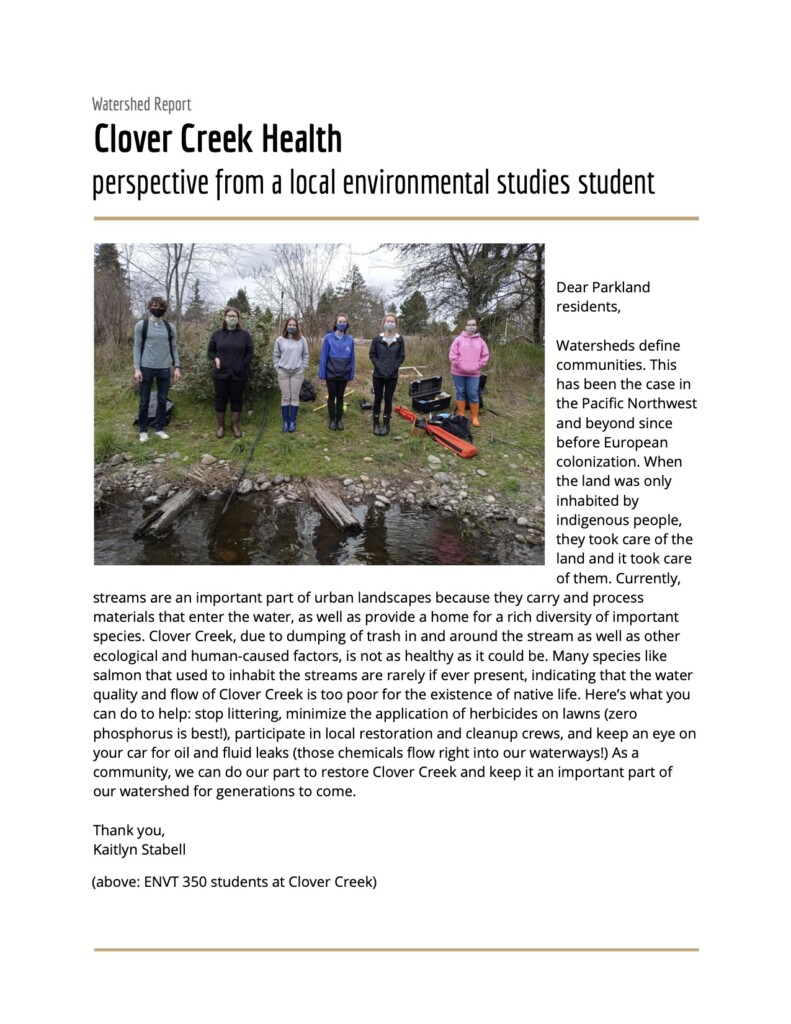
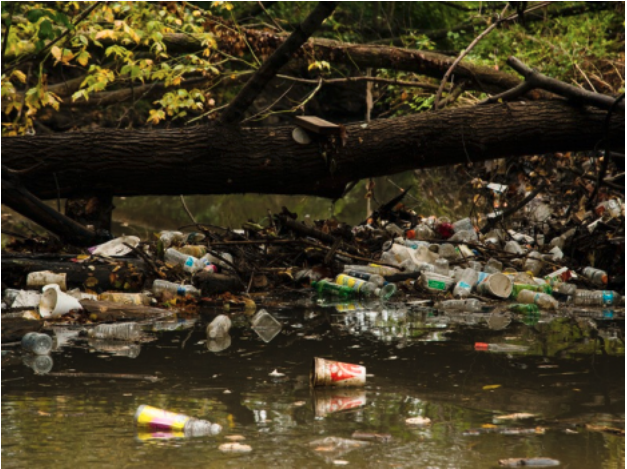
To the residents near and around the Clover Creek watershed,
As an Eastern Washington native, I am not well versed with the dilemmas present in this area, specifically those across Pierce county. However, over time, these lands started to become my second home due to my studies at Pacific Lutheran University and that was when these injustices became bright as day. It was not until this year that I witnessed and experienced these ecological injustices first hand at Parkland Prairie. My courses, ENVT 350 included, had us walk to the prairie and undergo experiments based on various aspects of the environment. The overall gist of all of these trips was to record and observe the living organisms that call this watershed home. It is clear to see that trash and pollution flows seamlessly throughout the watershed and while that may be discouraging, the water itself is not of terrible quality. Given that it is not ideal on the levels of pH and phosphate, just to name a few, it still provides a well rounded shelter and water source for countless organisms. I write this letter in the hopes that we all become more conscious in our food choices, discarded trash locations, and open mindedness of those we share this earth with. During the Anthropocene, we must not overpower and diminish the lives of other living organisms simply because we deem ourselves as superior. Careful consideration of our lifestyles or even going down to the watershed and picking up a handful of trash does not only improve the life for these aquatic creatures, but for those in the surrounding areas as well.
Your help is greatly appreciated,
Luis Reyes
Dear Residents of Clover Creek Watershed,
It is becoming increasingly evident that pollution is infesting the watershed that our community cares for. Pollution not only affects the wildlife populations that inhabit in and around the watershed but also the overall stream health. If Pierce County residents could start picking up human trash they find and could put in place more volunteer clean up organizations we could restore the watershed to its original beauty and liveliness.
-Mary Lynn McLeod
Dear Pierce County,
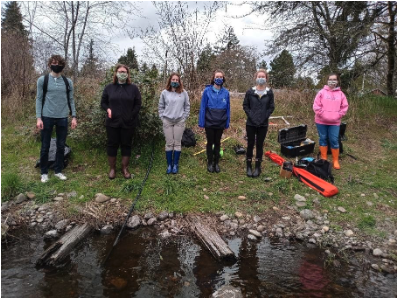
Over the last semester in my Environmental Studies 350 course at PLU, I began to truly appreciate the importance and impact of community. In a time of social distancing and virtual classes, the class’ rare physical sessions were a literal and metaphorical breath of fresh air. As we conducted our data collections at the Parkland Prairie, I could not stop thinking about the negative impact that our communities have had on other communities, both human and nonhuman. PLU sits on the traditional lands of the Nisqually, Puyallup, Squaxin Island, and Steilacoom peoples, and while Indigenous tribes are all different from one another, many share similar concepts of balance and reciprocity with the Earth. Because of this, harm to the watershed directly impacts the Indigenous peoples who still live here. They live in community with the Earth, and this is an important balance from which I think we all can learn a beneficial lesson. The Euro-American ideology has silenced Indigenous voices for far too long, and it is our responsibility to center Indigenous voices in conversations about environmental justice and protection. Thus, as a community we share a duty to come together, respect our Indigenous neighbors, and listen to them as they tell and show us how use the concepts of balance and reciprocity to care for the watershed and for the Earth. Once we begin to listen, we will learn how we can operate as beneficial members of the local watersheds and improve the health and safety of both human and nonhuman communities.
In community,
Ryan Shane
Dear Clover Creek Residents,
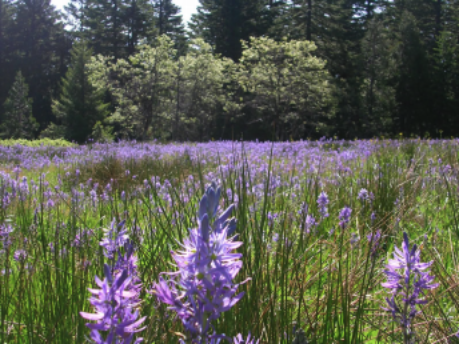
Pollution is an issue on many people’s minds right now, and it can seem like a big problem. It is easy to lose sight of how an individual can make a difference; however, it is possible for you to make a difference right here in the watershed. When it rains, runoff is produced. Runoff picks up chemicals from cars, lawns, and more along the way, then takes those chemicals directly into the waterway. This is because paved surfaces and lawns are impermeable surfaces, so rainwater can not get to the soil and be filtered that way. One way to help prevent runoff is to replace your lawn with native plants. The water will be able to go down into the soil, which helps prevent it from having to travel across the surface and decreases the amount of chemicals it can pick up and carry with it. Plus, the native plants can offer a nice pop of color.
Thank you,
Rosey Ireson
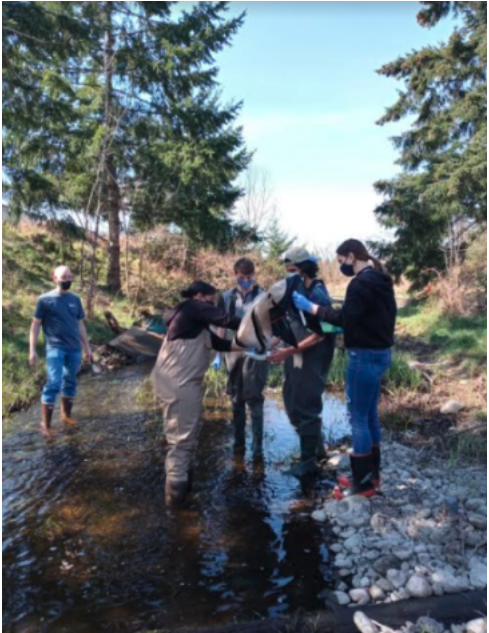
To Nearby Clover Creek Residents,
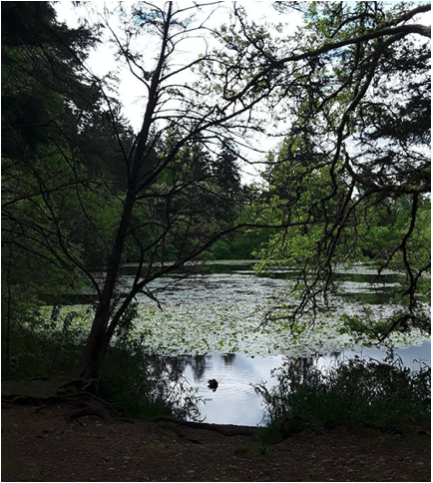
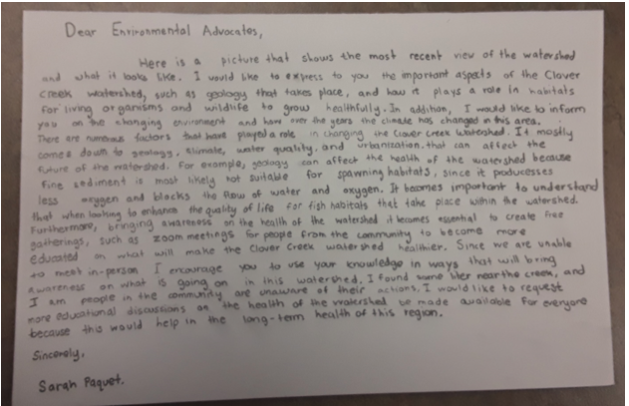
It is with great care and concern that I write to you and others interested in the health of the Clover Creek watershed. As an Environmental Studies major, I can confidently say that I found my vocation through the variety of courses that I have taken at Pacific Lutheran University. Captivated by nature’s indisputable beauty, a pivotal moment in my academic career was through the honorary privilege to extensively learn about the complex watershed that we unconsciously neglect. Although everyone does not have the opportunity to observe the watershed with the lens my peers and I did, this should not be a barrier to one’s awareness of what is in your backyard. Without a doubt, my first interaction with the watershed is one that has reminded me of the importance of considering the natural world as a privilege rather than a right. The message I would like to leave you with, is to consciously live in harmony with the watershed. Nature was once natural. Nature was once respected. Nature was once protected. As stewards of Earth, we must work to make these statements true once again.
Best,
Shalom
Dear Pierce County,
The management of invasive species is a key component when developing restoration sites in an attempt as a means to re-establish the native plant species. From our work in my Environmental 350 course at PLU, we discovered that herbicides are heavily used to diminish the invasive plant population. They are efficient and cost effective. However, the application of herbicides have unintentional environmental risks: they are toxic to applicators and they contribute to surface water pollution and bioaccumulation through exposure or consumption. For these reasons, I am requesting that for future restoration sites in the Chambers-Clover Creek watershed, the application of herbicides be avoided.
Thank you,
Sophia McDonald
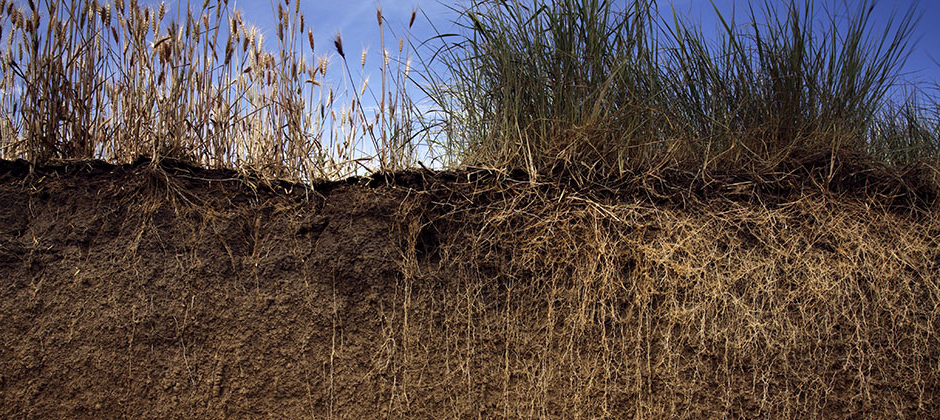
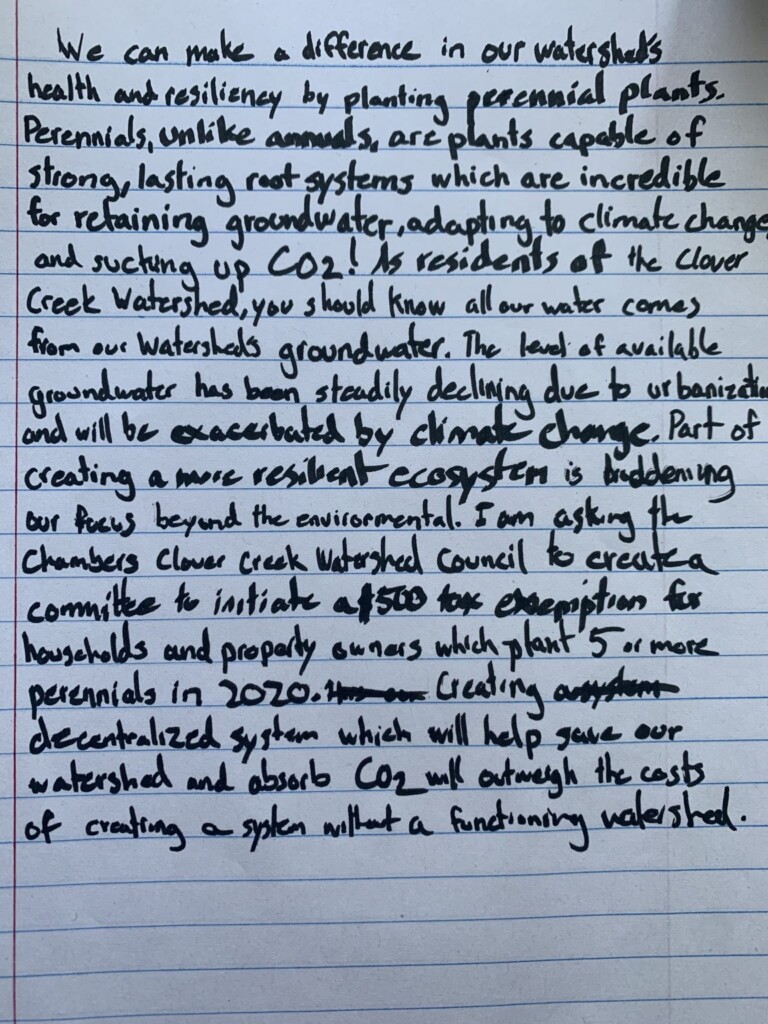
You can make a difference in our watershed’s health and resiliency by planting perennial plants. Perennials, unlike annuals, are plants capable of strong, lasting root systems which are incredible for retaining groundwater, adapting to climate change, and sucking up Co2! As residents of the Clover Creek Watershed, you should know all of our water comes from the Watershed’s groundwater. The levels of the groundwater have been steadily declining due to increased urbanization and will be exacerbated by climate change. Part of creating a more resilient ecosystem is focusing on more than the environmental. I am asking for the Chambers Clover Creek Watershed council to form a committee to create a tax exemption of $500 for property owners of the Clover Creek Watershed who plant 5 perennial plants. The costs of creating a decentralized system which saves our groundwater and absorbs C02 will outweigh an ecosystem without a healthy watershed.
Thanks,
Jack
Dear Pierce County Surface Water Management Division,
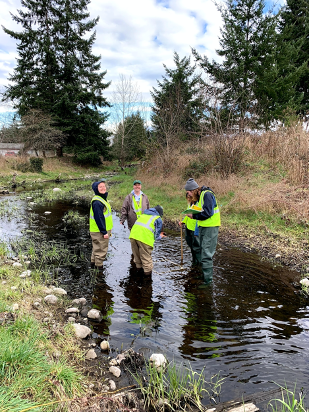
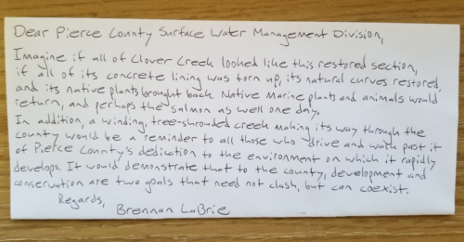
Imagine if all of Clover Creek looked like this restored area, if all its concrete lining was torn up, its natural curves restored, and its native plants brought back. Native marine plants and wildlife would come back, and perhaps the salmon too one day. In addition, a winding, tree-shrouded creek making its way through the county, would be a reminder to all those that drive and walk past it of Pierce County’s dedication to the environment on which it rapidly develops. It would demonstrate that to the county, development and conservation are two goals that need not clash, but coexist.
Regards,
Brennan LaBrie
Hello Clover-Creek residents,
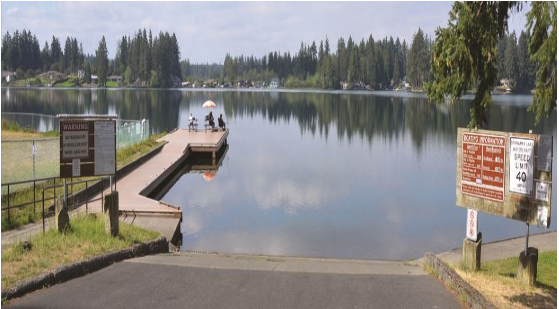
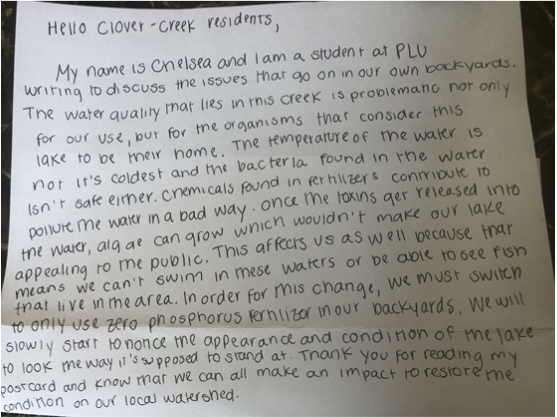
My name is Chelsea and I am a student at PLU writing to discuss the issues that go on in our own backyards. The water quality that lies in this creek is problematic not only for our use, but for the organisms that consider this lake to be their home. The temperature of the water is not it’s coldest and the bacteria found in the water isn’t safe either. Chemicals found in fertilizers contribute to pollute the water in a bad way. Once the toxins get released into the water, algae can grow which wouldn’t make our lake look appealing to the public. This affects us as well because that means we can’t swim in these waters or be able to see fish that live in the area. In order for this to change, we must switch to only use zero phosphorus fertilizer in our backyards. We will slowly start to notice the appearance and condition of the lake to look the way it’s supposed to stand at. Thank you for reading my postcard and know that we can all make an impact to restore the condition on our local watershed.
Dear Pierce County,
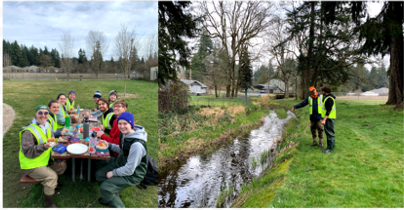
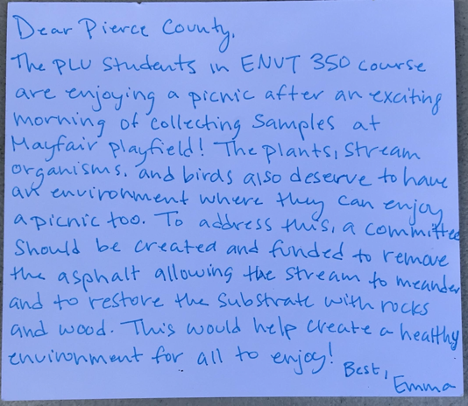
The PLU students in ENVT 350 course are enjoying a picnic after an exciting afternoon of collecting samples at Mayfair Playfield! The plants, stream organisms, and birds also deserve to have an environment where they can enjoy a picnic too. To address this, a committee should be created and funded to remove the asphalt allowing the stream to meander and to restore the substrate with rocks and wood. This would help create a healthy environment for all to enjoy!
Best,
Emma Mickelson
Dear Pierce County,
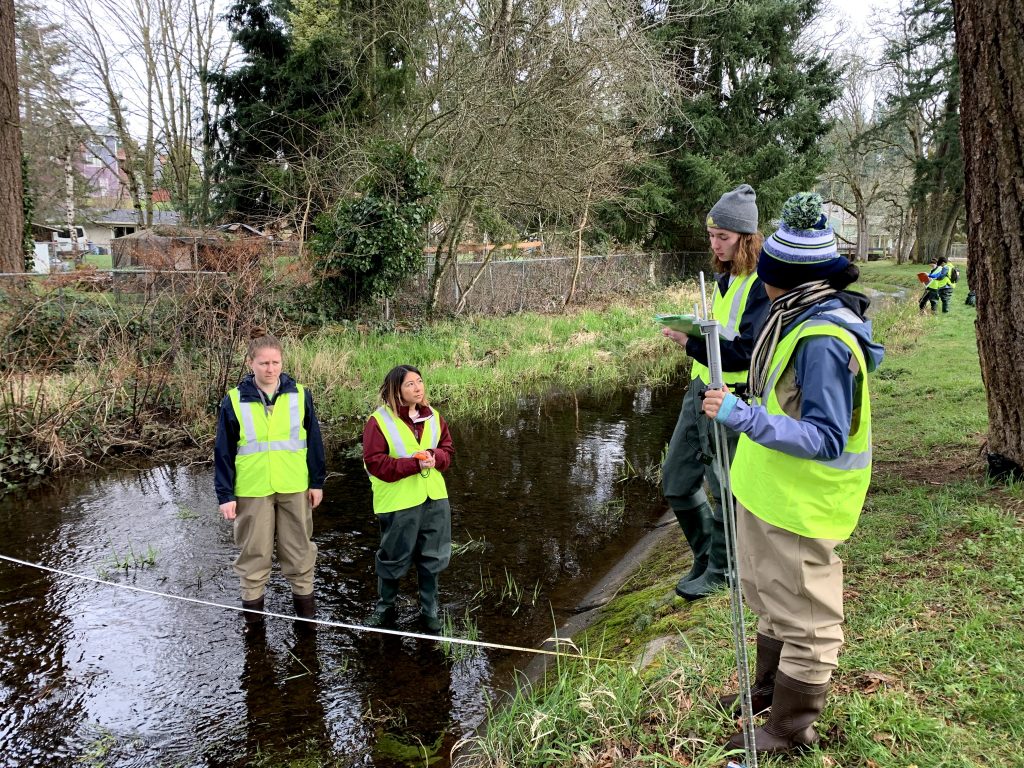
The county should remove channelization and pavement on the bottom of creeks in the Chambers-Clover Creek Watershed. These modifications were designed to prevent flooding, but they have many adverse effects. Although it would be a substantial financial investment, it would be a benefit to the watershed and local ecosystems. A stream’s curves provide refuge for wildlife, allowing salmon to potentially return. Pavement on the bottom of streams removes drainage processes, and affects wildlife as well. Restoring this watershed would benefit ecosystems and the community who will be here for years to come.
Thank you,
Nathan Buegler
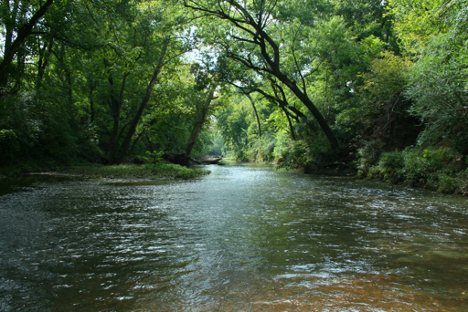
Restoring riparian zones is essential to the health of urban streams. A healthy riparian zone can help reduce in-stream temperature, provide nutrients and energy, and naturally filter water runoff and pollutants. Although funding salmon restoration programs can provide species-specific care, restoration supporting riparian zones supports local ecosystems and provides habitats for both salmonids and other aquatic organisms. Through small changes like the removal of invasive plant species or creating riparian vegetation planting committees we can see large improvements in water quality, therefore, the health of riparian vegetation should be highly prioritized when considering restoration of the watershed.
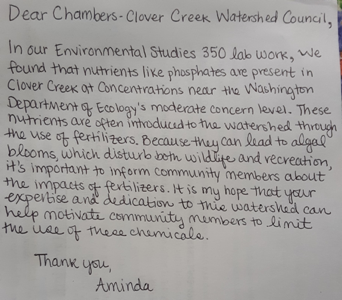
Dear Chambers-Clover Creek Watershed Council,
In our Environmental Studies 350 lab work, we found that nutrients like phosphates are present in Clover Creek at concentrations near the Washington Department of Ecology’s moderate concern level. These nutrients are often introduced to the watershed through the use of fertilizers. Because they can lead to algal blooms, which disturb both wildlife and recreation, it’s important to inform community members about the impacts of fertilizers. It is my hope that your expertise and dedication to this watershed can help motivate community members to limit the use of these chemicals.
Thank you,
Aminda
Dear Chambers-Clover Creek Watershed Council Members,
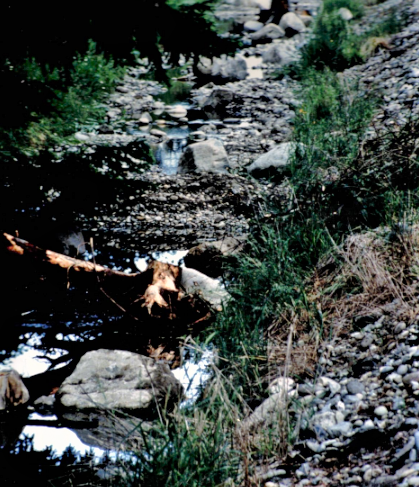
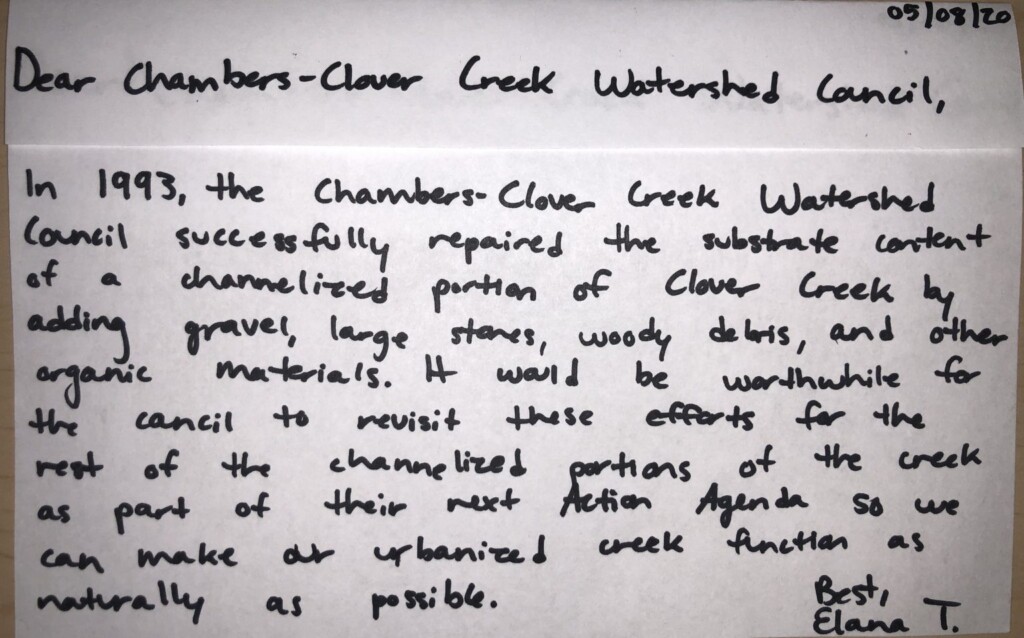
In 1993, the Chambers-Clover Creek Watershed Council successfully repaired the substrate content of a channelized portion of Clover Creek by adding gravel, large stones, woody debris and other organic materials. It would be worthwhile for the council to revisit these efforts for the rest of the channelized portions of the creek as part of their next Action Agenda so we can make our urbanized creek function as naturally as possible.
Best,
Elana
Dear Franklin Pierce School District,
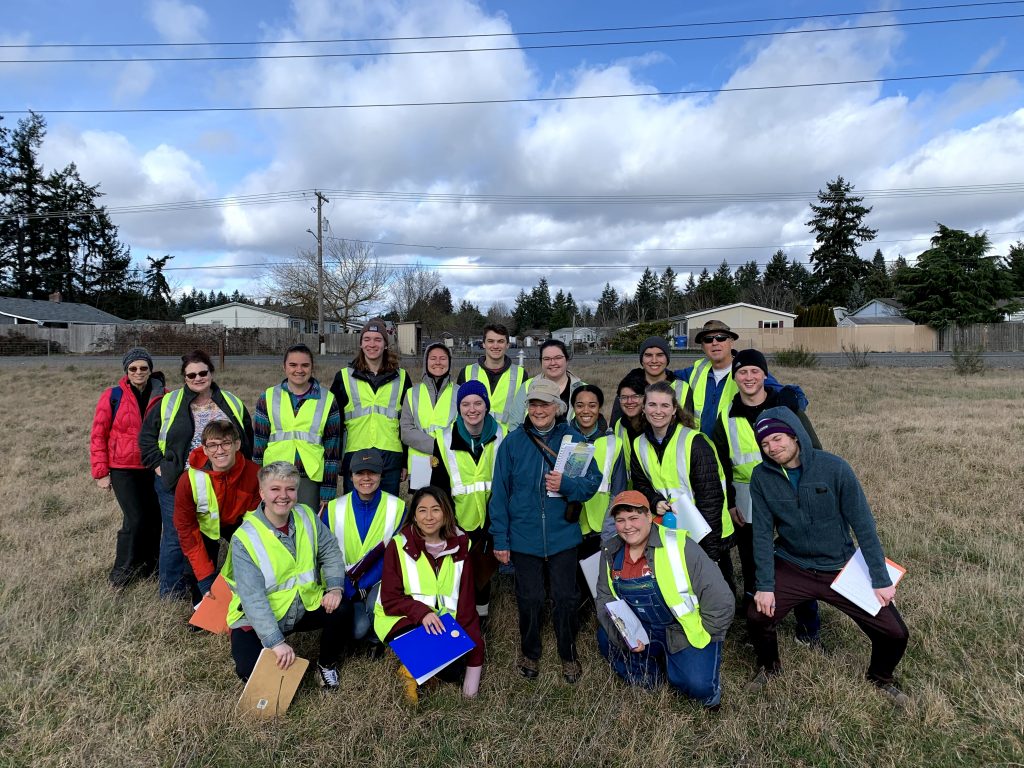
PLU’s Environmental Methods course focuses on the significance of Chambers-Clover Creek Watershed in our community. We would love to share some of that information with local high school students to promote awareness of the environment around us. Environmental education is becoming increasingly important as Climate Change becomes a hot topic in political discussions. The opportunity for high school and college students to converse about their local watershed and more broadly, environmental issues, would be a great learning experience for everyone involved.
Sincerely,
Grayson Peet
Hello Pierce County Homeowners!
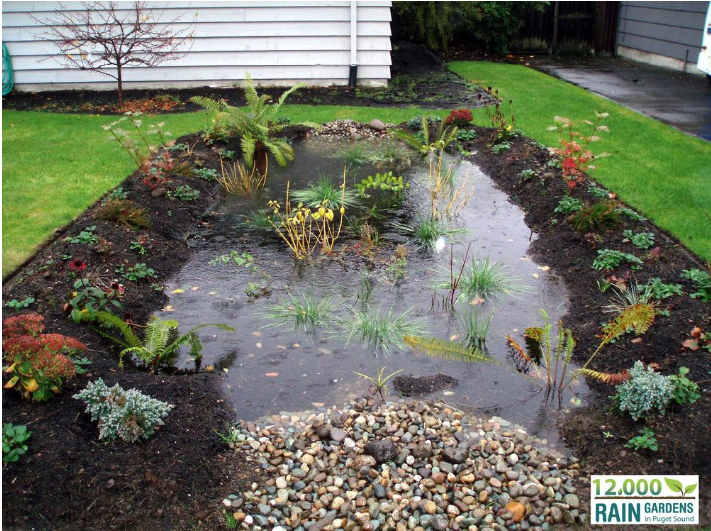
The Chambers-Clover Creek Watershed that we live in is in danger. Salmon are dying and streams aren’t healthy enough to support the life that thrives there. In order to help our watershed, we need to build rain gardens. Rain gardens collect rainwater and filter it through plants and soil into the groundwater. This provides healthier and more abundant water sources for organisms. This is your opportunity to have a positive impact on the watershed we all depend on.
Thanks for your help!
Ayana Freeman
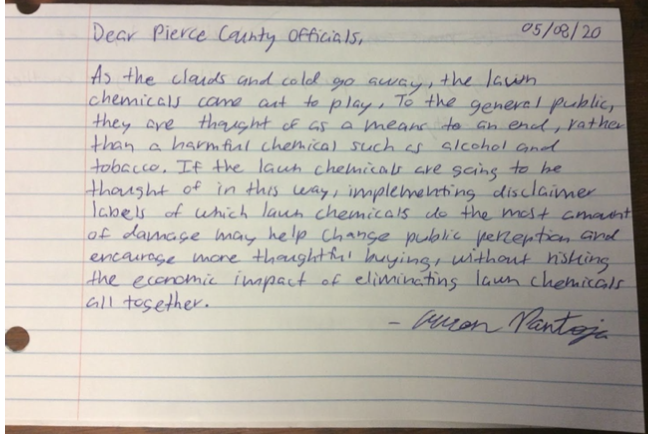
Dear Pierce County Officials,
As the clouds and cold go away, the lawn chemicals come out to play. To the general public, they are thought of as a means to an end, rather than a harmful chemical such as alcohol and tobacco. If the lawn chemicals are going to be thought of in this way, implementing disclaimer labels of which lawn chemicals do the most amount of damage may help change public perception and encourage more thoughtful buying, without risking the economic impact of eliminating lawn chemicals all together.
-Aaron Pantoja
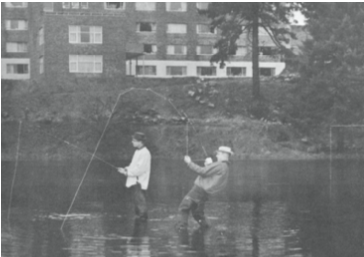
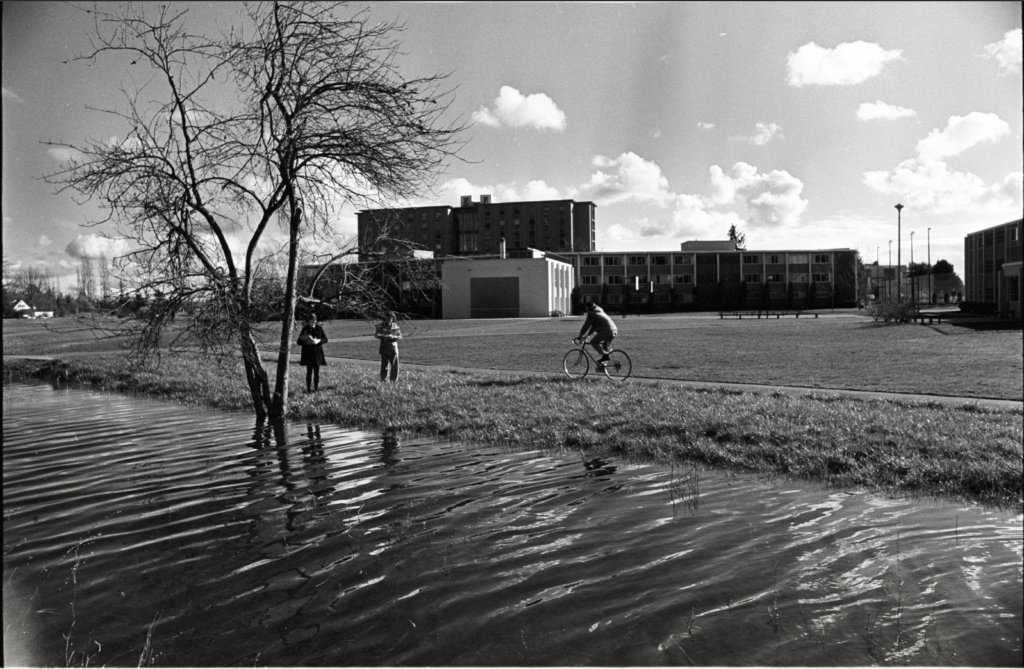
Action is needed to bring this beautiful part of campus back to life. 53 years ago PLU students were able to fish right on the underside of Hinderle hall until the creek got rerouted in 1967. The PLU Sustainability Committee needs to take part in funding the rerouting of the creek. This is to ensure future generations get to experience this part of campus life as well as bring back the many diverse ecosystems once inhabiting the area.
-Tanner Hendricks
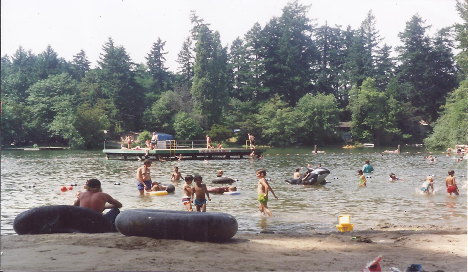
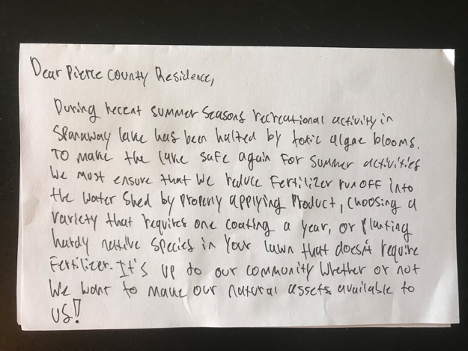
Dear Pierce County Residence,
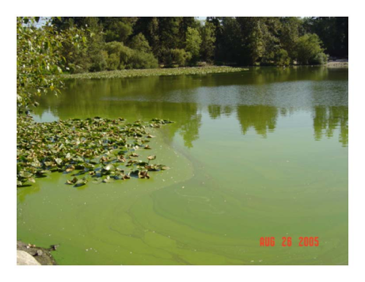
During recent Summer seasons recreational activity in Spanaway lake has been halted by toxic algae blooms. To make the lake safe again for summer activities we must ensure that we reduce fertilizer runoff into the watershed by properly applying product, choosing a variety that requires one coating a year, or planting hardy native species in your lawn that don’t require fertilizer. It’s up to our community whether or not we want to make our natural assets available to us!
Dear Dr. Ramos,
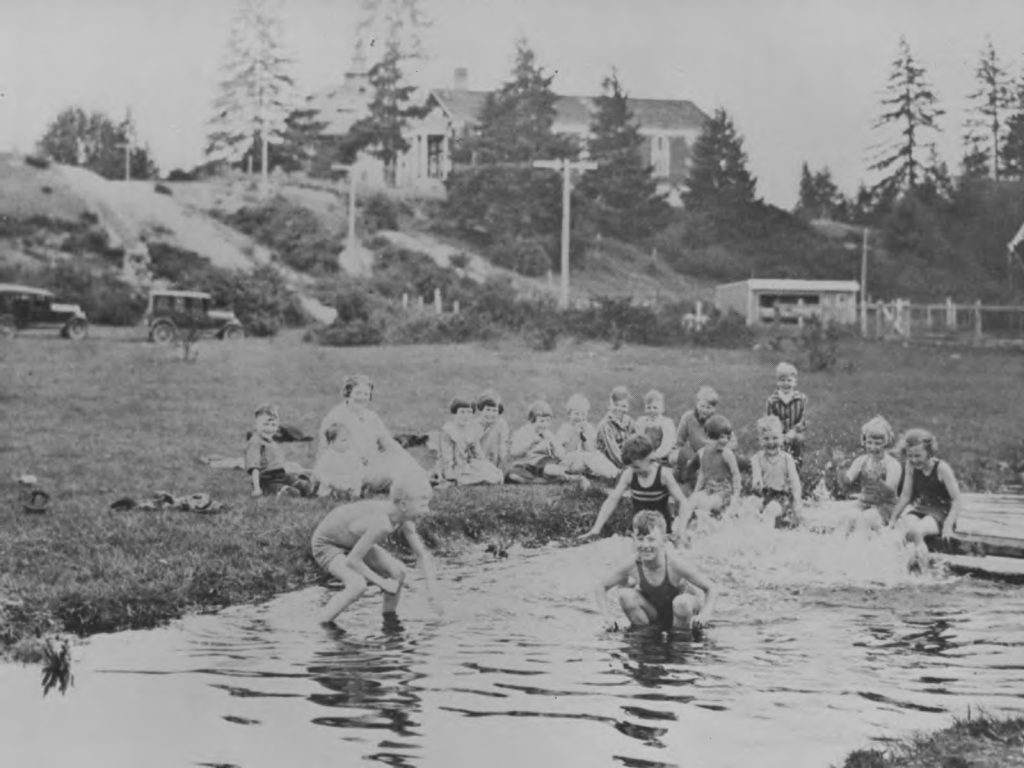
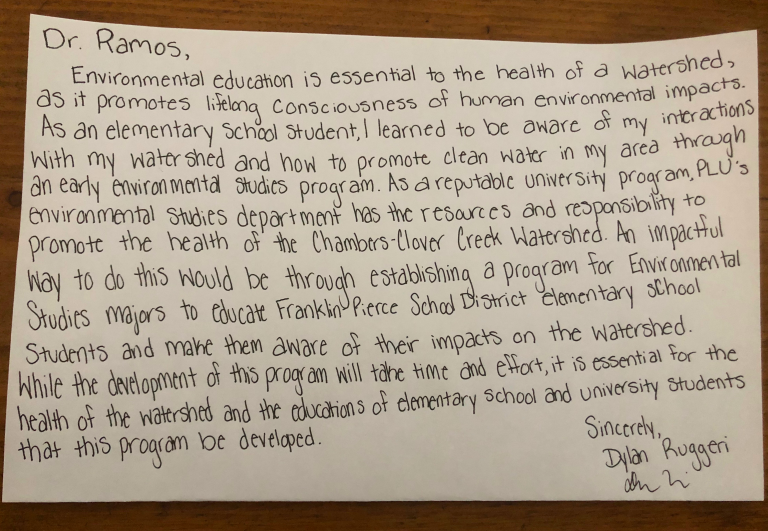
Environmental education is essential to the health of a watershed, as it promotes lifelong consciousness of human environmental impacts. As an elementary school student, I learned to be aware of my interactions with my watershed and how to promote clean water in my area through an early environmental studies program. As a reputable university program, PLU’s environmental studies department has the resources and responsibility to promote the health of the Chambers-Clover Creek Watershed. An impactful way to do this would be through establishing a program for Environmental Studies majors to educate Franklin-Pierce School District elementary school students and make them aware of their impacts on the watershed. While the development of this program will take some time and effort, it is essential for the health of the watershed and the education of elementary school and university students that we develop this program.
Sincerely,
Dylan Ruggeri
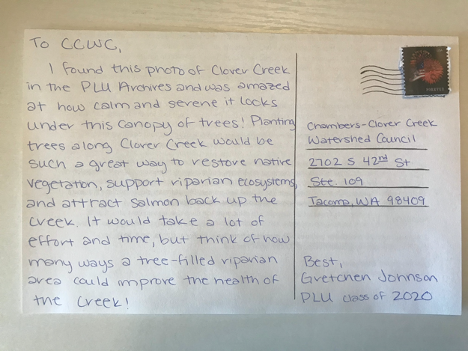
To CCWC:
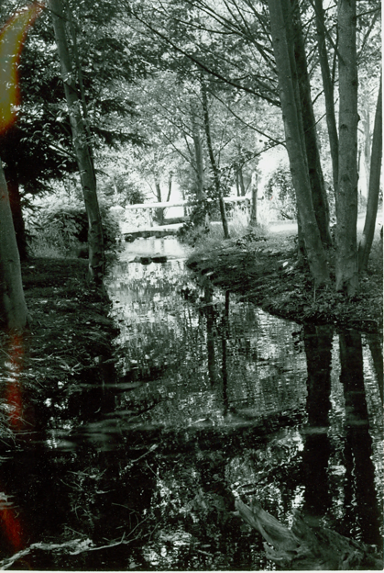
I found this photo of Clover Creek in the PLU Archives and was amazed at how calm and serene it looks under this canopy of trees! Planting trees along Clover Creek would be such a great way to restore native vegetation, support riparian ecosystems, and attract salmon back up the creek. It would take a lot of time and effort, but think of how many ways a tree-filled riparian area could improve the health of the creek!
Best,
Gretchen Johnson
Dear Faculty Colleagues,
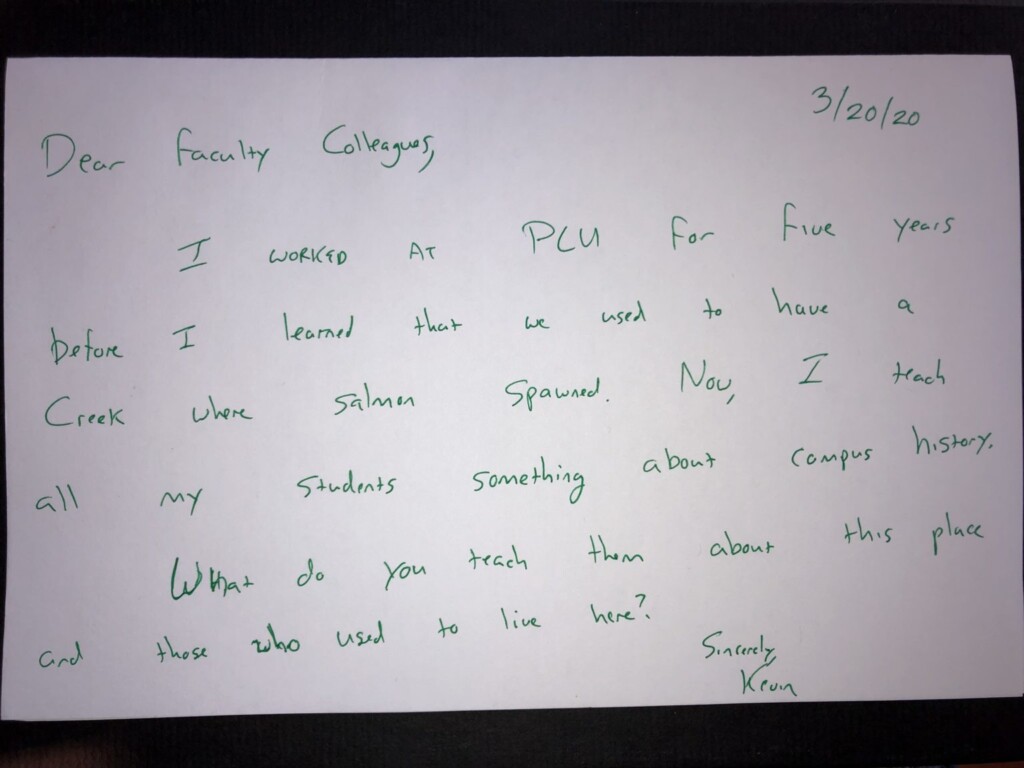
I worked at PLU for five years before I knew we used to have a creek where salmon spawned. Now, I teach all my students something about the history of our campus. What do you teach them about this place and those who used to live here?
Sincerely,
Kevin