


PLU student research recognized with multiple awards at 2025 Murdock Conference
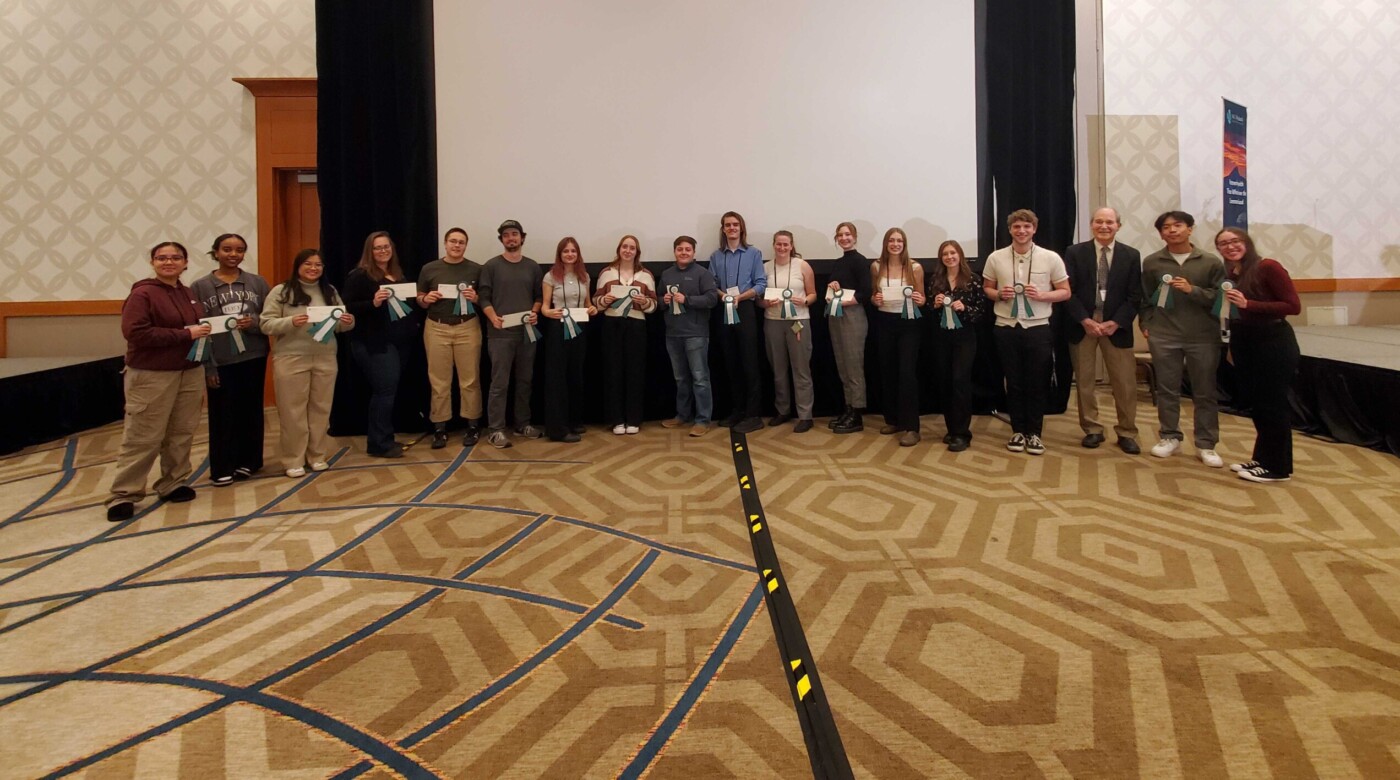
Image: All awardees gathered for a group photo at the 2025 M.J. Murdock Charitable Trust Conference on Science & Engineering.
By Britt Board
Assistant Director of Communications
PLU students earned awards for their undergraduate research at the M.J. Murdock Charitable Trust Conference on Science and Engineering, an annual regional conference that brings together student researchers and faculty mentors from across the Pacific Northwest.
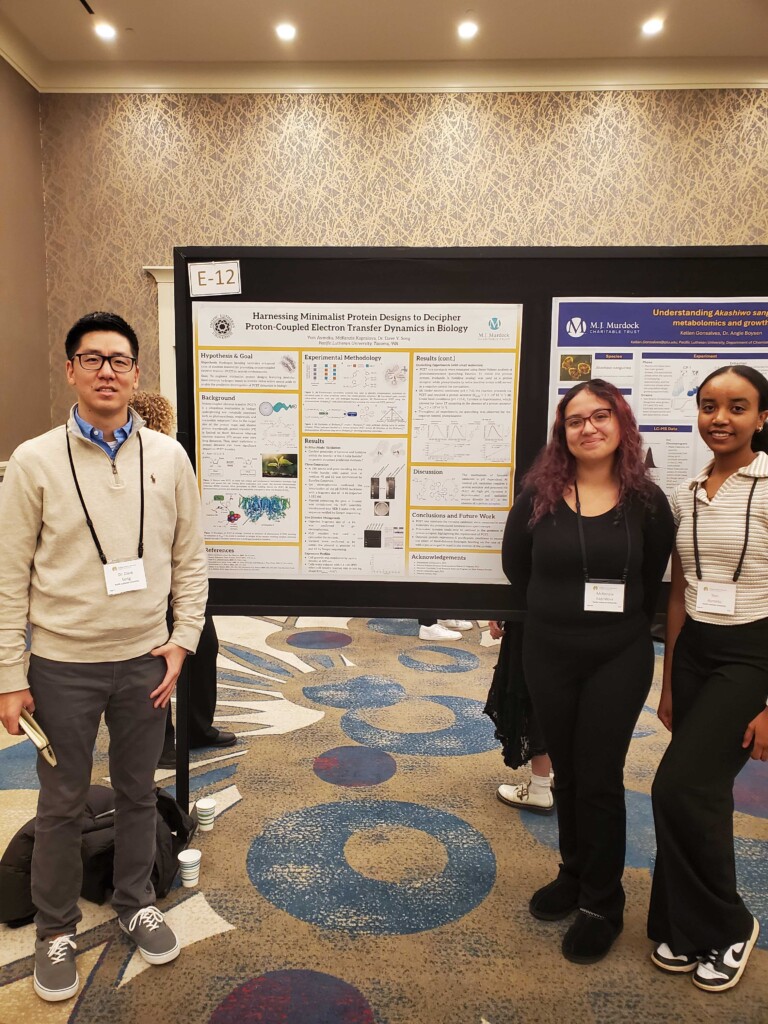
Several of the projects were supported through PLU’s Natural Sciences Summer Undergraduate Research Program (NSSURP), which provides students with the opportunity to pursue intensive, faculty-mentored research over the summer. Students McKenzie Kapalova ’27 and Yom Aymeku ’27, mentored by Assistant Professor of Chemistry Dave Song, won the Biochemistry Poster Award for their project, “Harnessing Minimalist Protein Designs to Decipher Proton-Coupled Electron Transfer Dynamics in Biology.” It’s complex research with real-life applications.
McKenzie and Yom set out to distill and incorporate the essential components of energy conversion found in complex biological systems into specialized protein scaffolds. Song explains, “These engineered models allowed the underlying processes of charge transport to be systematically explored in a controlled environment. This research has applications in sustainable energy technologies and human health.”
For biology major Mckenzie, the research process itself was a bit surprising. “I thought that when we were going through the research, we would read manuals and know exactly what to do. I was wrong about this approach. We had to read these protocols and make our own ideas on how we would set our experiment up for that day.” When their poster received the Biochemistry Award, the moment was unforgettable. “Presenting made me both nervous and excited. It was such a rewarding experience, and I felt like, ‘Wow, we really did this.’”
A biology major with a chemistry minor, Yom emphasizes how repeated challenges strengthened their problem-solving skills. “Through this experience, I gained a new perspective on the importance of patience and learning to trust the research process. This project allowed me to actively develop patience and grow both academically and personally,” Yom says.
As a professor and mentor, Song emphasizes that student collaboration is central to the lab’s mission. “The highlight of this project is working alongside undergraduate student collaborators. I get to watch as students transition from the classroom to becoming architects of proteins that never existed before. These students are helping answer essential questions about how life powers itself.”
Presenting made me both nervous and excited. It was such a rewarding experience, and I felt like, ‘Wow, we really did this.’
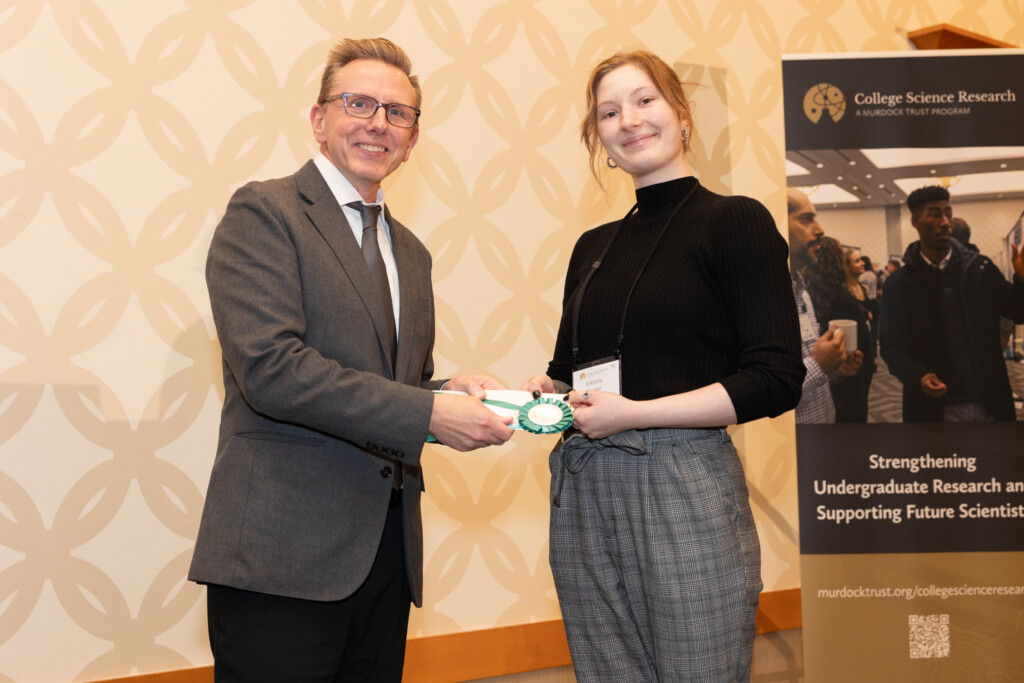
In addition to PLU students’ success in biochemistry at the conference, psychology student Viktoria Yeager, mentored by Professor of Psychology Sara Finley, won the Murdock Poster Prize for Neuroscience-Psychology-Exercise Science for “Word Final Devoicing: Patterns and Perception in Language.” Viktoria worked with Finley and fellow student Jasper Bragg on a project to see if they could find perceptually-based biases for different sound patterns using a response time measure. Finley shares, “When we can understand how languages are learned, and what factors shape language, we can use that knowledge for many things. This could be computer speech recognition, or helping children and adults who struggle with language learning.”
These kinds of experiences are rewarding for faculty, too. “You get to see students go from knowing almost nothing about a topic to giving PhD-level presentations in just a few months. I don’t know if there are any other places that give students opportunities like that. And working with Jasper and Viktoria was an amazing experience for me. They rose to the challenges I set for them and exceeded all of my expectations. It’s amazing what students can achieve when we give them space to be successful.”
Encapsulating what this kind of experience can mean to students, Yom shares, “Receiving this award has had a significant impact on both my confidence and motivation. It reminded me that hard work really pays off and showed me that I am capable of doing things that I put my mind to. Moving forward, it has inspired me to continue growing, striving not only to reach my own potential, but also to make my family, mentors, peers, and supporters proud.”
About the Natural Sciences Summer Undergraduate Research Program (NSSURP)
NSSURP supports faculty-mentored research across biology, chemistry, computer science, earth science and environmental studies, mathematics, physics, and psychology, giving students the opportunity to design studies, analyze data, and present findings while gaining confidence through both research setbacks and discoveries — experiences that prepare them for future careers and engaged global citizenship.