


Faculty Scholarship Seminar
The Wild Hope Faculty Scholarship Seminar is a paid professional development opportunity that invites PLU faculty to cultivate a sense of meaningful belonging, demonstrate the potential for vocational exploration, reignite their determination for purposeful education, and nurture their commitment for human and ecological flourishing. At a time when PLU reforms for a new era, we have created a seminar that explores the “why(s)” behind who we are and what we do. The Wild Hope center for Vocation invites faculty members to affirm the collaborative working ethos of PLU in a supportive community. This seminar aims to reflect on PLU’s vocational institutional mission and examine the ways in which it intersects with faculty and their personal, and professional calling(s) and development. Meeting five times during the academic year, the seminar offers a $1000 stipend for full participation. Faculty members have to apply directly even when nominated by their Deans. The call for applications will be sent via email at the end of August each year.
Participants 2025-2026
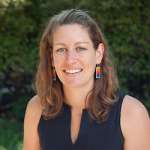
What’s something you’ve learned about vocation?
Although it can overlap with your career, vocation is something greater. We’ve talked in the seminar about the interplay between what you can (and need to) give to the world and what the world needs.
Bio
I am trained as a virologist (someone who studies viruses) and a biology education researcher (someone who studies how we can teach more effectively to all of our students). I mostly teach courses about the biology you cannot see: cells, molecules, and microbial organisms. Outside of my work, I’m a mom, a rock climber, a traveler, a community member, and a fan of stand up comedy.
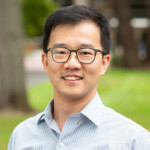
What’s something you’ve learned about vocation?
True vocation reflects the needs and hopes of the community that we are part of, rather than just pursuing our personal goals. Learning is not the end game, but a foundation for service, through which we give back to the larger world. In this spirit, vocation can become a shared journey of contribution and connection.
Bio
Fang (Hank) Lin is an Assistant Professor of Business at PLU where he primarily teaches a wide spectrum of finance classes, including investments, international finance, derivatives, and financial markets. His research focuses on leveraging data to explore topics in corporate finance, energy economics, and sports economics. Outside of academia, he is a CFA charterholder and an avid (but very average) half marathon runner.
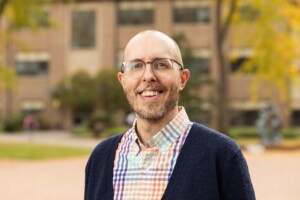
What’s something you’ve learned about vocation?
I’ve been reminded that vocation is not simply, nor even largely, about self-fulfillment. It is about attuning to the common good, and contributing to a society in the ways best suited for us.
Bio
I was raised in the Pacific Northwest and have always been happy to call it home. I study and teach about Buddhism and I am also a Buddhist. I live with my wife and cats in Tacoma.
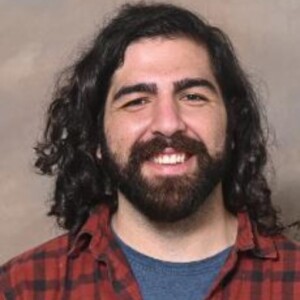
What’s something you’ve learned about vocation?
Vocation is as much about an individual’s calling as it is about the community that nourishes and sustains that purpose.
Bio
I grew up on the far southern border of California. I majored in critical theory at Williams, where I arrived wanting to study history and political science and left wanting to be an English professor and work on critiques of the law, mostly in poetry. After college, I spent a year as a Watson fellow living in Quaker communities in countries with histories of conflict. After that, in 2015, I moved to Princeton for a Ph.D. where I studied early modern literature and antinomianism, which is to say a version of Christian anarchism and its literary off-shoots, particularly in John Milton’s prose and poetry, and especially in Paradise Lost. I am currently an Assistant Professor in the English Department at PLU.
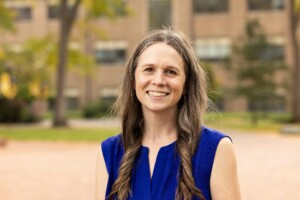
What’s something you’ve learned about vocation?
Something I’ve learned about vocation is how deeply connected it is to community. A vocation is not just a calling for ourselves, but a calling to and with others, a reciprocal relationship, or existing in an ecology of giving and receiving. It goes far beyond our immediate lives and extends to the people we don’t know. In this way, it connects to the sociological imagination, what C. Wright Mills defines as the ability to connect our personal experiences with larger social forces and history.
Bio
Dr. Fitzwater grew up in the Pacific Northwest, spending several years of her childhood in France, which gave her a deep appreciation for and interest in other cultures. She earned her Bachelor’s degree in Sociology from Seattle Pacific University, and her Master’s and PhD in Sociology from North Carolina State University, with concentrations in the family and social inequality. She has been at PLU for eight years and loves teaching and mentoring students. She lives with her husband and two kids, and loves to travel all over the world.
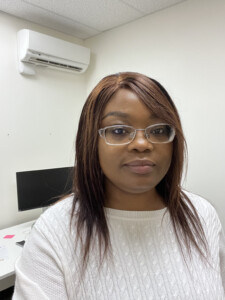
What’s something you’ve learned about vocation?
I’ve learned that vocation is about using your gifts to serve others and make a positive difference. It’s not just about choosing a career, but also about understanding why your work matters and who it benefits. For me, vocation is less about a final goal and more about growing into the person you’re meant to be through the ways you help others.
Bio
Lise Ekani teaches a range of courses in French language, Francophone literature and culture, as well as interdisciplinary classes in Global Studies. Her teaching and research are grounded in a deep commitment to inclusive pedagogy, with a focus on how language and storytelling shape our understanding of identity, power, and place. She approaches her work and life with curiosity and creativity, guided by a sense of wonder that she has never outgrown.
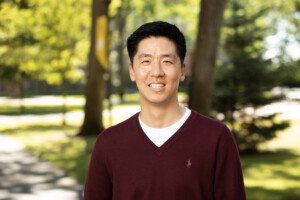
What’s something you’ve learned about vocation?
Vocation is more than a job. It is a calling by God’s grace that makes us His handiwork and sends us beyond ourselves into community for the service of others and the common good.
Bio
My research focuses on understanding energy conversion processes in chemistry and biology through a ubiquitous mechanism called proton-coupled electron transfer with applications in human health and energy technologies. In the classroom and through mentorship, I love partnering with students to cultivate their problem solving and critical thinking skills and helping them grow in the self-efficacy needed to confidently pursue their own vocational callings! Outside of my passions for science, education, and Christ-centered community, I enjoy spending time with my wife, golfing, playing tennis, fishing, and reading the Bible.
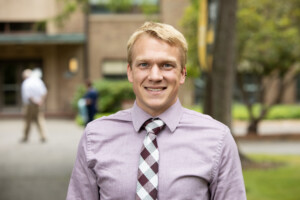
What’s something you’ve learned about vocation?
Vocation is not a calling in a vacuum. Our communities and experiences pull us in the direction of our callings rather than an isolated epiphany. As our communities and experiences change, our relationship with different callings also adjust. This means we are never finished discerning our vocation.
Bio
Ryan Swartzentruber challenges students to think like an economist when tackling life’s problems. In a world with troubling environmental issues, he engages students in understanding the nature of those problems and imagining the solutions. Outside of work, he approaches life as an economist, quantifying the benefits and costs of anything and everything. In his free time Ryan can often be found mountain biking or hiking with his family.
Social Media