


Wellbeing for one is wellbeing for all. Because people, communities, and environments are interdependent, the wellbeing of one is interconnected with the wellbeing of all.
Wellbeing is dynamic, not fixed—a continuum from surviving to thriving, shaped by changing seasons, experiences, and conditions.
Our goal is multidimensional flourishing. We promote wellbeing for all Lutes and our communities—human and environmental—so our shared ecology can thrive.

Jump to sections:

Resources for PLU Students
Resources for PLU Employees
Resources for All PLU Community & Friends
Multidimensional Wellbeing
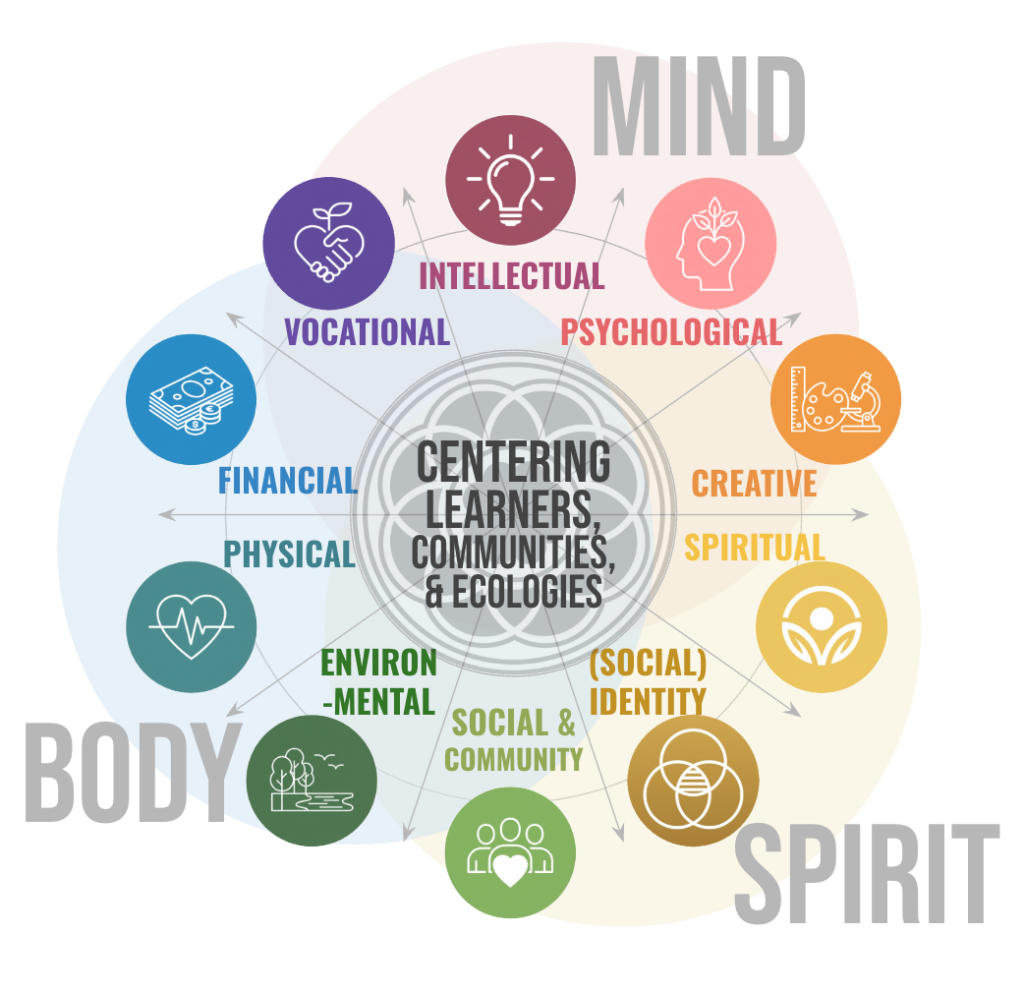
Wellbeing is a dynamic experience composed of multiple interacting and intersecting dimensions that contribute to overall sense of wellbeing, thriving, and flourishing. At PLU, multidimensional wellbeing includes dimensions of:
- Intellectual (academic)
- Psychological (mental & emotional)
- Creative
- Spiritual
- Identity (social identity & location)
- Social (family, friends, community)
- Environmental
- Physical
- Financial
- Vocational (service, work, career)
As illustrated in the graphic to the left, these dimensions overlap, often influencing one another (for example, one’s social health might impact one’s psychological health), which is why at PLU we focus on them intersectionally. At the center of our wellbeing ecology model are learners (including students, employees, and beyond) and our intersecting communities and ecologies because our goal is fostering mutual thriving and flourishing for all.
Intellectual
(Academic)
What does this mean?
The ability to stay curious, critically think, expand understandings, morally reason, and engage in lifelong learning, furthering educational pursuits.
- regular learning: classes, reading, practicing skills
- puzzles, games, and other brain exercises
- nurturing curiosity, journaling, asking questions
Psychological
(Mental & Emotional)
What does this mean?
The ability to recognize emotions in self and others, to express and manage thoughts and feelings in healthy and mature ways, and to demonstrate vulnerability and seek help from others.
- mindfulness: grounding, gratitude, meditation
- curiosity about thoughts/emotions; reframing
- seeking support when needed (e.g., counseling)
- practice diverse coping skills for stress/hard times
Creative
What does this mean?
The ability to embrace everyday creativity (or “little c” creative activities and problem solving) to promote individual and community thriving.
- make time for play/expression (e.g., dancing, music, writing)
- setting intentions: inspiration boards / journaling
- embracing mistakes as part of the process
Spiritual
What does this mean?
The ability to explore purpose and meaning and to nurture connection to something, someone, or someplace greater-than-self.
- meditation, prayer, mindfulness, reflection
- connection to nature &/or others (e.g., service)
Identity
(Social Identity)
What does this mean?
The ability to develop a sense of personal identity by examining one’s social identities and location(s) and understanding these in relationship with systems of power.
- values-reflections & goal-setting
- critical-consciousness development (awareness)
- action in support of social justice movements
- Diversity & Inclusion at PLU
- Center for Diversity, Justice, & Sustainability (DJS)
- DJS & Civic Engagement Clubs
- Resources for
- Other Community & DJS Resources
- Title IX and Titles VI & VII
- Academic Programs:
Social
(Family, Friends, & Community)
What does this mean?
The ability to cultivate social networks with others that are rooted in mutual trust, respect, and accountability, with sensitivity and awareness towards others’ feelings, and a recognition that one’s intentions do not always match impact on others.
- connecting with others through shared interests, values, and/or community (e.g., join a group/club)
- nurturing relationships: active listening, expressing gratitude, open communication, boundaries
Environmental
What does this mean?
The ability to attend to the holistic ecology in which one is situated, including one’s own environment (e.g., living, working, studying) and promoting environmental justice for all people, natural relatives (e.g., animals, plants, land, water, air), and the planet.
- reflect on your spaces (e.g., are they energizing? depleting?); change what you can to make spaces nurturing
- environment: waste reduction, energy conservation, eco-friendly/ sustainable choices
Physical
What does this mean?
The ability to attend to one’s body as interconnected with mind and spirit, including eating balanced and nutritious food, engaging in regular movement/physical activity, getting enough sleep, practicing safe(r)/healthy sexual relations, and feeling body positive/neutral.
- movement: ~20 min/day supports health/learning
- nutrition-rich foods & plenty of water intake
- sleep hygiene: consistent routines
- preventative care: vaccines, check-ups, screening
- substance management: mindful consumption
- stress management: breathing, mindfulness practices, professional care
Financial
What does this mean?
The ability to navigate financial and resource systems to achieve goals, including realistic budgetary habits within one’s means and managing finances/resources for desired lifestyle.
- creating a budget within one’s means
- mindful spending; resources/finances awareness
- build savings/reserves when possible
- build financial literacy and skills
- mindful credit usage and monitoring
Vocational
(Purpose & Work)
What does this mean?
The ability to use one’s strengths and talents to positively impact one’s communities and shared ecologies (PLU’s Wild Hope Center defines vocation as being called with others to promote human and ecological flourishing), which may include paid (job/career) & unpaid (volunteer, community-based action) work.
- align values with meaningful works to serve communities
- recognize and celebrate accomplishments
- strategic opportunities; use networks/mentors