
Environmental Studies
Undergraduate Major & Minor College of Natural Sciences
Bachelor of Arts
Major Minute: Environmental Studies Transcription
[video: From left to right, Professor Crawford O’Brien, Professor Ramos, and Professor O’Brien are sitting at a round table in an office with various artwork in the background](gentle music)
Professor Crawford O’Brien: Hi, I’m Suzanne Crawford O’Brien, Chair of Native American and Indigenous Studies.
Professor Ramos: Hi, I’m Adela Ramos, Chair of Environmental Studies.
Professor O’Brien: And hi, I’m Kevin O’Brien in the religion department.
All: And this is our Major Minute.
[video: A visual countdown from three flashes on the screen in yellow and black colors. A countdown clock appears on the left side of the screen counting down from 60 seconds after Man claps his hands in the foreground](three beeps)
[video: Only Professor Ramos centered on screen]Professor Ramos: What does it take to understand climate change, or how human activity impacts geological formations, or how different cultural beliefs or political views shape our relationship to the earth. It takes interdisciplinary expertise and a robust place-based learning curriculum. These complex questions can’t be answered by a single discipline or field.
[video: All three professors framed on screen]This is why, what makes our major unique in the region is in our last name. Studies.
[video: Only Professor O’Brien framed on screen]Professor O’Brien: Our interdisciplinary classes draw not only on many different perspectives
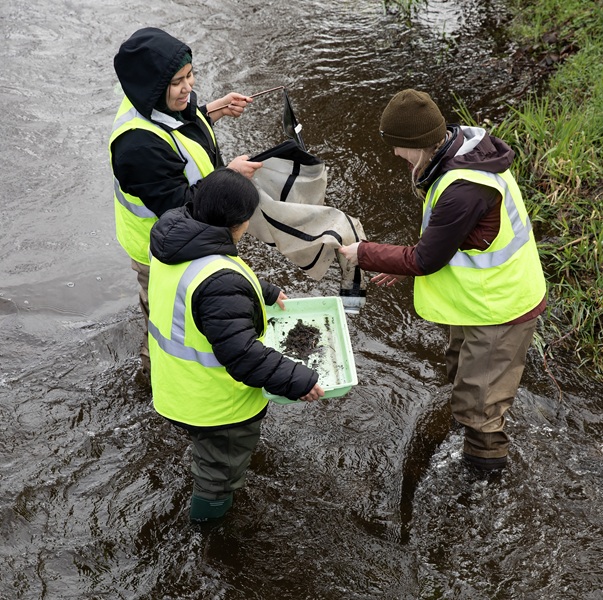
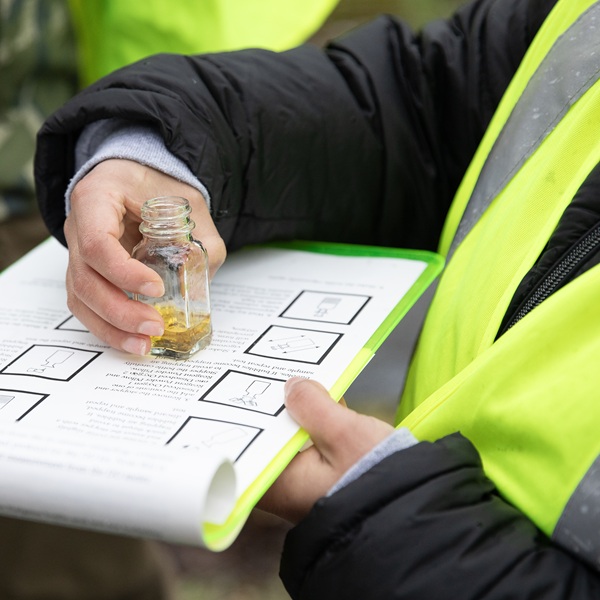
but also on different parts of campus, to understand and to engage environmental challenges. You will wade into our local watershed, you’ll analyze samples with a chemistry professor, make maps of the watershed with a geology professor, and reflect on the ethics of water with a philosophy professor.
That kind of interdisciplinary work is essential for a healthy environment and for real environmental change.
[video: Only Professor Crawford O’Brien framed on screen]Professor Crawford O’Brien: Our commitment to place-based learning considers indigenous traditional ecological knowledge and how it should inform our approach to sustainability and environmental justice. Our campus is located on the traditional territories of the signatories of the Medicine Creek Tree, the Muckleshoot, Nisqually, Puyallup, and the Squaxin Island Nations.
[video: All three professors framed on screen]Professor Ramos: This interdisciplinarity (laughs)
[Man Off Camera]: That’s okay.
(everyone laughs)
[video: Cuts to black screen with white text reading, “Take Two.” Flashes back to all three professors in the office.]Professor Ramos: This interdisciplinarity distinguish our students and alumni from other candidates when applying for internships, graduate school and the job market. We’re proud to see how they transform their passion for the environment into careers at national parks, state and federal environmental offices, in the healthcare and education sectors, AmeriCorps and other not-for-profit organizations.
About:
Environmental Studies at PLU is all about understanding the complex web of connections between people and their environments. You’ll look at environmental challenges from different perspectives — like environmental justice and Native American and Indigenous Studies — while asking big questions about ethics, culture, and our responsibility to the planet.
We live in a world that’s constantly changing — climates shift, communities grow, and ecosystems adapt. Studying the environment helps you understand these changes and prepare to meet challenges like pollution, conservation, and access to clean water with creative, real-world solutions.
With a degree in Environmental Studies from PLU, you’ll be ready for a wide range of paths. Some students pursue graduate school, while others jump into careers in education, conservation, sustainability, nonprofits, labs, consulting, or environmental policy. Whether you’re interested in protecting ecosystems, working for change in your community, or influencing corporate or government decision-making, you’ll graduate prepared to make a difference.
Skills you'll gain from this program:
- Ecological Analysis — Study ecosystems using field methods, surveys, and modeling to interpret biodiversity, species interactions, and conservation challenges.
- Environmental Policy & Economics — Explore how governments, businesses, and communities make decisions, evaluating policies and trade-offs that impact sustainability.
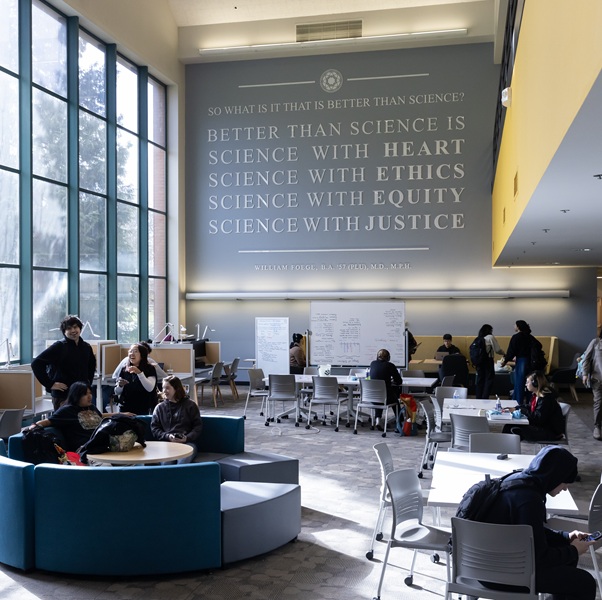
- Environmental Ethics & Justice — Investigate how culture, history, and values shape environmental issues, with a focus on justice, Indigenous perspectives, and sustainability.
- Scientific Research Methods — Gain hands-on lab and field experience collecting, analyzing, and presenting environmental data such as water and soil quality.
- Interdisciplinary Problem-Solving — Combine science, policy, and humanities to design creative solutions for challenges like climate change and resource management.
Graduates from the last 5 years: Their jobs
- Environmental Educator, Nisqually River Foundation
- English Teacher, Kent School District
- Environmental Health Specialist, Tacoma-Pierce County Health Department
- Political and Civic Engagement Coordinator, Washington Conservation Action
- Quality Control Laboratory Technician, Callisons
- Associate Analyst, Content Engineering, GlobalLogic
- Outreach Educator, Pacific Science Center
Graduates from the last 5 years: Their graduate programs
- PhD in Marine Science, University of South Florida
- Master of Public Administration, University of Washington
- Master of Science in Biological Sciences, California Polytechnic State University
- Master of Science in Land Resources & Environmental Sciences, Montana State University
- Master of Arts in Education, Pacific Lutheran University
- Master of Arts in Psychology, University of Minnesota
- Master of Science in Geology, Northern Arizona University
It’s FREE to apply to PLU
When you're ready, we're here. Apply now and fulfill your potential!
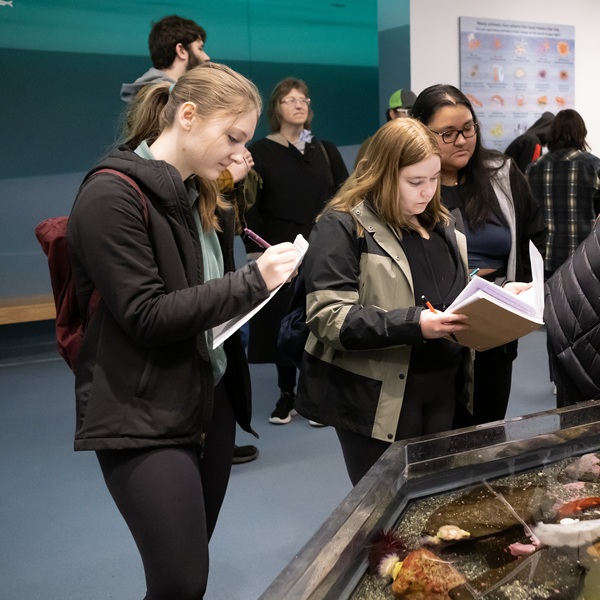
Get Started100% of Environmental Studies majors complete 80+ hours of experiential learning through internships, research with a professor, or volunteer work with an organization.
Study Abroad
See the world through an environmental lens. Environmental Studies students have studied away in Namibia, Norway, Trinidad & Tobago, Scotland, Costa Rica, Australia, New Zealand, and more.
Get Involved
Join PLU’s GREAN (Grass Roots Environmental Action Now) Club, volunteer in PLU’s Community Garden, or check out the STEMinist Club!
Campus Events
Environmental Studies plays a central role in organizing one of PLU’s biggest events: Earth & Diversity Week.